
An overhead bridge crane is specified by five hard gates that must be set before pricing is even requested: safe working load (SWL), span between runway rails, lifting height, duty classification (FEM/ISO 4301 or CMAA), and power supply / environment. Chinese export listings for CE-marked single-girder bridge cranes cluster between US$15,000 and US$100,000 per set FOB at 1-set MOQ, a band that maps to roughly 1-20 t SWL with light-to-medium (FEM 1Am-2m, CMAA A-D) duty [S2].
The decision is industrial-scoping, not commercial: an undersized bridge drives up the total cost of ownership through accelerated wear, anti-sway payload losses, and unplanned stoppages; an oversized one locks capital into structural steel and runway civil works for a decade or more. Selection therefore starts on the plant floor with cycle counts, hook paths and product mix, not in a sales catalogue [S1][S2].
Duty Class: FEM/ISO 4301 vs CMAA 70 as the First Gate
Duty class is the first hard gate, because it sets the hoist mechanism, motor sizing, gearbox ratio and the number of starts per hour the bridge must absorb without thermal derating. The European FEM 1.001 / ISO 4301 family grades cranes by load spectrum and daily operating time, while North American CMAA 70 classes run A (standby/infrequent) through F (continuous severe service); the two systems are not numerically equivalent and require cross-walk by application, not by class letter [S1].
Selection on duty is the cheapest insurance on the bill: a 10 t crane rated FEM 2m (roughly 160-320 starts/hr at 60% of SWL) versus FEM 1Bm (roughly 8-16 starts/hr) typically shifts the hoist motor from a 7.5 kW single-speed unit to a 15-22 kW two-speed or VFD-driven hoist, and the long-travel drive train gains a second brake and a heavier rail wheel set [S1]. For typical machine-shop or light-assembly duty, FEM 1Am-1Bm covers the cycle; for steel-coil handling or stamping press tending, plan FEM 2m-3m and budget accordingly [S2].
SWL, Span and Deflection: the Geometry Triangle
SWL is the rated load at the hook, but the bridge itself must be checked for combined bending, shear, and—critically—vertical deflection, which for overhead bridge cranes is normally capped at span/600 to span/1000 depending on the duty service and the specifier's tolerance for hook-induced swing. PDE (partial-differential-equation) models of the coupled bridge-beam and trolley system show that the dynamic coupling between the main girder and the moving trolley contributes a non-trivial share of mid-span bending, particularly when the trolley accelerates near mid-span with a near-rated payload [S1].
Span drives the girder depth and the runway rail alignment tolerance: a 20 m span single-girder crane typically needs a 600-900 mm deep fabricated box or I-section, while a 30 m+ span usually forces a double-girder layout to keep deflection and self-weight in check. Runway alignment is the silent failure mode: 2-3 mm/m lateral misalignment on a 30 m runway amplifies trolley skew, accelerates wheel-flange wear, and is the single most common cause of end-car noise and end-truck bearing failure in field service reports.
Single-Girder vs Double-Girder: the Layout Decision
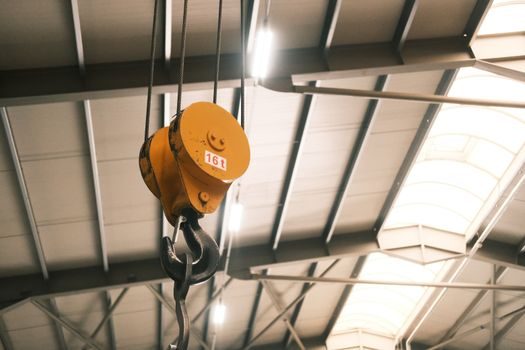
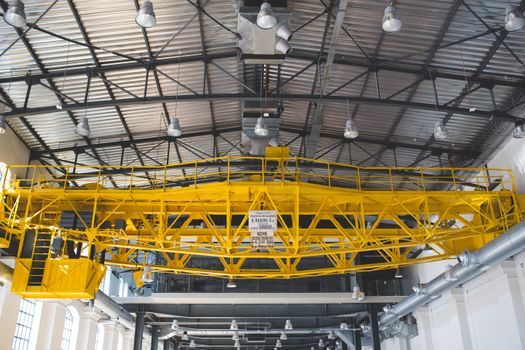
Single-girder bridge cranes carry the hoist on the lower flange of one main beam, with the hoist body suspended between the end trucks; this keeps self-weight low (typically 30-50% lighter than a double-girder of the same SWL/span) and is the dominant CE export configuration up to roughly 10 t SWL [S2]. Double-girder cranes mount the hoist on a trolley that rides on rails fixed to the top of two parallel main girders, which gives a higher hook approach (closer to the floor on short lifts), larger hook-path envelope for very long traverses, and is the standard layout above 10-15 t or where the spec calls for an open-winch maintenance platform.
The decision matrix is short: pick single-girder when SWL ≤ 10 t, span ≤ 20-25 m, and lifting height is moderate; pick double-girder when SWL > 10-15 t, span > 25 m, or the process needs a low-headroom hook (hoist body above the girder, hook pulled up between the two beams) to maximise useful lift under a low ceiling. A gantry crane is the mobile/leg-supported sibling used when there is no structural steel runway, while a mobile crane substitutes for one-off lifts rather than repetitive production cycles.
Hoist Type: Wire Rope vs Electric Chain vs Hoist Trolley
Wire-rope hoists dominate above roughly 3 t and are standard on CE single-girder export units across the FEM 1Am-2m spectrum; electric chain hoists are common below 3 t where compact headroom and lower cost matter more than cycle life. For foundries, steel mills, and any environment with heat, scale or dust, hoist IP rating and hoist thermal class (typically FEM motor class 4 for general industrial, class 6 for heavy) drive the next gate. [S1]
For a process engineer, the hoist choice is fixed by three numbers: rated SWL, required lifting height (C dimension, hook-floor to hook-up), and duty class. Below 3 t with a 6-9 m lift, a low-headroom electric chain hoist on a single-girder is the lowest-cost compliant configuration. Above 5 t, or when a crane scale must hang below the hook for weigh-in-motion batching, plan a wire-rope hoist with adequate headroom for the scale and the swivel hook block.
Control, Power and Safety: the Often-Underbudgeted Layer
Power supply is a hard gate: 380-400 V three-phase 50 Hz is the CE export default, with 460-480 V 60 Hz common in North American retrofit work; voltage mismatch at commissioning is one of the most common field snags. Control philosophy (pendant, radio remote, cab, or full VFD line-up with anti-sway) is where most of the selection overspend happens, and where the specifier should set the requirement up front, not after the bridge arrives. [S2]
For a one-off comparison with self-propelled or wheel-mounted handling, the truck-mounted vs tower crane decision frame is a useful adjacent read; the runway-less, leg-supported gantry crane buying guide and the related gantry crane price/cost article also map onto the same SWL/span logic when there is no structural steel to hang from.
Comparison Matrix: the Main Bridge-Crane Options
Lining the main options against four decision criteria — typical SWL band, span band, headroom efficiency, and indicative price band — gives the specifier a one-page triage. Single-girder wire-rope covers 1-10 t, up to ~25 m span, with low headroom and a CE export band of US$15,000-100,000 per set FOB; single-girder chain hoist handles 0.5-5 t, up to ~20 m, with the lowest headroom and the lowest price; double-girder wire-rope covers 5-100+ t, 10-40 m span, with a high hook approach and a 2-4x price multiple over the equivalent single-girder; a crawler crane or mobile crane substitutes only when runway civil works are not justified by the cycle count. [S3]
For an overhead conveyor integrated cell, a single-girder unit with a low-headroom hoist and a crane scale below the hook is the cleanest fit; for a heavy steel-coil yard, a double-girder with VFD long-travel and anti-sway is the only sensible answer, and the incremental cost of going from a 2-speed hoist to a full VFD hoist is recovered in hook-swing-related cycle time within a typical 18-30 month window on two-shift operation [S1][S2].
What Bridge Cranes Are Not For, and Common Failure Modes

An overhead bridge crane is not the right tool when the load centre shifts radically during the lift (use a specialised rotator or a custom below-the-hook attachment instead), when the duty cycle is below roughly 5 lifts per shift (a forklift or mobile crane is cheaper to own), or when the building has no structural runway and the operator cannot install runway beams to ±2 mm/m tolerance. Failure modes cluster in three places: end-truck wheel and rail wear from runway misalignment, hoist motor thermal overload from over-classed duty, and electrical contactor failure from underspec'd control panels; each is traceable back to a single number being set wrong in the original spec. [S1]
The cheapest verification step before purchase is to walk the proposed runway with a level and a tape, confirm the available lifting height C-dimension against the tallest expected load plus rigging, and write the duty class, SWL, span, lifting height and power supply on a one-page data sheet. Send that data sheet to at least three suppliers, ask for a FEM/ISO or CMAA duty-class declaration on the quote, and budget 12-18 weeks for CE-marked export units from China, 20-30 weeks for fabricated-in-EU or North American builds [S2].
Trackable signals to watch over the next two quarters: any tightening of EU Machinery Regulation 2023/1230 enforcement on CE-marked lifting equipment (which will push more Chinese exports to upgrade from self-declared CE to Notified-Body CE), and incremental VFD price erosion that closes the cost gap between 2-speed and full VFD hoist line-ups on light-duty single-girder units. Plant-level buyers can also re-benchmark against the published 2026 gantry crane price and duty-class ranges, since the structural and hoist cost drivers overlap heavily with the single-girder bridge segment.