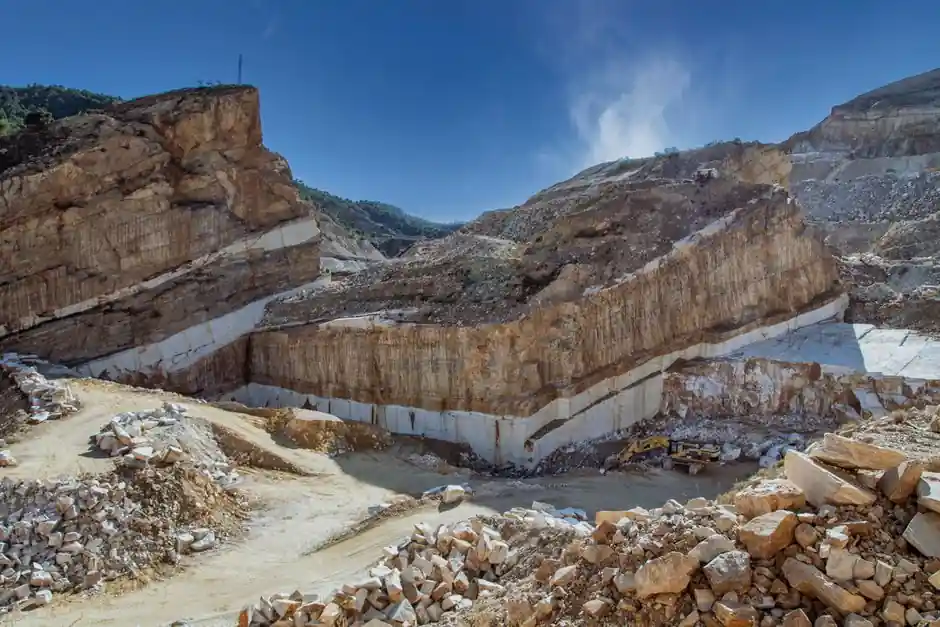
Quarry-duty overhead bridge cranes are almost always top-running double-girder designs in the 5-50 ton range, with CMAA Class D (heavy production) or Class E (severe duty) service classification, IP54 minimum enclosure rating, and dust-sealed gearboxes on bridge and trolley drives [S1][S3].
Quarry applications punish standard indoor cranes: ambient silica-laden dust, temperature swings from -20°C to 50°C outdoors, hard shock loading from skips and rock boxes, and frequent starting under 60-80% rated load. Specify the duty class and the enclosure first; the capacity comes after [S3].
Duty Class and FEM/CMAA Working Levels for Quarry Duty
CMAA 70/74/75 (now superseded by CMAA 74-2020) classifies cranes A-F; aggregate and stone-handling operations typically fall into Class D (400,000-1,000,000 cycles, 8-16 shifts/year equivalent) or Class E (1,000,000-2,000,000 cycles, 16-24 shifts/year equivalent) [S3].
CATET and other Chinese OEMs publish European FEM/ISO equivalents side-by-side: a quarry-duty double-girder bridge is commonly offered as M5-M7 (ISO 4301), translating to 2M5 (medium-heavy) through 2M7 (heavy) [S3]. Electric double-beam bridge cranes in 3-500t range with M5-M7 working level are the standard quarry offering from this OEM [S3].
For process-side spec writing, the rule of thumb is: bucket or grapple work, 8+ hours/day, hard-rock aggregate = at least Class D / 2M5. Anything with magnet grabs or clamshell bucket cycling across multiple shifts = Class E / 2M6 minimum [S3].
Top-Running vs Under-Running for Quarry Buildings
Top-running double-girder bridge cranes (rail on top of runway beams) are the quarry default because they lift higher per dollar of building height, deliver longer spans (commonly 20-40 m), and tolerate heavier end-carriage wheel loads (up to 80-120 kN per wheel for 30-ton units) [S1][S3].
Under-running (under-hung) single-girder designs cap out around 10 tons and 20 m span; they are not specified for primary quarry duty [S5]. Where they appear in a quarry is on light-duty secondary work: small parts, motor swaps on crushers, maintenance shops [S5].
Hoisting Ltd's published oil-sands project profile is a 35-tonne top-running double-girder crane with an 8-tonne outboard monorail, illustrating the typical capacity combination buyers ask for in heavy-aggregate service [S2].
Dust, Enclosure, and Drive Protection in Aggregate Plants
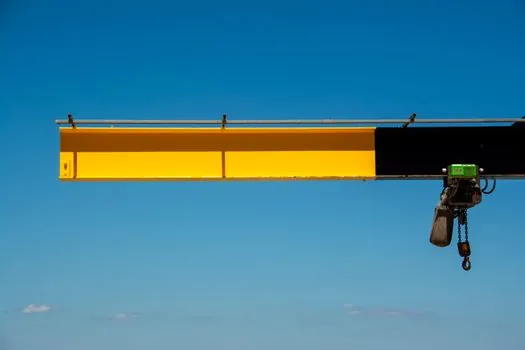
Quarry air is abrasive. The minimum enclosure spec for outside or wash-plant buildings is IP54 (dust-protected, splash-proof) on the control panel and motor terminal boxes, with IP65 on operator pendants and exposed cable reels [S3].
For crushing towers, transfer houses, and bag-house floors, step up to IP65 across the trolley and bridge drive enclosures. Bridge motors should be TEFC (totally enclosed fan-cooled) with sealed bearings; gear reducers need dust-proof breathers and food-grade or synthetic grease rated for the local temperature band [S3].
Variable Frequency Drives (VFDs) on both bridge and hoist motions are now standard for quarry duty: they cut starting current, allow soft acceleration under shock load, and let buyers program creep speeds for bucket positioning. AFE Crane's product list places VFD controls under "Advanced Technology Options" in their Modernization & Upgrades menu, alongside other electrification retrofits [S1].
Hoist, Trolley, and Drum Selection Under Dust
Wire-rope hoists dominate quarry duty over chain hoists because of duty-cycle life and 30+ ton capacity availability; standard offerings from CATET run 1-30t on the single-beam (single-girder) line and 3-500t on the double-beam line, with M3-M5 and M5-M7 working levels respectively [S3].
Hoist rope sheaves should be flame-hardened steel (typical surface hardness 55-60 HRC) and guarded against spillage. For crusher-feed applications, hoist motor frames commonly step up one IEC size from the indoor equivalent to derate for ambient heat; many Chinese OEMs offer 220V/380V/440V multi-voltage supply to handle generator-fed sites and grid connections interchangeably [S3].
Hoist duty is where a quarry crane fails first, not the bridge structure. Insist on a hoist service factor of 1.5 above nameplate when bucket-cycling hard rock, and confirm the gearbox and motor are derated for the local ambient plus any solar gain on uninsulated runway beams [S3].
Runway Beams, Rail, and Building Coordination

Top-running cranes put wheel loads through the runway beam flange; for a 30-ton quarry crane with an 8-ton auxiliary hoist, the buyers-side structural engineer needs reactions of roughly 100-130 kN per wheel at the runway column head, including dynamic factor (typically 1.1-1.3 on static) and impact factor per CMAA 74 [S2][S3].
Standard rail for quarry duty is 171 lb/yd (85 lb/yd is too light) or welded Vignole rail on a continuous stiffener; check the rail clip system and wheel-flange lubrication before buying, since grit ingestion is the leading cause of runway-side wheel wear [S5].
Dearborn Crane's 60-year product range explicitly spans both top-running and under-running bridge classes plus pre-engineered and custom gantry cranes, which is the practical fallback when the quarry has no suitable runway building (e.g. loading bays over a stockpile) [S5].
Safety, Standards, and Inspections Buyers Cannot Skip
Quarry cranes in the US fall under OSHA 29 CFR 1910.179 (overhead and gantry cranes) for general industry, and ANSI/ASME B30.2 (overhead and gantry cranes) for the operational side; Canada uses CSA B167 plus provincial OH&S codes. Washington state explicitly mandates national certification for construction crane operators [S4].
For procurement, require a documented design code on the nameplate: CMAA 74, FEM 1.001, or ISO 4301. Hoisting Ltd's 30-year service track record in Western Canada and AFE's 60-year US history (formerly American Fabricators & Engineers) are typical backgrounds to ask for in the vendor prequalification [S1][S2].
Periodic inspection under OSHA 1910.179 covers daily visual checks, frequent inspections monthly to yearly depending on service, and annual third-party load testing. A service vendor that supplies both cranes and 24-hour emergency cover is worth the premium in remote quarry locations [S5].
Decision Matrix: Which Configuration Fits the Job
For a small aggregate yard, 5-10 ton under-running single-girder crane (M3-M4, Class B-C), IP54, span 10-18 m, with the rail built off existing building steel. [S2]
For a hard-rock crushing tower or wash plant, 20-50 ton top-running double-girder (M5-M7, Class D-E), IP54 with IP65 on operator controls, span 20-35 m, full VFD hoist, auxiliary hoist 5-10 t for maintenance.
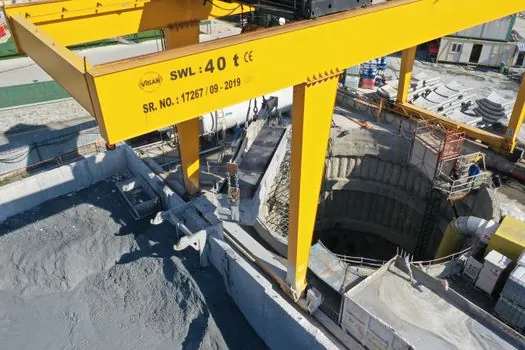
For an open stockpile without runway building, a 10-30 ton rubber-tyred or rail-mounted gantry crane with diesel or electric power, since the runway building investment cannot be justified at low utilization.
For mobile/field work (pit-side repairs, drill mast changes), mobile crane units beat any overhead install because there is no runway to build.
Common Failure Modes and What to Specify Against Them
Drum grooving from rope misalignment is the leading hoist-side failure in quarry duty. Specify a Lebus grooved drum and a rope tensioner; ask for the rope-to-drum wrap angle and verify against the OEM's chart at the spec stage [S3].
Bridge wheel flange wear from grit is the leading structural failure. The cheapest specifier-side fix is to add wheel-guard wipers and accept a 2-year wheel replacement interval; the expensive fix is closed-loop runway with positive-pressure ventilation, which is rarely economic outside of a mill [S1][S5].
For load monitoring, integrate a crane scale on the main hoist block, not on the auxiliary. Quarry crews routinely overload by skipping the scale when the hook is on the overhead conveyor feed, and the legal exposure on a weighbridge is lower than on a structural member.
Procurement and electrics matter: matching the crane supply to on-site motor specs avoids rewiring. For reference on selecting three-phase AC motors that suit quarry duty and the matching VFD package, see the AC motor selection guide.
Trackable next signals: confirm whether the buyer will accept M5 working level or insists on M6+; whether dust-collection permits an IP54 control panel or requires IP66; whether the building structural engineer has signed off on runway reaction loads at the column head. These three answers usually decide single- vs double-girder and Class D vs E at the first technical meeting.