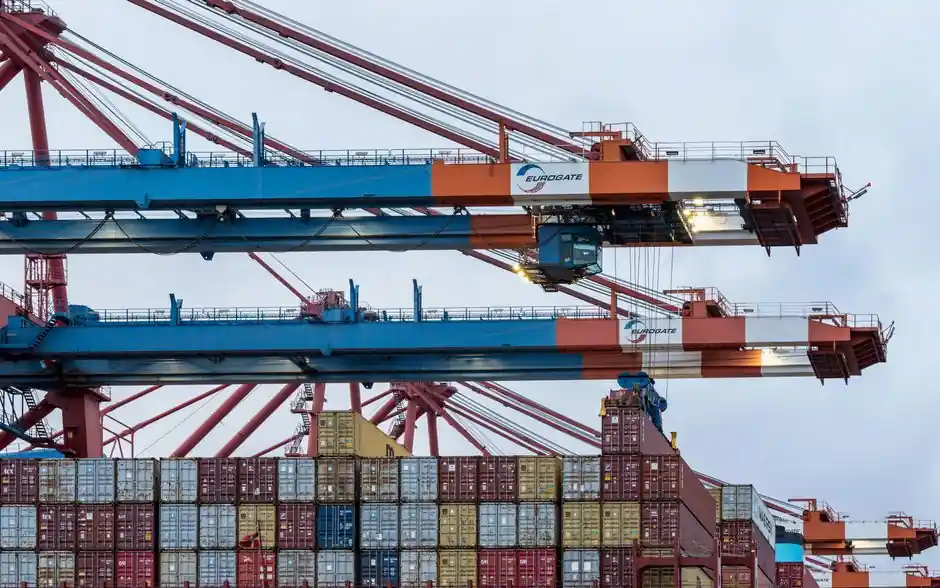
Specifying an overhead bridge crane for a port or intermodal terminal is a duty-cycle decision before it is a quotation decision, and ISO 9374-5:2021 (18 pages, ISO/TC 96/SC 9, ICS 53.020.20) remains the contract backbone for the information a buyer must hand a manufacturer and the information the manufacturer must return [S1].
The standard was confirmed in systematic review on 2026-04-15 and is still flagged stage 90.20, so the Edition 2 text dated 2021-06 is the controlling document engineers must call out on enquiry [S1]. Coupled with ISO 4301-1 duty classification and FEM 9.341 grouping, it gives port buyers a common language for spans of 20-40 m, lift heights above 12 m, and single-lift capacities commonly crossing 20-80 t for container handling yards and 100-500 t for shipyard-panel transfer.
ISO 9374-5:2021 Enquiry Data Sheet: What the Buyer Must Fill In
ISO 9374-5:2021 Part 5 is explicit that the purchaser must declare the crane type (overhead travelling versus portal bridge), span, lifting height, hook approach dimensions, number and arrangement of hoists, rated capacity per hoist, group classification per ISO 4301-1, and the intended operating environment, while the manufacturer must return matching structural, mechanical, and electrical data including limit devices, braking systems, and noise figures [S1]. The standard lists 18 discrete data blocks and treats the buyer's "Annex A" form as a hard contract artefact, not a marketing wish list [S1].
For a port buyer, the fields that drive real cost are span, lift height, group classification, and duty cycle, because each of them changes the bridge girder section, the hoist reeving, and the bridge-drive motor sizing. A standard 30 m span, 20 t capacity, ISO 4301-1 A6 (FEM 2m) bridge crane for a container freight station will be sized very differently from a 35 m span, 80 t A7 unit for steel-coil handling on the same quay, even though both run on the same rail gauge. ISO 9374-5:2021 requires these to be declared in writing so no party is surprised by re-quoted steel mass or motor kW after the order is placed [S1].
Bridge Travel Drive Stack: Encoder, VFD, and Gearmotor
Bridge positioning accuracy on modern port overhead cranes is driven by an encoder-feedback loop on the long-travel wheels, with Baumer's crane-bridge-drives guidance explicitly tying exact-position targeting and pinpoint load-lowering to closed-loop feedback rather than open-loop contactors [S3]. The typical stack is a planetary gearmotor sized to the bridge mass (a 30 m span, 20 t crane bridge with end-carriages commonly needs 2 x 5.5-7.5 kW long-travel motors), fed from a vector VFD with a 4-quadrant active front-end for regenerative braking during plug-stop manoeuvres, and backed by a SIL-rated safety encoder on the motor shaft for overspeed detection.
The same encoder family covers hoist cross-travel and main hoist, with absolute multi-turn encoders preferred on the hoist so the controller retains hook position after an E-stop without a homing cycle [S3]. On port cranes the trolley and bridge drives see salt-laden, humid air, so the standard requirement is IP65 minimum on the encoder housing and stainless steel couplers, with cable glands rated to the same ingress class. Anti-condensation heaters inside the encoder body are specified for installations near deck wash-down zones, because the combination of night-time cooling and daytime humidity cycles is the dominant failure mode reported by port maintenance crews.
Selection Criteria: Container Yard, Steel Yard, and Bulk Yard
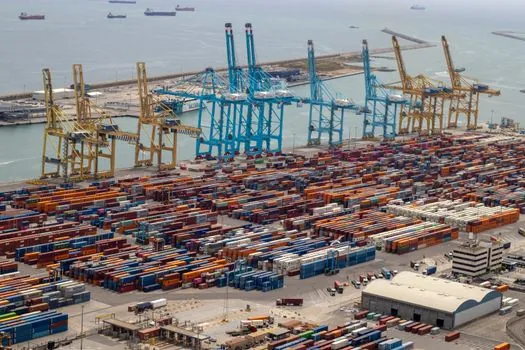
Overhead bridge cranes in port and terminal work split into three operational profiles, and each profile lines up against a different combination of span, capacity, and duty group. A container yard crane typically runs 30-40 m span, 20-45 t capacity, 12-18 m lift, ISO 4301-1 A5-A6 (FEM 2m-3m) classification, with two-speed or variable-frequency hoists for spreader handling. A steel or coil yard crane pushes to 40-60 t capacity, A6-A7 (FEM 3m-4m) duty, 18-25 m lift, and almost always a dual-rail bridge to manage the asymmetric load of a coil C-hook. Bulk-handling cranes (timber packs, bagged cement, steel scrap in grabs) lean back to A7-A8 (FEM 4m-5m) and frequently need a single 32 t auxiliary hoist under the main 80 t hoist for tool handling. [S1]
The decision grid in practice: for a 1,000,000 lift cycle design life on a container yard, specify A6 and budget for 2 x 7.5 kW long travel plus 30 kW hoist; for the same life on a steel-coil yard, specify A7 and add 30-50% to the bridge drive and 60-100% to the hoist motor frame size. Container-yard operators who under-classify their crane to A5 typically see rail-wheel flange wear inside 5-7 years; those who over-classify to A7 pay 20-30% extra capex for steel and motors that the duty never uses. A simple four-axis comparison - capacity in tonnes, span in metres, lift in metres, FEM/ISO group - covers roughly 80% of the selection conversation; the remaining 20% is electrical supply, ambient temperature, and crane-to-crane anti-collision zoning on shared rails.
Standards, Power Supply, and Environmental Envelope
Port crane electrical design is governed by IEC 60204-32 for hoisting machines, which mandates the 48 V PELV control circuit, the safety-related stop categories, and the cable colour codes that every port electrician expects. The 5 kW-to-75 kW power range covers most port bridge-crane bridge and trolley drives, with the 400 V 50 Hz three-phase supply used across European ports and 480 V 60 Hz across North American ports; a 690 V supply is common on shipyard-panel transfer bridges where the long-travel feeder is several hundred metres. The ambient envelope is the under-discussed driver: IEC 60721-3-2 class 4C2 (coastal, low-salinity air) is the floor for most quayside cranes, with 4C3 chosen for open-deck installations. Salt-laden air forces the enclosure spec up to IP55 minimum, and crane cabins in tropical ports need air-conditioning because control-cabinet internal temperatures above 45 °C start derating the VFD output stage. [S2]
Engineers should also treat crane-to-crane anti-collision and zone interlocks as a control-architecture decision, not an add-on. On a shared-rail terminal, the standard pattern is absolute linear encoders on each end-carriage with a bus-linked controller, so a slowdown zone (typically 3-5 m buffer) is enforced by ramp-down rather than by trip-and-stop; trip-and-stop is reserved for the final 1 m buffer because it costs production time and slams the mechanical buffers. For port buyers, the procurement note is straightforward: write the encoders and the bus protocol into the enquiry form, not just into a vendor "options" page, because that is the only place ISO 9374-5:2021 does not dictate the choice [S1][S3].
Inspection, Rebuild, and Lifecycle Cost Signals
Port cranes are designed for 250,000 to 1,000,000 full-load cycles, but the actual rebuild decision is driven by the rail wheels, the hoist gearbox, and the bridge-drive motor bearings, not the structural steel. The pragmatic capex/opex pattern is: spend on the bridge-drive package (VFD + encoder + gearmotor) because it dictates positioning accuracy and energy recovery, and save on the cabin finish because salt air eats the cabin anyway. A 20-30 t, A6 container-yard bridge crane is a serious capex decision, so the rebuild-versus-replace threshold sits at roughly 1.5 x the original electrical cost once the bridge girders are still certified. [S1]
For a useful cross-domain read on tier mapping and rebuild pricing in a similarly heavy-asset class, see the spec-first walk-through of Mining Equipment 2026: Tier Map, Model Codes, and Rebuild Pricing; for a deeper look at instrumentation stacks that often ride on the same port maintenance budget, see Machine Tool Process Control: Instrumentation Stack and Brand Landscape. Safety-light-curtain integration on the bridge approach zones follows the same Type 4 / IP65 logic used in adjacent yard equipment, as detailed in Safety light curtain selection for construction sites: Type 4 resolution, range and IP.
Who an Overhead Bridge Crane Suits (and Who It Does Not)
An overhead bridge crane is the right tool for any port or terminal job where the load path is a rectangular footprint, the lift path is fixed in two axes, and the operator can be seated 6-15 m above deck on a fixed cabin. It is the wrong tool for yards where containers must be stacked more than 4 high (use a rail-mounted gantry or rubber-tyred gantry), for open-water quays where the ship moves with swell (use a ship-to-shore gantry), or for high-density bulk storage with aisle widths under 8 m (use a terminal block-style automated stacker crane). For mixed-fleet operations where 80% of lifts are below 20 t and 20% are between 40 t and 80 t, the dual-hoist bridge crane is often the lowest total-cost option, because one crane covers the spectrum without yard re-positioning. [S1]
Port buyers who already run overhead conveyor systems for in-shed transfer should think of the bridge crane as the horizontal-mover, the conveyor as the longitudinal-mover, and the overhead bridge crane reference page as the spec anchor for the shared vocabulary on span, lift, and duty group. Weighing is best done with a crane scale hung below the hook on a separate load pin, not on the hoist rope dead-end, because rope-end load pins drift with rope stretch and reading error can hit 2-3% over a year. Cab and lighting equipment and electric lamps for the operator cabin must be specified for IP65 in coastal air, with LED arrays preferred for the 50,000-hour design life that matches the crane's first overhaul interval.
Two signals worth watching through the rest of 2026: ISO/TC 96/SC 9's systematic review of ISO 9374-5:2021, which moved into stage 90.20 on 2026-04-15 and is the only document that controls what must be on the buyer's enquiry form [S1]; and the growing port-standardisation push toward 690 V crane supplies on new-build Asian and Middle-East terminals, which lets a single feeder serve the bridge, trolley, and hoist drives without a step-down transformer. Watch for an amendment or new edition of ISO 9374-5 to be queued once the 90.60 close-of-review date is logged, and watch for the next round of terminal electrification tenders, which is where the 690 V pattern is most likely to show up first.