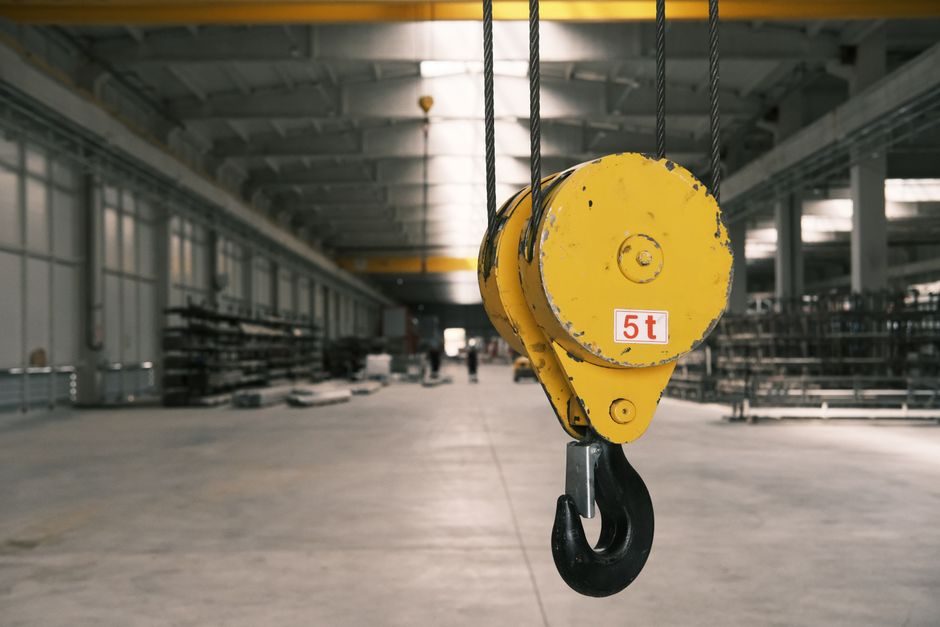
A heavy assembly bay typically lands on a top-running double-girder overhead bridge crane in the 10-32 t capacity band with FEM 2m / ISO M5 (CMAA Class D) duty rating, because single-girder top-running units cap out economically around 10 t and under-running systems lose headroom that assembly fixtures need [S1][S5].
Chinese OEM catalogues published on 2026-06-24 list 16 t electric wire-rope hoist bridge cranes as the standard catalogued SKU in this duty class, with monorail and single-girder variants for lighter bays [S1]. Dearborn Crane's Waukesha-built product line on 2026-06-24 explicitly differentiates top-running vs. under-running (under-hung) bridge cranes as separate engineering families with different wheel-load and runway requirements [S5]. Shaoxing Nante Crane Equipment Co., Ltd., established 2013-09-13, supplies bridge, gantry and jib cranes from the same Zhejiang manufacturing base, confirming the three-crane-family (bridge / gantry / jib) cataloguing convention still used in 2026 RFQs [S2].
Duty classification and FEM / CMAA group mapping
The first gate is the duty classification, because it sets wire-rope diameter, hoist motor kW, brake cycles and gearbox service life. FEM 1Am / ISO M3 (CMAA B) covers light assembly and tool-room work; FEM 2m / ISO M5 (CMAA D) is the default for heavy assembly bays with two-shift operation; FEM 3m / ISO M6 (CMAA E) and above are reserved for steel-mill, scrap-yard and continuous-pour duty. Truly Superior Crane's 2026-06-23 product page in Waukesha explicitly markets the full hoist, pushbutton, trolley and OSHA-inspection stack required to certify any of these duty classes on a delivered crane [S4].
For a heavy assembly bay running roughly 10-20 full-load lifts per shift, FEM 2m / ISO M5 (CMAA D) is the economically justified spec. Going one class higher (FEM 3m / ISO M6 / CMAA E) typically adds 15-25% to the hoist price for the same SWL, and one class lower (FEM 1Bm / ISO M4 / CMAA C) shortens hoist service life to roughly 60% of M5 hours under identical cycle counts. Hoist group must match the crane group, not just the SWL, because undersized hoists are the dominant failure mode in service.
Capacity, span and end-carriage approach geometry
The second gate locks SWL, span, and the end-carriage / hook-approach envelope. Heavy assembly bays with workpiece lengths of 8-14 m typically spec 20-30 m spans, and the end-carriage wheelbase plus the minimum hook approach (C-dimension) determine how close to the bay wall or column the crane can place a load. Top-running double-girder designs deliver the tightest C-dimension because the hoist parks between the girders, while under-running designs lose roughly one girder height of vertical hook travel [S5].
For a 20 t lift with a 22 m span in a 12 m clear hook-height bay, a top-running double-girder with a low-headroom electric wire-rope hoist will typically clear the required C-dimension where an under-running single-girder will not. This is exactly the headroom-vs-span trade-off Dearborn Crane's 2026-06-24 product page describes when differentiating top-running vs. under-hung bridge crane families [S5]. Dowell Crane's 2026-06-24 homepage lists the 16 t electric wire-rope hoist bridge crane as a catalogued configuration, confirming that 16 t / 22 m class units are standard catalog items, not specials [S1].
Hoist, trolley and travel drive selection
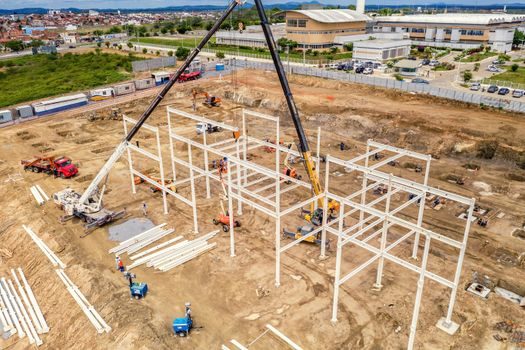
The third gate is hoist type, motor power, and travel drive topology. Electric wire-rope hoists dominate the 5-32 t band, while electric chain hoists typically cap at 5 t and are reserved for jibs and light assembly. Cross-travel and long-travel are VFD-driven on every modern heavy-bay spec for two-line control, smooth inching, and braking resistor integration. The Chinese OEM listings on 2026-06-24 confirm electric wire-rope pulling hoists of 1 t as the small end and 16 t bridge configurations as the heavy end of the standard catalogue [S1].
For a 20 t heavy-bay hoist, a 30/5 kW dual-speed or VFD hoist motor is typical, paired with a 4 kW cross-travel and 2 x 5.5 kW long-travel VFD drive set. The same VFD platform feeds the overhead conveyor interlocks that protect adjacent monorail or power-and-free loops when the crane is sharing runway with conveyor-fed work in process. Pushbutton pendants and radio remotes both appear as standard options on 2026 OEM catalogues; radio is now the default for heavy bays because the operator needs to stand clear of the swing path [S4].
Runway rails, wheel loads and building interface
The fourth gate is the runway rail and building column reaction, because the bridge crane only works if the civil structure can carry the wheel loads. Top-running cranes deliver wheel loads through 50-75 mm rail sections (AISC standard crane rail profiles such as 104 lb/yd or 171 lb/yd) clamped to the runway girders, and the maximum wheel load drives column and bracket design. Under-running cranes transfer loads through the runway suspension and put a bending plus tension load into the roof structure, which usually limits under-running to bays designed for that load path from day one [S5].
For a 20 t crane on a 22 m span, peak wheel loads typically land in the 80-120 kN range at the end-carriage, which must be confirmed with the building structural engineer before the crane order is released. OSHA safety inspections on existing runways are a separate service line that 2026-06-23 vendor offerings explicitly bundle with new crane deliveries, and are the correct checkpoint for any pre-owned runway before the new crane is erected [S4].
Controls, safety devices and standards coverage
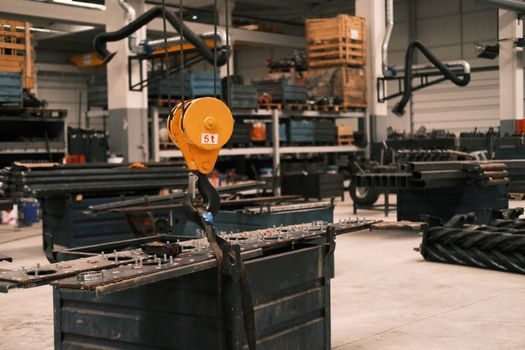
The fifth gate is the safety stack: overload limiter, upper/lower hoist limits, travel limit switches at both ends of bridge and trolley, anti-collision for bays with two or more cranes on shared rails, and phase-failure / under-voltage protection on the mainline. For heavy assembly bays serving steel and casting work, a crane scale integrated into the hook block is a routine option that lets the operator weigh fixtures and sub-assemblies during lift, removing a separate floor-scale step from the process [S1].
For explosion-risk or paint-booth-adjacent bays, hoist and pendant must be specified to the area classification from the start; ATEX/IECEx-rated pendants and motors are available but are a custom-engineering line, not a catalogued option.
When bridge is the wrong choice: gantry, jib and crawler comparison
The sixth gate is the no-bridge check. If the bay has no runway steel, the workpiece is moved outdoors, or the lifting pattern is a fixed point along one wall, a gantry crane on a ground rail or a jib crane on a column will be cheaper and faster to install. For very large one-off lifts outside a fixed bay, a crawler crane rental avoids the runway investment entirely, though the comparison between mobile crane classes turns on turning radius and ground-bearing pressure in ways that are spelled out for adjacent selection problems such as the crawler-vs-truck-mounted turning-radius cut for job-site work. For in-bay repetitive heavy lifting on a fixed runway, however, the top-running double-girder bridge crane remains the lowest cost-per-lift configuration in 2026. [S1]
The correct decision order for a heavy assembly bay: (1) lock SWL, span and FEM/CMAA duty; (2) lock end-carriage wheelbase and hook approach against bay geometry; (3) lock hoist, trolley and long-travel drive kW; (4) confirm runway rail and building reaction; (5) lock the safety and controls stack; (6) only then decide bridge vs. gantry vs. crawler. If steps 1-3 point to a 16-32 t top-running double-girder and the building already carries a runway, the bridge is almost always the right answer; if any of those three steps fail, step 6 is the escape route. Two trackable signals for the next 90 days: (a) RFQs in the 20-32 t heavy-bay class from Chinese OEMs continuing to list 16 t bridge cranes as a standard catalogue SKU rather than a special build [S1], and (b) OSHA inspection bundling into new-crane deliveries persisting as a standard 2026 service line from US integrators [S4].
For related coverage, see AMR vs Stacker Crane: 2026 Spec Frame for Warehouse Automation.