
Autonomous Mobile Robots (AMR) and stacker cranes are the two dominant options for pallet and tote movement inside distribution centers, but they occupy fundamentally different engineering envelopes: AMRs are free-navigation platforms driven by SLAM, LiDAR, and vision-based localization on the open warehouse floor, while stacker cranes are rail-guided vertical-handling machines that combine horizontal travel, mast lift, and load-handling into a single rigid structure [S1][S5].
Payload, lift height, and throughput ceilings diverge sharply between the two. AMRs typically handle 50–1500 kg per unit on a single deck, with fork, roller-top, or conveyor-top variants, and navigate via 2D/3D LiDAR plus wheel-odometry fusion [S3]. Stacker cranes in miniload or unit-load AS/RS configurations lift to 12 m on a single mast and to 40 m in crane-based storage buildings, with single-cycle times of 40–180 s depending on travel distance and lift height — a class of equipment documented in detail on the stacker crane reference page.
Navigation Stack: SLAM-Free Path vs Rail-Bound Axis
AMRs rely on simultaneous localization and mapping (SLAM) using 2D safety LiDAR (typically scanning at 10–40 Hz over 270°), optional 3D depth cameras, and IMU fusion to estimate pose in a pre-built or continuously updated map; recent open-platform releases publish pre-validated ROS 2 packages for sensor ingestion, classification, environment modeling, and action planning [S1]. Path planning runs in real time on the vehicle's onboard compute, with dynamic obstacle avoidance re-planning at 5–20 Hz when humans, forklifts, or other AMRs enter the safety field.
Stacker cranes eliminate that navigation uncertainty by constraining motion to a steel rail on the floor and a rigid mast for vertical travel, with absolute encoders (typically 16–24 bit) on each axis and a frequency inverter or servo drive commanding travel and lift motors. The result is repeatable ±5 mm positioning at the rack bay — accuracy an AMR cannot match because its wheel-odometry drift and floor-surface variability introduce ±10–30 mm endpoint variance even with fiducial aids.
Throughput and Density Math
Stacker crane throughput scales with aisle length and lift height, and is governed by the single-aisle S/R machine cycle formula: T_cycle = 2 × (t_horizontal + t_vertical + t_load) where horizontal travel at 2–4 m/s and vertical lift at 0.5–2 m/s combine with load-handler engage times of 3–8 s. A typical unit-load stacker crane delivers 20–60 single-cycles/hr per aisle, and AS/RS buildings parallel multiple cranes in dedicated aisles to compound throughput — the architectural pattern contrasted against pallet rack in the Pallet Rack vs AS/RS 2026 breakdown. [S1]
AMR fleet throughput scales with fleet size and traffic-management software, not with a single vehicle's cycle time; a 10-vehicle fleet coordinated by a fleet manager typically delivers 80–250 picks/hr in goods-to-person workflows, with diminishing returns past 15–20 vehicles per zone due to intersection congestion. The relevant baseline unit is the AGV robot family — AMR is the navigation-up evolution of AGV, replacing magnetic-tape or QR-floor guidance with on-board perception.
Safety Case and Standards Boundary
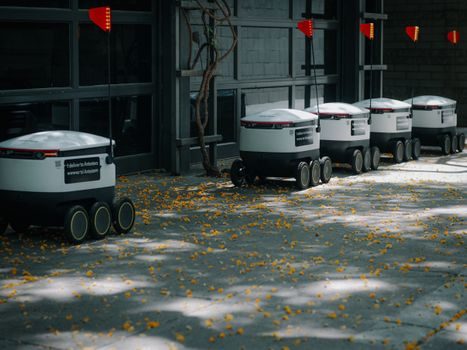
AMR safety cases must clear ISO 3691-4 (driverless industrial trucks — safety requirements) on the vehicle side and IEC 61508 / ISO 13849-1 on the safety-rated functions (typically PL d / SIL 2 for the protective stop, with safety LiDAR rated to Type 3 / Cat. 3 PL d); published engineering packages document 41 hazards, 46 safety functions, and 29 identified gaps in the safety case, with multi-standard traceability through AIAG-VDA DFMEA and a V-model test plan of 153 cases [S3].
Stacker cranes fall under EN ISO 3691-1 (industrial trucks — safety) plus machinery directive 2006/42/EC, with category-3 / PL d safety circuits on the rail travel and a separate light-curtain or laser-scanner perimeter at each aisle entrance. Both equipment classes must satisfy the same end-customer WMS/WCS handshake contract, but the certification burden on a free-navigation AMR (perception, mapping, decision logic all in scope) is materially higher than on a rail-bound crane (motion safety only).
Decision Matrix: 4 Criteria, Two Columns
On four selection criteria the two technologies diverge cleanly. (1) Footprint: an AMR needs 1.0–1.5 m of free aisle width plus dynamic buffer zones; a stacker crane needs 0.9–1.2 m of fixed rail aisle and no buffer because motion is constrained. (2) Storage height: AMRs work the floor (0–2 m lift on a few models, typically pallet-jack or low-lift variants); stacker cranes reach 12–40 m on the mast. (3) Capital per pick position: AMR slots cost roughly $1,500–$4,000 per tote/pallet position in goods-to-person layouts; stacker crane AS/RS slots cost $800–$2,500 per position at high density, with the rack structure dominating the bill of materials. (4) Flexibility vs density: AMR wins on layout reconfiguration (no floor work, no rack rebuild); stacker crane wins on storage density (single-deep or double-deep racks up to 40 m tall). [S2]
For the mobile-floor use case, the Autonomous Mobile Robot 2026 Buying Guide lays out the same payload, navigation, and fleet-spec selection gates in detail; for the high-density vertical case, the pallet stacker family entry covers the lighter-duty cousins of AS/RS stacker cranes.
Failure Modes and Operational Limits
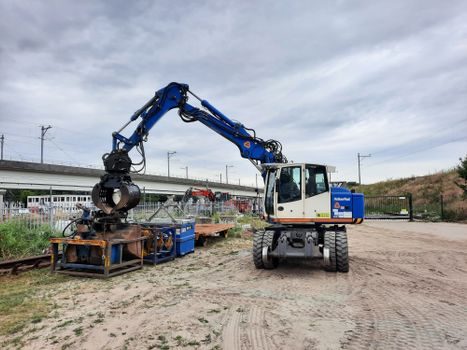
AMR failure modes concentrate in perception and localization: LiDAR contamination (dust, plastic wrap, condensation) drops mapping confidence; wheel slip on wet or polished concrete inflates odometry error; dynamic crowds of pedestrians or forklifts force repeated re-plans that erode cycle time. Published open-platform documentation calls out sensor data ingestion and environment modeling as the modules most exposed to environmental drift [S1].
Stacker crane failure modes concentrate in mechanical wear: rail joint misalignment, mast roller bearing fatigue, and wire-rope stretch on the lifting mechanism. A single-aisle S/R machine is also a single point of failure — a stalled crane halts the aisle, and redundancy is typically achieved by a second crane in an adjacent aisle rather than a hot spare on the same rail. AMRs tolerate single-vehicle loss gracefully because the fleet manager re-balances work to the remaining units.
Sourcing and Standards Reference
Procurement specs should pin the applicable standards explicitly: ISO 3691-4 for AMR functional safety, IEC 61508 / ISO 13849-1 for safety integrity, EN ISO 3691-1 plus EN 17261 for stacker crane safety, and the machinery directive 2006/42/EC for CE marking of either platform. The Intel Open Edge Platform AMR documentation serves as a baseline reference for open ROS 2 navigation stacks and pre-validated sensor drivers, with the proviso that open-source code carries no functional-safety certification on its own [S1].
Two trackable signals to watch through 2026: (1) revision activity around ISO 3691-4 amendments addressing mobile manipulators and outdoor AMRs, and (2) the spread of 5G-URLLC private networks on warehouse floors, which would lower AMR fleet latency and tighten the safety case for higher-density AMR operation. The articulated-robot reference at articulated robot covers the fixed-base picking arm that frequently pairs with an AMR in a goods-to-person cell.