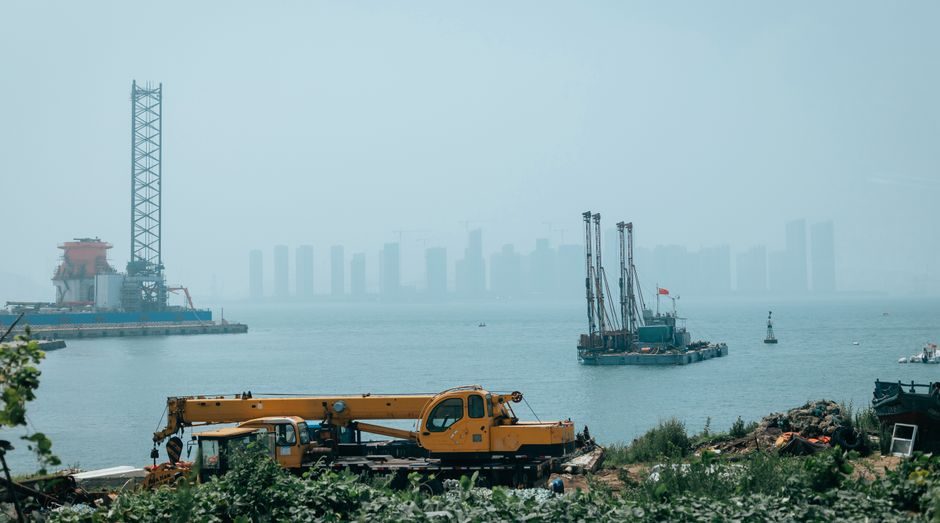
An overhead bridge crane (also called EOT or bridge crane) is a material handling system that moves heavy loads horizontally along a fixed runway inside a facility, with single-girder versions typically rated 1-30 t and double-girder versions rated 5-500 t (working level M3-M7) per current Chinese OEM catalogs [S1][S2].
A stacker crane is an aisle-bound, rail-guided storage and retrieval machine built for pallet or bin handling in high-bay warehouses, where vertical reach and aisle width (typically 1.5-3.5 m) drive the spec more than raw tonnage. The two equipment families address different problems: bridge cranes optimize for heavy lifting and wide horizontal coverage; stacker cranes optimize for cube density and inventory turns.
Definition, Scope, and Operating Envelope
An overhead bridge crane rides on two parallel runways fixed to the building's roof structure or columns, with a bridge girder carrying a hoist that traverses the span and a trolley that travels along the bridge; single-girder units cover 1-30 t at working level M3-M5, while double-girder units cover 3-500 t at M5-M7 per current factory data [S2]. IP54/IP65 enclosures are typical for indoor heavy-duty double-girder builds, with supply voltages of 220 V / 380 V / 440 V at 50 Hz [S2].
A stacker crane is a mast- or column-supported machine running on a bottom rail and top guide rail inside a dedicated aisle, fitted with a telescopic fork or platform for pallet or bin handling; aisle widths commonly fall between roughly 1.5 m and 3.5 m, and storage heights regularly exceed 30-40 m in automated warehouses. The two equipment classes differ structurally: bridge cranes distribute load through runway beams to the building frame, while stacker cranes carry the full vertical and horizontal load through a self-supporting mast anchored at floor level.
Load Capacity and Span Comparison
The headline difference is tonnage class. Single-girder bridge cranes from the current CATET catalog cover 1-30 t at M3-M5, while double-girder units cover 3-500 t at M5-M7, with one specific 150 t IP54/IP65 heavy-duty model listed for steel-mill and power-plant service [S2]. Stacker cranes, by contrast, are built around unit loads (typically 1-2 pallets of 1,000-1,500 kg each) rather than continuous tonnage, and their capacity is constrained by mast stiffness, rail alignment, and fork geometry rather than by bridge strength.
For the same floor footprint, a 100 t bridge crane can move a single heavy lift across a 30 m span, while a stacker crane in a 2.5 m aisle can service pallet positions on both sides of that aisle up to roughly 40 m high. If the job is one heavy lift across a wide shop, the bridge crane wins; if the job is thousands of pallet moves per shift in a confined footprint, the stacker crane wins. For related material-handling context where conveyors complement cranes in production lines, see the chain conveyor vs belt conveyor spec-first selection map.
Footprint, Building Interface, and Installation
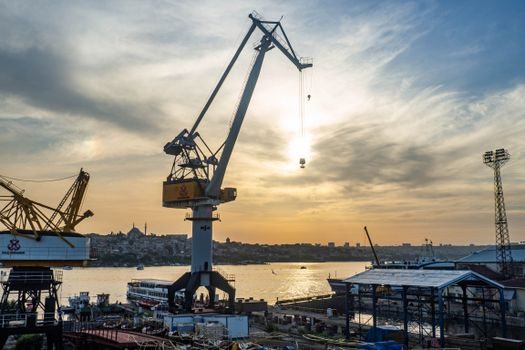
An overhead bridge crane requires a structural building capable of carrying runway loads; runway beams are typically fixed to roof trusses or columns, and the crane's dead weight plus dynamic loads are transferred into the building frame. The catalog data lists 3-phase AC 380 V 50 Hz as standard supply for the lighter 5-30 t single-beam gantry derivative, with span and lifting height typically up to 5-60 m and 3-20 m respectively [S1][S2].
A stacker crane requires a flat, level floor slab rated for the combined mast and payload load, plus a top guide rail attached to the racking or building superstructure; it does not require runway beams across the entire building. Stacker crane aisles are designed as part of an AS/RS (automated storage and retrieval system), with aisle length matching the rack depth and aisle width set by mast plus load-clearance. Footprint-wise, a stacker crane can roughly double warehouse cube utilization compared with a bridge-served floor block, but only if the racking is built to the same tolerances.
Duty Cycle, Speed, and Working Level
Bridge crane working levels span M3 to M7 per FEM/ISO 4301 conventions as quoted in current OEM data: single-girder M3-M5 for lighter, intermittent duty, and double-girder M5-M7 for heavier, more frequent cycles [S2]. A 150 t IP54/IP65 double-girder unit from the same catalog is positioned for heavy-duty lifting with environmental sealing for dusty or semi-outdoor service [S2].
Stacker cranes operate at working levels closer to continuous or intensive duty during shift hours, with horizontal travel speeds typically 1-2 m/s and lifting speeds of 0.5-1 m/s depending on mast height and load. For throughput modeling, a single stacker crane in a 40 m tall, 80 m long aisle can handle on the order of 30-60 dual-command cycles per hour; a bridge crane moving a 50 t coil from bay to bay may only need a few cycles per hour but each cycle can be a 5-10 minute heavy lift. The two equipment classes are tuned to different definitions of productivity: stacker cranes to moves-per-hour, bridge cranes to tons-per-move.
Selection Criteria: When to Specify Which
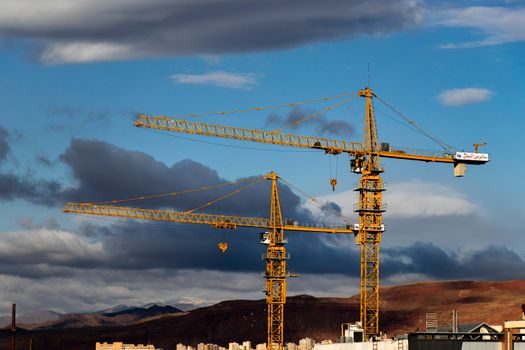
Specify an overhead bridge crane when the load is heavy (above ~5 t routinely, up to 500 t), the lift height is moderate (under 20 m in most industrial builds), the building is already designed with runway support, and the duty is intermittent or heavy-shift rather than continuous. Typical use cases include steel-coil handling, machine-shop tooling changes, foundry ladle moves, and paper-roll handling. [S1]
Specify a stacker crane when the storage height exceeds roughly 12-15 m, the SKU count is high with many small unit loads, floor area is expensive, and the operation needs inventory accuracy and throughput automation. Typical use cases include cold-storage pallet AS/RS, automotive parts warehouses, e-commerce fulfillment, and pharmaceutical finished-goods storage. Do not specify a stacker crane for heavy sub-1 t industrial parts in a low-bay shop — a pallet stacker or fork truck is the better fit, and a stacker crane is wasted capex. Conversely, do not specify a bridge crane for high-density pallet storage — the runway and building structure cap will be reached long before the rack density required for AS/RS.
Safety, Standards, and Integration
Both equipment classes fall under crane and lifting safety regimes (e.g., FEM 1.001 / 9.341, ISO 4301 for classification, and regional codes such as ASME B30 in the US or EN 15011 in Europe) and must be specified with the right duty class, overload protection, limit switches, and anti-collision logic for the environment. Bridge crane installations in steel mills and shipyards are increasingly paired with crane scale load monitoring for overload prevention and load-traceability, with typical accuracy classes of 0.1% FS for steel-mill service. [S1]
Stacker crane installations in AS/RS environments are typically integrated with WMS/WCS software via industrial Ethernet (PROFINET, EtherNet/IP) for position reporting and slot management, and they require laser or rail-guided navigation plus anti-collision between cranes in adjacent aisles. A crawler crane is sometimes used during the construction phase to erect racking and stacker crane rails, but it is not a substitute for either equipment class in operation. For factory-floor conveyor integration where an overhead conveyor feeds the bridge crane bay, the interface spec must match voltage, control protocol, and emergency-stop category.
Cost, Lead Time, and Sourcing Posture
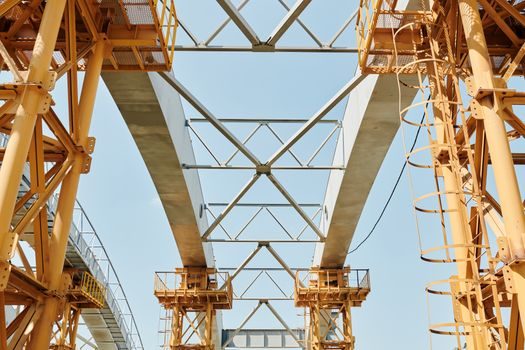
Bridge crane lead time from Chinese OEMs is typically 30-60 days for standard single-girder and double-girder units at 1-30 t / 3-500 t, with engineered heavy-duty units (such as the 150 t IP54/IP65 model) often requiring 90-150 days including FAT (factory acceptance testing) [S2]. Standard configurations on catalog sites list FOB-style pricing with no formal minimum order quantity for engineered units, while platform units on B2B portals show MOQ of 1 set with price bands of roughly US$4,000-12,500 for 5-50 t single/double-beam hoist packages.
Stacker crane lead time is longer and more integration-dependent: a single aisle stacker typically runs 120-180 days, and a full multi-aisle AS/RS project including racking, conveyors, and WMS integration can run 9-18 months. Sourcing for both is dominated by Chinese OEMs, but stacker crane projects are more often delivered through system integrators because the racking, controls, and software are inseparable from the machine. For plants already running conveyorized production, the bucket elevator vs belt conveyor spec-first selection map covers a related material-flow decision that often sits upstream of the crane spec.
The decisive next step for a buyer is to fix the duty class and throughput target before talking to vendors: define the heaviest single load, the maximum lift height, the aisle or span geometry, the cycles-per-hour, and the working environment (temperature, dust, cleanroom). With those numbers, the bridge-crane-vs-stacker-crane question reduces to a 5-minute decision; without them, both equipment classes get over-specified. Trackable signals to watch: tighter integration of crane-scale telemetry with MES platforms, and growth of mini-load stacker cranes in sub-12 m warehouses as e-commerce retrofits older buildings.