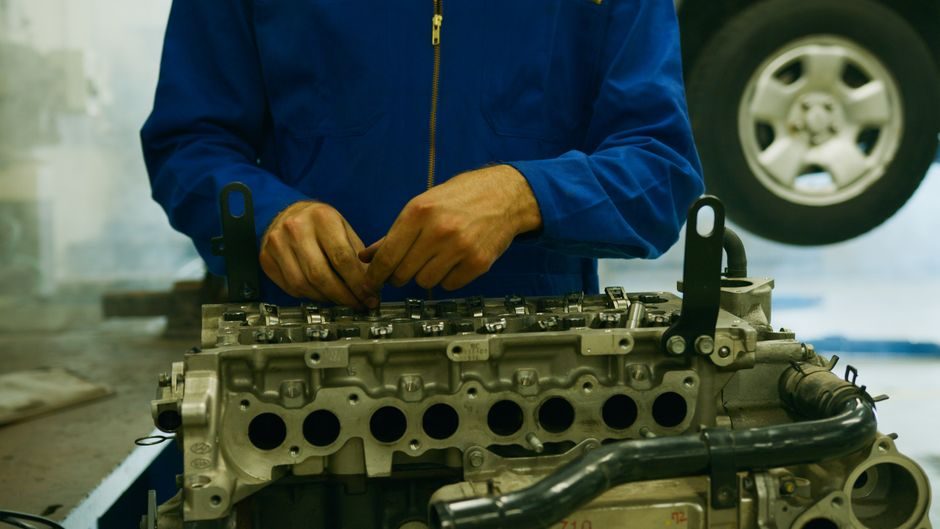
Overhead conveyors for automotive parts logistics are dominated by enclosed-track (5–60 fpm, 10–500 lb per carrier) and power-and-free configurations that keep door, engine, and chassis sub-assemblies suspended in the exact build order from robotic cell to marriage station [S5].
For Just-In-Sequence (JIS) operations specifically, suspended transport acts as a continuous FIFO rail: parts enter in production order, are routed through intermediate buffers and diverters, and exit matched to the body arriving at the assembly point [S1]. Selection must therefore balance carrier load, track geometry, environmental exposure (paint booth, e-coat, wash), and direct handoff to robot or AGV upstream.
Why Overhead, Not Floor, for JIS Lines
Overhead conveyors reclaim the floor footprint that body-in-white skids, tugger trains, and roller tables normally occupy, which matters in plants where trim, final, and sub-assembly halls share a single bay footprint [S2].
Suspended carriers also protect cosmetic surfaces: doors hung on a rail travel from the robotic trimming cell to the marriage point without touching a conveyor belt, roller, or another part, eliminating scratch and contamination risk inherent in belt conveyor accumulation [S1]. For high-variance builds (different option codes per vehicle on the same line), overhead JIS lines act as a live, reorderable buffer rather than a static rack.
The Three Configurations That Actually Win Automotive Bids
Three overhead architectures cover nearly every automotive JIS scenario: enclosed track for light carriers and paint lines, power-and-free for accumulating buffers, and monorail for heavy engine or chassis moves. [S1]
Enclosed-track overhead conveyors run a continuous chain inside a bolted aluminum or steel profile and carry 10 to 500 lb per carrier at 5 to 60 fpm, which fits garment-style paint skids, small sub-assemblies, and door hangers where the line never needs to stop individual carriers [S5]. Power-and-free systems split the loop into a powered chain and a freely rolling trolley on a secondary rail, letting carriers stop, accumulate, and re-enter on demand — the standard architecture for sequencing doors or instrument panels ahead of the body [S2]. Monorail conveyors, often I-beam based, take heavier engine, transmission, and axle carriers above the assembly hall, accepting loads that exceed the 500 lb per-carrier ceiling of enclosed track [S2].
JIS-Specific Specs: FIFO, Diverters, Buffer Length

JIS selection criteria differ from generic overhead specs: a buyer must lock FIFO behaviour, diverter count, buffer capacity in line-meters, and the physical interface with the upstream robotic cell before vendor talks begin [S1].
Two technical facts drive the spec. First, a true JIS overhead line uses the rail itself as the sequencing buffer: parts hang, advance, and are released without ever being unloaded to a tray, so the sequence-rail length between cell and marriage station defines the maximum station-to-station build-time differential the system can absorb [S1]. Second, diverters and intermediate buffers create branches in the circuit without reloading, so a single loop can feed multiple trim variants (e.g. LHD/RHD, sunroof/no-sunroof) from one supply point [S1]. Designers should size buffer capacity in line-meters, not in part count, because carrier pitch and part length set the real inventory ceiling.
Automotive Environmental Exposure
Overhead conveyors in body, paint, and e-coat zones must tolerate specific atmospheres: powder-coat or galvanized chain for paint booths, stainless or plated hardware for e-coat immersion drainage, and drip trays above weld cells to keep lubricant off the carriers [S2].
Curve radius and vertical lift geometry deserve equal weight: the minimum inside radius determines the largest door or instrument-panel carrier the plant can ever run, and that number is set by the building column grid, not by the conveyor vendor [S6]. For greenfield plants, layout the column grid to a radius that lets the largest planned carrier clear inside curves with at least 50 mm margin on each side; for retrofits, reverse-engineer the maximum carrier envelope from the tightest existing curve.
Integration with Robotic Cells and AGV Handoff
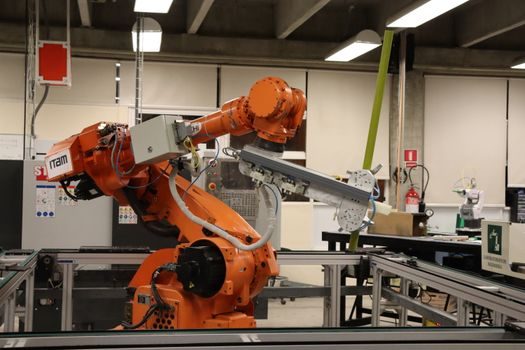
An overhead JIS line is only as reliable as its handoff: the robot end-effector, carrier hook geometry, and AGV lift interface must be co-engineered with the conveyor supplier, not specified afterwards [S1].
The standard JIS automotive case is a robotic trimming cell that hangs a finished door on a moving overhead carrier; the carrier then runs through buffer, diverter, and storage zones, and is released at the marriage station exactly as the matching body arrives [S1]. Some plants extend this same overhead concept all the way to tier-1 suppliers, with the conveyor physically crossing the factory wall so the supplier hangs parts directly onto the OEM's rail [S1]. Buyers evaluating chain conveyor or pneumatic conveyor alternatives for the same handoff should compare the FIFO guarantee: chain conveyors preserve order only when not stopped, and pneumatic conveyors abandon FIFO entirely once parts enter the air stream.
Selection Criteria Comparison Across the Three Architectures
The table below lines up the dominant overhead architectures on the four decision criteria that drive automotive JIS specification. [S1]
Enclosed track scores best on cost and paint-shop tolerance but loses on accumulation: carriers cannot stop independently, so it suits continuous-flow paint or e-coat, not sequence buffering [S5]. Power-and-free is the only architecture that gives true in-line accumulation and re-sequencing via the free trolley, which is why it dominates door, IP, and bumper JIS lines despite higher mechanical complexity [S2]. Monorail takes the heaviest per-carrier loads and the longest single spans, fitting engine, transmission, and axle moves where an overhead bridge crane would be over-specified, but it cannot accumulate and requires larger curve radii. Specification writes should lock architecture first, then per-carrier load, line speed, buffer length in line-meters, and minimum inside curve radius as the four non-negotiable numbers.
What Overhead JIS Is Not For, and Common Failure Modes
Overhead JIS is the wrong tool when parts are too heavy for any carrier, when the build sequence varies too widely to absorb in a fixed-pitch buffer, or when upstream cells cannot synchronize handoff to a moving rail. [S1]
Three failure modes recur in retrofits. First, undersized buffer length: a 20 m rail cannot absorb a 15 minute station stop, so any upstream delay empties the line [S1]. Second, contaminated carriers in paint: bare steel hardware sheds into the booth, so specifiers should mandate powder-coated or galvanized chain and stainless hanging hardware from the start [S2]. Third, mismatched handoff interfaces: a robot end-effector tooled for a static rack cannot place a part on a moving carrier without a vision-guided handoff zone, and retrofitting vision after installation costs more than specifying it during tender.
Procurement, Sourcing, and Reference Data
Overhead conveyor sourcing for automotive plants should follow a spec-first workflow: lock the four architecture numbers above, request vendor matching against enclosed-track or power-and-free standards, and validate FIFO behaviour on a test loop before site installation [S2][S5].
The global overhead conveyor market is treated as a sub-segment of broader material-handling equipment, with automotive JIS lines representing one of the highest-mix, highest-throughput applications in that segment [S8]. Reference spec ranges to anchor RFQs against: enclosed track at 5–60 fpm and 10–500 lb per carrier [S5]; power-and-free architectures defined by free-trolley pitch and accumulation rail length [S2]; monorail defined by I-beam section and per-carrier load above the 500 lb ceiling of enclosed track [S2]. Plants evaluating overhead for non-automotive lines — for example pharmaceutical distribution or food and beverage — should reset the same four architecture numbers against wash-down and cleanability requirements before carrying automotive specs across. Track next: confirm column-grid inside radius vs largest planned carrier, and confirm buffer rail length in line-meters against the worst-case upstream station stop before any vendor commitment.