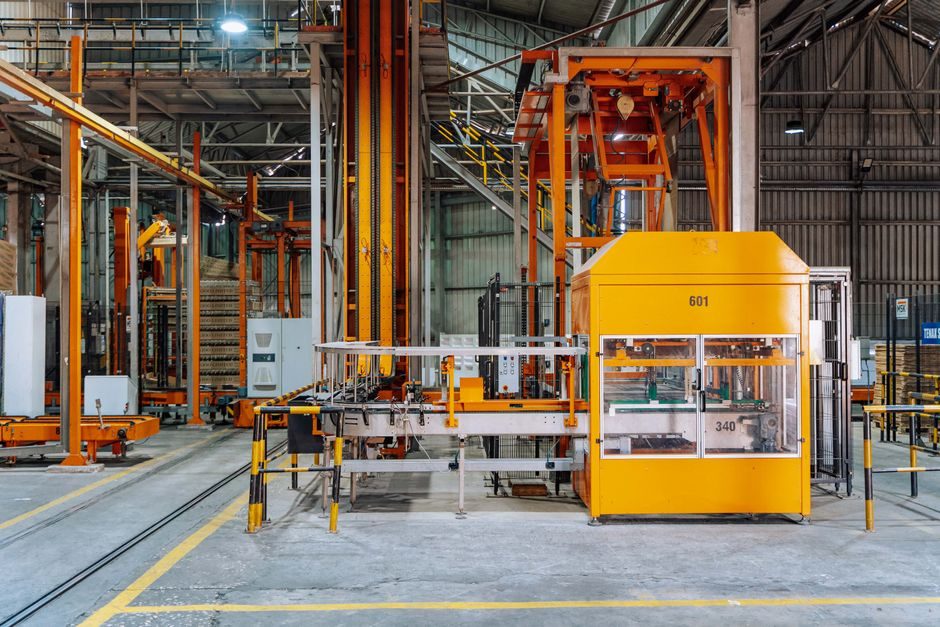
Overhead conveyor selection is governed by four hard numbers — payload per carrier, chain pitch, total path length, and accumulation duty — and skipping any one of them produces a system that either stalls under load or overpays for capacity. The DirectIndustry overhead-conveyor category lists 12 transport-classified systems from active OEMs [S2], confirming that overhead transport remains a fragmented, application-specific segment rather than a commoditised line item.
Bridgeveyor's C-250 conveyor, marketed as a North-American-made overhead line, sets a 250 lb per-carrier working load as its published baseline [S3], which is a useful yardstick: light-duty overhead carriers under 100 lb/cart are typically monorail X-348 or X-458 chain, mid-duty 100–500 lb/cart moves to power-and-free, and anything above 500 lb/cart usually escalates to a hand-pushed I-beam or a bridge-crane-style trolley (see also bridge-crane basics).
Define the Load Envelope Before Touching a Catalog
DirectIndustry catalogues overhead-conveyor product applications under "transport" (12 listings), "industrial handling" (11), "clothing" (9), "accumulation" (7), and "assembly line" (5) [S2], and that taxonomy is itself a sizing hint: an accumulation-classified line must have low-back-pressure friction trolleys, a transport-classified line tolerates higher tow forces. A clothing/garment line typically runs 5–15 kg/cart on 3-inch pitch; an automotive-body line for e-coat (electrophoretic paint) demands carriers rated for 800–1 500 kg suspended load, which historically was the design point of US patent US4512869A covering the loading-station frame and vertically moving guide structure [S6].
List the worst-case loaded mass per carrier, the longest dwell time in accumulation zones, the lift height between floor and rail, and any wash-down or cleanroom rating before requesting quotes. McGinty Conveyors explicitly segments its range into monorail overhead, safe-rail, tire-retread, zig-zag, inverted zig-zag, and I-beam sidetrack families [S5] — a six-way split that mirrors real process geometry, not marketing categories.
Chain Pitch, Trolley Spacing and Path Geometry
Chain pitch sets the minimum carrier pitch and therefore the maximum number of carriers per metre of path. The common North-American X-type chain family — X-348 (3 in pitch), X-458 (4 in), X-678 (6 in) — each step roughly doubles the per-link working load and the trolley mass, which feeds back into drive kW. A 100 m closed-loop X-348 line with 150 mm trolley pitch carries ~666 carriers; halving the pitch doubles the chain mass and the rolling friction, often pushing the designer from a 0.75 kW to a 1.5 kW gearmotor. [S1]
For accumulation duty, vendors like ELECTRON publish powder-coating conveyor variants specifically engineered for overhead routing with heat-resistant trolleys [S1]; the same is true of chain conveyor sizing logic, where pitch and drive sizing interact in the same way. TUKU Conveyor Systems in Singapore markets an "elevating material handling" overhead product, confirming that vertical-lift and inclined sections are routinely scoped into a single overhead line rather than handed to a separate elevator [S4].
Drive Sizing: Force, Speed and Accumulation Back-Pressure

Overhead conveyors are force-limited, not power-limited: the design check is "can the drive pull the worst-case loaded train through the highest-friction section," not peak kW. A practical rule is tow force = (total train mass × coefficient of rolling friction) + (vertical-lift mass × 9.81 × sin θ); for steel-on-steel X-chain, the rolling-friction coefficient typically sits between 0.02 and 0.05. Accumulation back-pressure adds roughly 5–15 N per loaded carrier depending on trolley type, so a 200-carrier accumulation zone adds 1–3 kN of steady drag that the drive must overcome continuously. [S2]
Standard line speeds run 4–15 m/min for garment and finishing lines, 6–30 m/min for general assembly, and 1–4 m/min for heavy-body paint lines [S6]. Sizing the gearmotor at 1.5–2× the calculated continuous draw is a normal engineering margin; undersizing shows up first as chain stretch in the drive sprocket, not as motor stall.
Application Fit: Who Overhead Is — and Is Not — For
Overhead conveyor is the right answer when floor space is reclaimed for value-add work, when the product is awkward (long, flexible, garment-hung, body-in-white), or when the line must dip into baths and ovens on a captive carrier — e-coat and powder coating being the textbook cases [S1][S6]. It is the wrong answer for high-throughput palletised goods (a belt conveyor or roller conveyor is faster to install), for any line that changes SKU geometry mid-shift, and for cleanroom pharma where stainless tolerance and crevice-free trolley design are usually easier on a chain conveyor with covered pans.
Automotive, e-coat, garment finishing, tyre retread and electrophoretic paint shops remain the strongest vertical fit [S5][S6]; the DirectIndustry product-application histogram puts "automotive applications" at 4 listings, "clothing" at 9, and "for textiles" at 6 [S2] — a useful sanity check that the market is more diversified than the historical "automotive-only" reputation suggests.
Material, Lubrication and Environmental Spec Gates
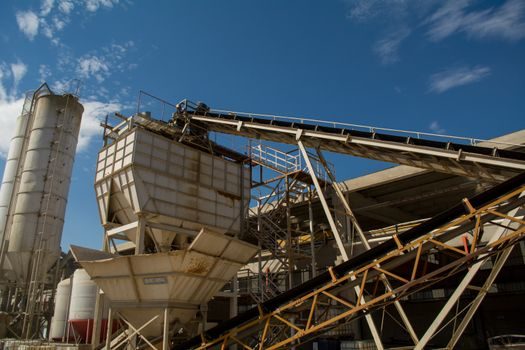
Three environmental gates decide the bill of materials. First, wet process (e-coat, pre-treatment, powder coating) demands stainless trolley pins and chain; Bridgeveyor explicitly markets a stainless-steel system for "strict standards" compliance [S3]. Second, high-temperature oven exposure (>180 °C) requires lubricated-for-heat chain and high-temperature-rated bearings, with lubrication intervals shortened to 500 h or less. Third, food and beverage overhead duty needs sanitary trolley covers and food-grade grease; the DirectIndustry index logs two dedicated food-and-beverage listings [S2].
A linear guide or crossed-roller guide typically appears in the lift or transfer section between overhead and floor conveyors, so the guide's load rating should be checked against the heaviest loaded trolley crossing it, not against the nominal carrier rating.
Standards, Safety and Vendor Verification
Overhead conveyors are covered by general machine safety (ISO 12100) and by CEMA-style design practice for unit-handling conveyors; the exact applicable standard depends on the regional machinery directive. For overhead conveyor design referencing an overhead conveyor system, specifying a minimum safety factor of 5:1 on chain tensile strength and 3:1 on drive train components is widely accepted, but the binding requirement must be checked against the actual contract documents and the local enforcing authority. [S3]
For 2026 sourcing, cross-check three signals: (a) the OEM's published per-carrier working load with explicit units (lb or kg, not "rated"); (b) the chain pitch family and its tensile rating; (c) the maximum accumulation-zone length and the back-pressure curve. Bridgeveyor, McGinty, TUKU and the DirectIndustry shortlist of 12 transport-rated OEMs [S2][S3][S4][S5] all expose at least one of these in public product data, which is the minimum bar for a first-round shortlist. Direct requests for cycle time, dwell time, and a one-line process flow will quickly sort real vendors from catalogue resellers.