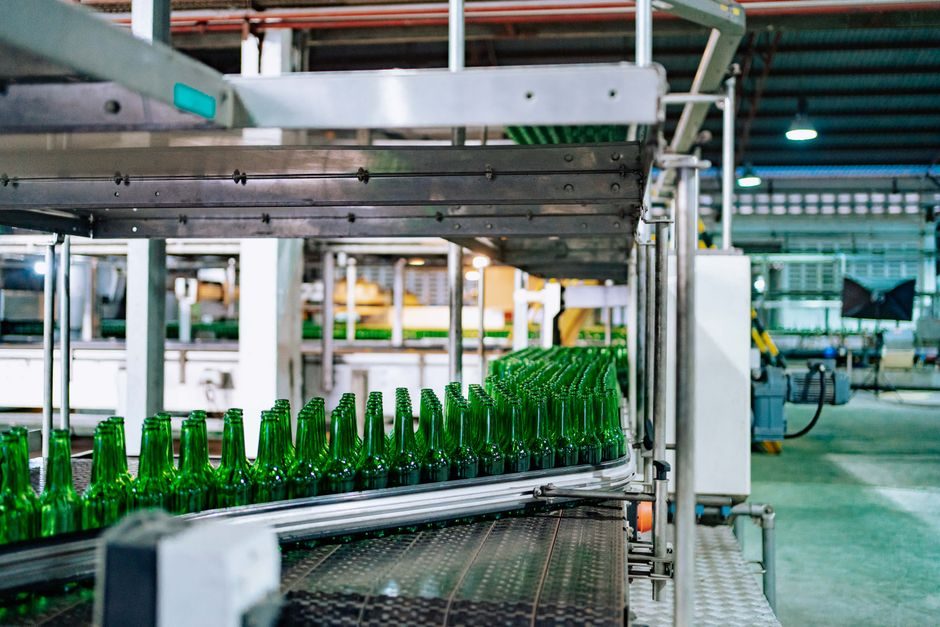
Food and beverage lines specify mesh belt conveyors in two dominant form factors: stainless steel woven wire (balanced spiral, flat-flex, chain-edge) for high-temperature baking, frying, freezing, pasteurising and CIP wash-down, and modular plastic flat-top (often PP, POM or PA) for accumulation, packaging infeed and bottle/can lines operating below 100 °C [S1][S2].
Global suppliers covering the F&B belt segment include SIDEL and KHS on the integrated line side [S1][S2], Wire Belt Company on woven metal mesh [S3], and Chinese fabricators such as Shuke Metal on woven stainless mesh [S4]. Procurement should be evaluated against four hard gates — material grade, belt pitch and opening, regulatory compliance for direct food contact, and mechanical duty — before any commercial comparison.
Material Selection: 304 vs 316L Stainless Steel
AISI 304 (EN 1.4301, ~18% Cr / 8% Ni) is the default for general food, beverage and dairy applications where chloride exposure is limited to routine wash-down chemicals at neutral pH; 316L (EN 1.4404, ~16% Cr / 10% Ni / 2% Mo) is specified where chlorides, salt brines, vinegar, sauces or aggressive CIP detergents contact the belt surface [S3]. L-grade 316L reduces carbide precipitation risk in welded or heavily cold-worked zones, which matters for spiral mesh returning through tight radii on cooling or proofing spirals.
For high-acid products (citrus juice lines, tomato sauce, pickling) and for brewery CIP with hot caustic followed by acid sanitising, the standard practice is to step up to 316L for the full belt assembly, or at minimum the contact wires, to avoid pitting and stress-corrosion cracking. 304 remains adequate on bottle/can transport where the belt is shielded by product or container and the wash regime is mild alkaline [S1].
Belt Construction: Woven Wire vs Modular Plastic
Stainless woven wire belts — flat-flex, balanced weave and compound balanced — dominate where temperatures exceed 100 °C: baking ovens (180–260 °C belt surface in many cracker, biscuit and bread lines), steam cookers, blanchers, pasteurisers, spiral freezers (–40 °C air, belt near 0 °C), and fryers. Wire Belt Company and similar fabricators stock standard pitches from 1/4 inch upward with edge options including plate-rod, hook and chain-edge for positive-drive sprockets [S3]. Chinese OEM Shuke Metal also services foodstuff and chemical woven-belt applications from a fabrication base, with standard carbon-steel and stainless constructions [S4].
Modular plastic belt conveyors — flat-top, flush-grid, raised-rib, and radius/side-flex variants — are standard on bottle, can, carton and shrink-wrapper infeed/outfeed. KHS lists its Innopack Kisters CD as a horizontal merge/transport modular belt conveyor with high-capacity throughput for food and beverage line integration [S2]. SIDEL lists transport conveyor systems rated for empty PET/HDPE bottles, glass bottles, cans, cartons and plastic containers on production lines [S1]. Modular belts change the wear part, not the conveyor, which is why they are favoured where changeover between SKUs is frequent.
Operating Limits and Drive Duty
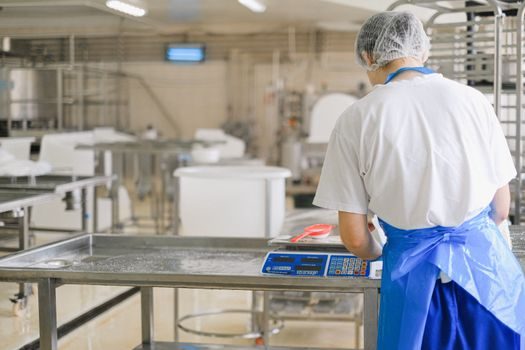
Stainless woven wire mesh belts in food service typically operate from –40 °C (freezer spirals) to roughly 400 °C for special high-temp alloys, with the common 304/316L envelope bounded near 300 °C continuous. Modular plastic belts cap out near 100 °C continuous for PP and around 80 °C for standard POM; high-temperature PP and PE compounds push that higher but lose impact resistance. A mesh belt conveyor is mechanically rated by belt pull (N/mm of width), drive sprocket tooth count, shaft load, and the take-up travel — all of which must accommodate thermal expansion when the belt is heated in-process [S3].
Drive selection should be sized for the worst-case loaded start with the appropriate service factor: 1.0–1.25 for uniform packaged goods, 1.5+ for sticky or variable-mass food product. A belt tensioner is mandatory on long over-floor runs to keep mesh elongation inside the take-up window; the standard ratio is 1–3 % of the conveyor centre distance depending on belt style. Comparing alternatives, stainless woven wire supports the highest temperature, modular plastic supports the fastest changeover, and flat-belt fabric or PU conveyors sit between them on temperature but are not part of the mesh-belt family.
Regulatory and Hygiene Compliance
For direct food contact, belts must be sourced from manufacturers declaring FDA 21 CFR (US) and EU 1935/2004 / EU 10/2011 compliance for plastic modular belts, and FDA plus appropriate metallurgy for stainless. Hygienic design follows EHEDG Doc. 2 / Doc. 8 principles: open, drainable frames; no horizontal catch points; welded and polished (Ra ≤ 0.8 µm on contact surfaces for high-hygiene zones) stainless construction; and CIP spray-ball coverage verified by riboflavin or similar coverage testing. Shaft seals should be specified as cassette or labyrinth rather than lip-seal where continuous wash-down is expected [S1][S2].
For high-care zones (ready meals, dairy, infant formula) the standard practice is to require documentation of material traceability (3.1 certificates per EN 10204 for 304/316L), weld maps, surface-finish reports, and validation that lubricants are food-grade H1 registered where incidental contact is possible. On the steel mesh side, weave specification — wire diameter, pitch, cross-section — drives both cleanability and product support; finer pitch means smaller opening, better support for small product, and harder cleaning.
Decision Matrix: When to Pick Which
Use the matrix below as a first pass before talking to a vendor. [S1]
• Pick stainless 304 woven wire mesh for general baking, cooling, freezing and packaging transfer at ambient or high temperature, low to moderate chloride wash, and a target belt life of 5+ years with periodic inspection [S3].
• Pick stainless 316L woven wire mesh for salt, brine, vinegar, sauce, brewery CIP, and any direct-contact high-acid application; budget 20–40 % material cost premium over 304.
• Pick modular plastic (PP/POM/PA) for bottle, can and carton lines below 100 °C with frequent SKU changeover; easier to repair, changeable in sections, and forgiving of misalignment [S1][S2].
• Pick a ribbed-belt or PU modular hybrid only when you need incline capability or accumulation with low back-pressure; not part of the wire-mesh family but common as a downstream complement.
A baseline mesh belt conveyor for a small bakery or freezer line in 304 stainless, 1 m wide, balanced weave, runs in the lower mid-range of the woven-mesh price band. A 316L spiral freezer belt with full sprocket drive and turnhead is a multi-line capital item and is almost always quoted against a process spec, not a list price.
Supplier Landscape and Sourcing Reality
The food-grade mesh belt market splits into three layers: integrated line builders (SIDEL, KHS, Krones-adjacent and similar European OEMs) whose belts ship as part of a complete conveyorised line [S1][S2]; specialist belt fabricators (Wire Belt Company in the US/UK, and Chinese fabricators such as Shuke Metal serving foodstuff, chemical and furnace applications) whose product is the belt itself [S3][S4]; and general conveyor OEMs that integrate third-party belts into frames.
Lead time is the dominant procurement variable after spec: stock woven mesh for common weave and width ships in weeks, but special 316L spiral freezer belts with welded edges and turned-up side guards run several months. Sourcing from Chinese fabricators is competitive on price for standard 304 weaves, but for 316L with full 3.1 certification and EHEDG-aligned fabrication, the European or US specialist tier is usually safer on documentation [S3][S4]. If your line is going into a regulated food plant, treat the belt as a validated component, not a commodity spare.
For a deeper dive on the mechanical pre-purchase gates, the practical checklist in mesh belt conveyor selection: 4 hard gates before you talk to a supplier lines up with the four gates above (material, pitch, contact compliance, duty). For bottle/can line infeed where modular plastic overlaps with chain-driven accumulation, the chain conveyor selection for pharmaceutical lines and chain conveyor sizing and selection pieces cover the adjacent decision space. The next trackable signal to watch is the 2026–2027 update cycle on EU 1935/2004 guidance for stainless food-contact surfaces and any shift in EHEDG Doc. 2 hygienic-design thresholds, both of which directly affect what 304 vs 316L call-outs F&B buyers will see on quotes.