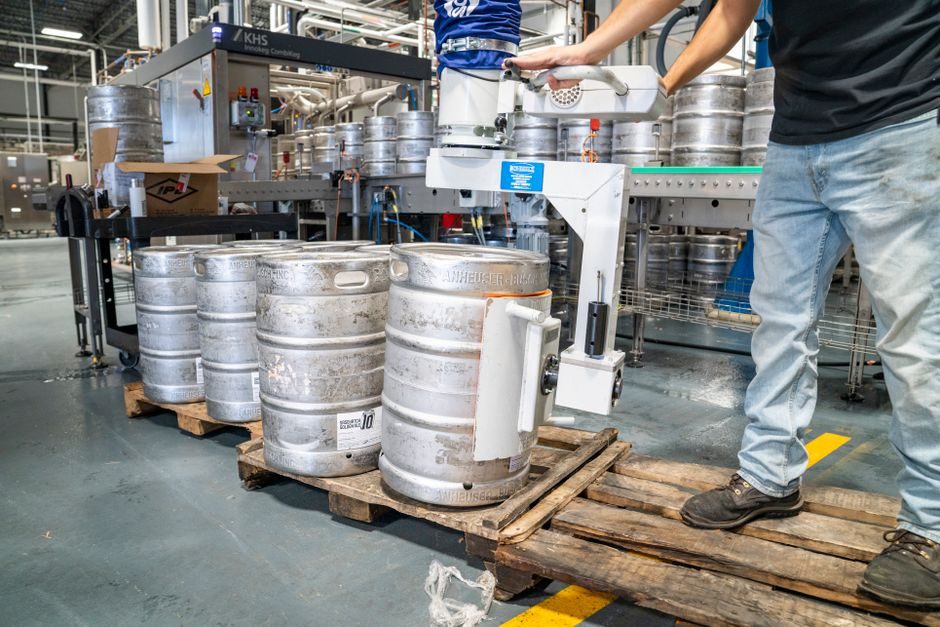
Across 2026 Q1–Q2 industrial listings, pallet stackers resolve into three machine classes with clearly different spec envelopes: semi-electric/manual walkie stackers rated 1500–2000 kg with lift heights of 1600–3500 mm on 24 V battery hydraulics [S4]; electric rider-pallet stacker trucks such as the TCM SP series with rider platform or walk-behind tiller [S2]; and automatic pallet stacker-destacker cells like the PALOMAT GREENLINE that buffer stacks of 15 or 25 empty pallets at the end of a line [S1].
Used-market listings for the same window show used electric riders in the 1.3–1.6 t class with lift heights around 1.7 m and 24 V batteries flagged for replacement — the operating envelope buyers should benchmark against, not the brochure maximum [S3]. The buying decision lives in four numbers: rated capacity, mast lift height, aisle/turning footprint, and power source (manual hydraulic, semi-electric, full electric). Everything else is options.
Class 1: Manual and Semi-Electric Walkie Stackers (1.0–2.0 t)
Manual and semi-electric walkie stackers dominate the entry tier of the 2026 catalog, with Made-in-China supplier listings quoting 1500 kg and 2000 kg rated capacities at 1600–3500 mm lift heights using a 24 V DC battery pack driving a single-lift hydraulic cylinder [S4]. The 1.5 t / 1600–2000 mm combination is the volume SKU in 2026: it fits standard EUR/UK pallet footprints (1200×800 mm and 1200×1000 mm) and clears most loading-dock door heights with a single-stage mast. A 2.0 t / 3500 mm version costs more in mast steel and a taller cylinder, but is the right pick where pallets are racked at the second level.
Use the walkie class when aisles are ≥ 2.2 m wide, the operator walks (no stand-on platform), and the duty cycle is below roughly 30 lifts per shift. Do not specify a walkie where the operator covers more than ~80 m between pick faces — that is a rider-pallet-stacker workload, and pushing a walkie that distance destroys shift productivity. Manual pump versions still ship in this class, but the 2026 market has effectively standardised on 24 V semi-electric because a single lift on a manual pump takes 25–30 handle strokes versus one button-press on a semi-electric. For a deeper view of how a walkie stacks against a pallet stacker cell in a low-throughput line, the engineering trade-offs are the same: rated load, lift envelope, and aisle width drive the call, not brand.
Class 2: Electric Rider Pallet Stacker Trucks (1.3–2.0 t, with Platform)
Electric rider-pallet stacker trucks — typified by the TCM SP series configurable with either a rider platform or a walk-behind tiller — are the 2026 answer for medium-throughput warehouses with longer travel distances [S2]. Used-market data for the same window shows rider units in the 1.3 t class at 1.7 m lift height on 24 V batteries, with Samag and similar European fleets dominating resale listings [S3]. That 1.7 m figure is a deliberate design point: it matches the first beam height of standard selective pallet rack systems, so the truck can place or retrieve a pallet without a free-fork mast extension.
Specify a rider when the operator travels more than 80 m between pick faces, when shift volumes exceed 60–80 lifts, and when aisle width is at least 2.6 m. Do not specify a rider in narrow-aisle (< 2.4 m) applications — a rider platform adds 250–400 mm of truck length over a walkie and the rear-pivot steering geometry needs room to scrub. Battery choice matters: 24 V / 200–300 Ah lead-acid is still the cost baseline in 2026, but lithium-iron-phosphate (LiFePO₄) packs at the same 24 V nominal are now quoted as a factory option by several Chinese OEM lines, with opportunity charging that removes the battery-swap shift pattern. Buyers running two-shift operations should price LiFePO₄ upfront, not as a retrofit.
Class 3: Automatic Pallet Stacker-Destacker Cells (15/25-Pallet Magazine)

Automatic pallet stacker-destacker cells are a different machine entirely: they do not lift a load through space, they accumulate or dispense empty pallets at the infeed or outfeed of a palletising line. The PALOMAT GREENLINE stacker-destacker, for example, accepts a stack of no more than 15 or 25 pallets, dispenses one pallet at a time to the downstream conveyor or robot, and stacks the empties back into a magazine [S1]. Vendor lists for the same 2026 Q1–Q2 window name GEBHARDT Intralogistics Group, AP&T, THIMON, TRIAX, Webster Griffin, and Wasser Schnitt as competing integrators in this niche [S1].
Specify a stacker-destacker cell only when the line is fully automatic upstream and downstream, the pallet type is standardised (typically EUR 1200×800 mm or CHEP 1219×1016 mm), and the throughput justifies the cell cost — rough rule of thumb is ≥ 30 pallets/h, below which a manual stack works out cheaper. Do not retrofit a stacker-destacker onto a line that still has a manual palletiser or a human dispenser; the magazine will simply queue faster than the line can absorb and the ROI case collapses. The cell replaces a stacker, but it does not replace the linear guide and servo system that feeds the robot — those are separate line items.
Selection Criteria Matrix: Walkie vs Rider vs Stacker-Destacker
Line the three classes against four decision criteria the buyer actually controls: [S1]
Rated capacity: walkies 1.0–2.0 t [S4]; riders 1.3–2.0 t [S2][S3]; stacker-destacker cells are rated by pallet count, not weight (15 or 25 pallets per magazine) [S1]. Lift height: walkies 1.6–3.5 m [S4]; riders typically 1.7–4.5 m [S2][S3]; stacker-destackers do not lift a loaded pallet, they index stacks. Aisle width: walkies ≥ 2.2 m; riders ≥ 2.6 m; stacker-destacker cells sit at the end of line, not in an aisle. Throughput: walkies < 30 lifts/shift; riders 60–150 lifts/shift; stacker-destacker cells ≥ 30 pallets/h continuous. Read across the matrix: if any two criteria point to a different class, the higher-volume class wins, because under-spec'ing capacity creates the bottleneck that justifies the next capex.
Power source is a fifth criterion that interacts with the others. 24 V DC semi-electric is the 2026 default for walkies and most riders [S2][S3][S4]; full AC drive with EPS (electric power steering) appears on premium riders and cuts steering effort by ~60 % versus mechanical tiller steering. For a stacker-destacker cell, the magazine drive is usually a 400 V three-phase servo or a pneumatic indexer depending on the line environment — pneumatic for food-grade wash-down (stainless, no electrical cabinets in the wet zone), servo for high-speed FMCG lines where index time is on the critical path.
Real Use Cases and Failure Modes Buyers Hit in 2026
Three patterns show up across 2026 industrial buyer listings. First, mis-sized mast: buyers pick a 1.6 m lift walkie and then try to load second-level racking at 2.1 m, which is impossible without a free-lift or straddle mast — the crossed-roller guide on the lift cylinder binds before the forks reach the second beam. Second, wrong plastic pallet spec for the stacker: stacker-destacker cells calibrated for wooden EUR pallets will mis-index on injection-moulded plastic pallets with 5 mm dimensional shrink, jamming the magazine every cycle. Third, undersized battery: a 24 V / 150 Ah pack on a 1.6 t rider doing 80 lifts per shift will hit 80 % depth-of-discharge by mid-shift, which on lead-acid means the truck is dead by hour 7 of an 8-hour shift. Spec 24 V / 250 Ah minimum for a single-shift rider, or move to LiFePO₄ and opportunity charging. [S2]
For comparison shopping on capex, the 2026 Made-in-China price band for a 1.5 t / 1600 mm semi-electric walkie landed in the low-thousands USD FOB at container-load quantities [S4], while a used European rider at 1.3 t / 1.7 m lift on Machinio sat at a fraction of a new TCM SP series rider price [S3]. The gap is large enough that total-cost modelling must include the residual value of a rider over a 7-year life — riders hold resale value better than walkies because the drivetrain is the cost driver, not the mast. Buyers comparing walkie vs rider should model over 5–7 years, not 1–2.
Standards, Compliance and Sourcing Levers for 2026
EN ISO 3691-1 (safety of industrial trucks — self-propelled) is the governing standard for rider and walkie electric stackers in the EU/UK market, with EN 1726-1 covering rider-specific requirements; for the US, ANSI/ITSDF B56.1 applies. Automatic stacker-destacker cells integrated into a palletising line fall under EN ISO 10218-1 (robot safety) and EN 60204-1 (electrical equipment of machines) when the cell is electrically integrated. CE / UKCA marking is mandatory for the EU/UK market and is a 2026 hard requirement at every directindustry-listed OEM [S1][S2].
Sourcing-wise, the 2026 market shows three viable channels. Chinese OEM supply (Made-in-China, Alibaba) for walkies and entry-level riders at the lowest FOB price, with 24 V semi-electric as the baseline configuration and a 1500–2000 kg / 1600–3500 mm envelope [S4]. European OEM supply (TCM, Linde, Crown, Samag) for riders with AC drive, EPS steering and full EN ISO 3691-1 documentation, with used units available at meaningful discounts via Machinio [S3]. System-integrator supply (GEBHARDT, AP&T, THIMON, TRIAX) for stacker-destacker cells engineered to a specific line layout [S1]. For a buyer outside Europe, the steel plate price and cost guide is a useful cross-check on the mast-steel and chassis-fabrication cost line, since those materials flow through the same mills.
Trackable signals over the next two quarters: (1) LiFePO₄ penetration at 24 V on entry-level walkies, which in mid-2026 is still an option line on most Chinese OEM datasheets rather than a default; (2) revised EN ISO 3691-1 amendment text on automated stacker-truck interoperability, which will determine whether the rider class absorbs the lower-throughput stacker-destacker niche in mixed warehouses; (3) used-rider inventory depth on Machinio for 1.3–1.6 t / 1.7 m units, a leading indicator of capex tightening in European 3PLs. The buying decision in June 2026 is still driven by the four numbers — capacity, lift, aisle, power — but the 24 V battery chemistry and the EN ISO 3691-1 amendment cycle are the two variables to watch before the next purchase order.