
A 2B-finish 304 stainless plate in 5-ton mill order booked at US$1,000.00–2,000.00/ton, while an embossed 300-series sheet with full ASTM/AISI/GB/EN/DIN/JIS/ISO/RoHS/IBR certification carries US$2,000.00–2,200.00/ton on 30 March 2026 listings [S1].
The five-ton minimum order quantity is the de-facto purchase floor for cross-border plate buying [S1]; Metline Industries confirms it stocks 200/300/400-series coils and plates as an ISO 9001:2015 full-line distributor [S2], giving buyers a second pricing reference point beyond exchange-traded benchmarks. Working through the steel plate cost stack up front — base grade, finish, standard pack, MOQ, freight — is what separates a defensible RFQ from a budget surprise.
Grade and chemistry as the first cost axis
Austenitic 300-series stainless plate — the 304/316 family that dominates chemical, food and architectural RFQs — prices in a US$1,000–2,200/ton retail band on Made-in-China as of 30 March 2026 [S1]. Martensitic 420-grade sheet (420J2 / 1.4028 / 30X13 equivalents) lists alongside at US$1,000–2,000/ton, used where hardness and cutlery-grade polish matter more than chloride corrosion resistance [S1].
The chemistry delta is real: 300-series plates carry 16–20% Cr and 8–14% Ni, while 420-series relies on 12–14% Cr with elevated carbon for hardenability, which is why 420 is cheaper in raw-alloy terms but rarely interchangeable in service [S6]. Where impact toughness, sub-zero ductility or sour-service resistance is specified, alloy steel plate (4140, 4340, low-alloy high-strength grades) and carbon steel plate (A36, A516-70, SS400) sit on a separate cost curve entirely — and those grades are not what the US$1,000–2,200/ton band covers [S1].
Surface finish, thickness and standard pack as the second axis
Finish alone moves price more than most buyers expect. A 2B cold-rolled plate (smooth, reflective, annealed-and-pickled) is the default low-cost 300-series option; BA (bright annealed), No.4 brushed, HL hairline, No.8 mirror and embossed finishes each add a step of polishing, coating or roller texturing [S6]. Embossed 300-series plate with OEM/ODM sampling hit the top of the band at US$2,200/ton on 30 March 2026 [S1].
Thickness segmentation — ≤4 mm cold-rolled sheet versus >4 mm hot-rolled plate — is a separate cost driver from finish: cold-rolling tightens thickness tolerance down to roughly ±0.05 mm on thin gauges, which is why precision-stamping buyers pay a premium per kg for 0.3–3 mm sheet versus commodity hot-rolled 6–50 mm plate [S6]. The MOQ also flexes: an OEM/ODM stainless plate is gated at 5 tons [S1], while a steel mating plate for a punch press — a fabricated, machined subassembly rather than raw mill stock — carries a 1-piece MOQ at US$17,800–85,000/set on 12 May 2026 listings [S3]. Treating the two as comparable inflates budgets fast.
Standards conformity and certification cost
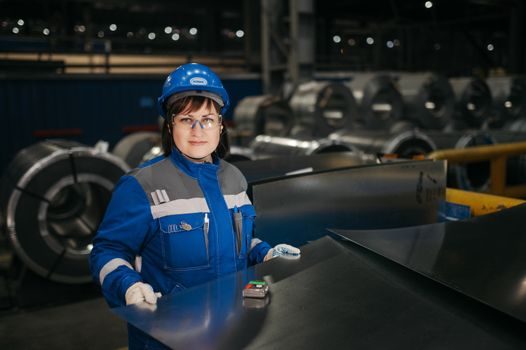
Eight simultaneous standard marks — ASTM, AISI, GB, JIS, DIN, EN, plus ISO 9001, RoHS and IBR on the higher band — is the audit trail a Western buyer should demand on every mill test certificate [S1][S2]. ISO 9001:2015 is the floor for distributor credibility [S2]; ASTM A240 / A480 governs 300-series chemical and tolerance limits, EN 10088 covers the European stainless designation, and JIS G4304 / G4305 map to the Asian equivalent grades.
Pressure-vessel and sour-service applications add a second compliance tier — ASME SA-516, NACE MR0175 for H₂S, EN 10028 for pressure purposes — none of which the US$1,000–2,200/ton commodity band implicitly carries [S1]. Where any of those codes is named on the RFQ, expect a 15–40% cost adder versus commodity plate, even before plate-vs-sheet MOQ differences are resolved. Cross-referencing the Steel Plate Buying Guide 2026 at the standards step prevents the classic mistake of quoting an A240 commodity plate into a PED/ASME enquiry.
Comparison: stainless plate vs alloy plate vs carbon plate on four decision axes
Stainless 300-series plate: cost US$1,000–2,200/ton retail, MOQ 5 tons, ASTM/AISI/JIS/EN/GB/DIN multi-mark standard pack, best for corrosion service with no sour requirement [S1]. Alloy steel plate (4140/4340 quenched-and-tempered, A514): cost tracks alloy content and Q&T premium — typically 1.5–3× carbon-steel plate on the same gauge — with 1-piece MOQ on cut pieces, best for high-strength structural and machinery parts. Carbon steel plate (A36, A516-70, SS400): the cost baseline, no corrosion resistance, best for structural and pressure-vessel shells.
Stainless 400-series (430, 420): US$1,000–2,000/ton retail band, magnetic, lower Ni content keeps price under austenitic, but welding and chloride service are weaker [S1]. For sour (H₂S) service, none of the stainless 300/400 commodity grades is qualified — NACE MR0175 / ISO 15156 names a restricted list that buyers should not assume a Made-in-China listing satisfies. Where the project sits outside corrosion-resistant commodity service, the aluminum market is a useful parallel for sourcing-spec thinking even though the alloy system is different.
Lead time, MOQ and freight — the hidden 20–35%

On top of FOB mill price, three line items routinely add 20–35% to the landed cost of a Chinese-origin plate order: ocean freight on 5–25-ton lots (volatile through 2024–2026), 5-ton MOQ-driven over-buy on small projects, and bank/LC fees on orders above US$50,000 [S1]. A steel mating plate for a punch press — 1 piece, US$17,800–85,000/set — sidesteps the MOQ tax but introduces custom-machining and crating cost in place of commodity sea-freight [S3].
For a 10-ton 304/2B order, a defensible budget is US$10,000–22,000 mill plus 18–28% landed uplift, i.e. US$12,000–28,000 DDP at a Western port, subject to 2026 freight surcharges. Domestic Chinese mill orders from an ISO 9001:2015 distributor like Metline [S2] typically come with mill test certificates and 7–15-day ex-works lead time versus 30–45 days for an export order, which is a real cash-flow lever on smaller RFQs.
Where this price band breaks down
The US$1,000–2,200/ton band is a retail/spot benchmark for commodity 300/400-series stainless plate on 30 March 2026 [S1] — it does not cover: thick plate >50 mm, Q&T alloy plate, pressure-vessel certified plate (ASME/A516), NACE MR0175 sour-service plate, duplex/super-duplex (2205/2507), or titanium-clad plate. Those segments sit on mill-negotiated contracts, not spot listings, and the price gap to commodity 304 can be 2–10×.
It also assumes a 5-ton minimum at a trading company; direct mill orders from a Baowu, TISCO or Tsingshan holding company typically move in 20–100-ton lots at contract prices 5–15% under spot. The 2-piece-sample and OEM/ODM pathway (1 piece, 5-ton MOQ mixed grades [S1]) is the right lever for prototyping but the wrong lever for serial production, which is a common error worth flagging before the first PO is cut.
Rebar bender capacity tiers are not directly relevant to plate pricing but follow the same Chinese-mill-cost pulse that drives plate moves quarter to quarter.