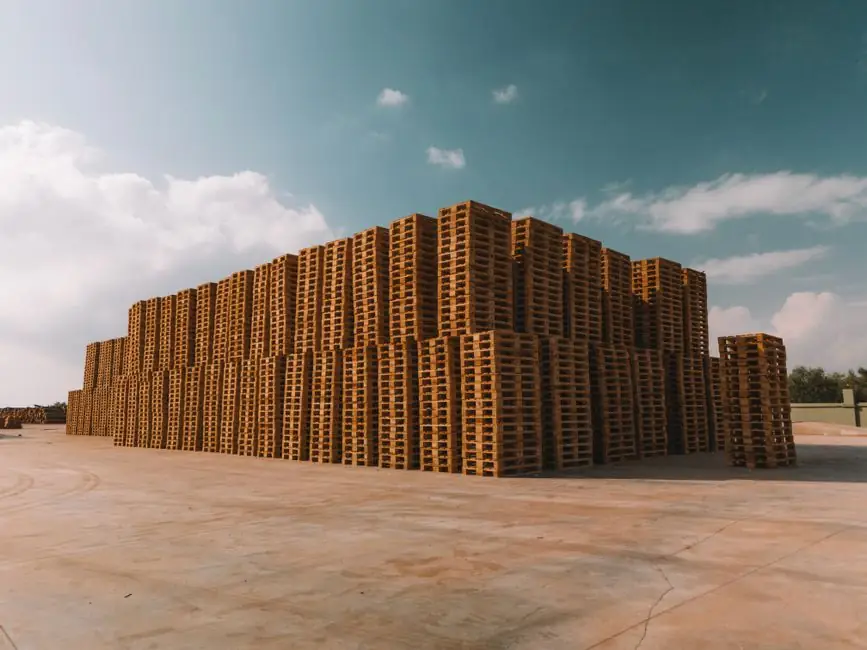
Retail backroom and dark-store operations typically need a 1000-1500 kg rated pallet stacker with 1600-3000 mm of lift, sized to a closed-bottom EUR/CHEP pallet footprint of 800 x 1200 mm and a working aisle between 2.4 m and 2.8 m, per current OEM selection guidance [S1][S2].
Stacker selection is governed by five hard inputs: load capacity (kg at a stated load center), maximum lift height (mm), minimum turning radius or aisle width (mm), pallet type (closed-bottom, open-bottom, stringer, or block), and daily throughput measured in pallets per shift [S1]. Each input narrows the machine class before any commercial comparison is made.
Machine Classes: Manual, Semi-Electric, Electric Walkie, Stand-On
Manual pallet stackers use a foot-pumped hydraulic circuit to raise forks to a fixed lift, typically 1600 mm on standard units and up to 3000 mm on long-mast versions, and remain the lowest-cost option for retail stockrooms lifting fewer than 50 pallets per shift at loads up to 1000 kg [S3][S5].
Semi-electric stackers retain manual travel but add motorized lift, which reduces operator fatigue when repetitive shelf-loading is required but travel distances stay short. Full-electric walkie stackers add motorized drive and lift, with typical Chinese-market OEM ratings at 1.0 t, 1.2 t, 1.5 t, and 2.0 t and lift heights from 1600 mm to 5500 mm depending on mast configuration (single-stage, two-stage, or three-stage) [S2]. Stand-on stackers become economic when horizontal travel per cycle exceeds roughly 30 m or when the operator runs the machine for more than 4 hours continuously [S2].
Load Capacity and Lift Height Decision Table
Stacker selection for retail distribution can be reduced to a small comparison matrix on three decision criteria: rated load, lift height, and aisle class. [S2]
Manual stacker, 1000 kg at 600 mm load center, lift to 1600-3000 mm, fits a 2.2-2.5 m aisle and suits stockroom shelf restocking at low throughput [S3][S5].
Semi-electric walkie stacker, 1000-1500 kg, lift to 2500-3500 mm, fits a 2.4-2.7 m aisle and is the typical pick for backroom-to-rack transfer in mid-volume stores [S2].
Full-electric walkie straddle stacker, 1200-1500 kg, lift to 3000-4500 mm, fits a 2.6-2.8 m aisle, and handles two-tier selective rack loading where residual capacity at full lift must stay above 800 kg [S2].
Full-electric stand-on or counterbalance stacker, 1500-2000 kg, lift to 4500-5500 mm, fits a 2.8-3.2 m aisle and is the right answer for dark-store and regional DC roles with multi-shift duty [S2].
For heavy single-pallet moves above 2000 kg, the same OEM guidance points buyers to electric forklifts or reach trucks rather than larger stackers, because residual capacity at full lift on a 2 t stacker is the limiting factor, not the rated static load [S1][S2].
Pallet Type, Aisle Width, and Floor Condition
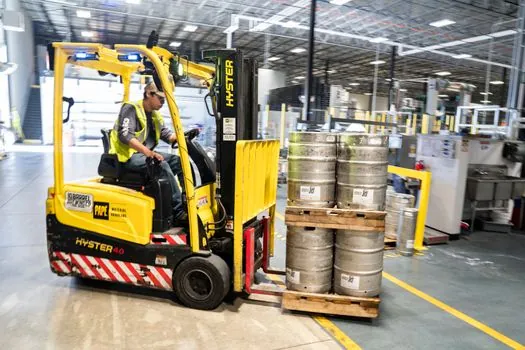
Closed-bottom EUR pallets (800 x 1200 mm, 25 mm deck height) require straddle-leg stackers with adjustable forks; open-bottom or GMA stringer pallets can be served by standard fork-bar stackers, which are typically 150-200 mm narrower overall and turn inside smaller backroom aisles [S1][S3].
Floor flatness matters as much as aisle width: a 1500 kg stacker on a 5 mm deviation over 2 m will drift under load and eat any gain from a tight aisle. Epoxy-coated retail-DC floors with documented flatness to 3 mm over 2 m are the operating envelope that the residual-capacity numbers in OEM brochures assume; a polished concrete floor that has cupped joints will force a wider aisle to keep the same margin [S2]. Plastic pallet decks also slide more on steel forks than wood, so a non-slip fork coating or wheel-loaded braking is worth specifying for grocery backrooms with high plastic-pallet share [S3].
Battery, Charging, and Daily Throughput
Chinese-market electric stackers in 2026 ship in two dominant battery formats: lead-acid at 24 V / 210-280 Ah for budget builds, and LiFePO4 at 24 V / 100-200 Ah for opportunity-charging duty, with the LiFePO4 route typically cutting wall-plug charging time from 8-10 h to 2-3 h at the same usable energy [S2].
Daily throughput is the real battery sizing rule. For multi-shift retail DC operation, LiFePO4 with a 30-40 A opportunity charger parked at the break area is the configuration that meets throughput without oversizing the battery compartment.
Safety, Standards, and Operator Training

Mandatory safety equipment on retail-spec electric stackers includes overload protection, emergency stop, lift-height limit switches, and a power-cutoff brake, all of which are listed as functional components on 2026 OEM product pages rather than optional extras [S3].
Manual stackers in the same range are expected to carry reliable hydraulic braking, an overload valve to prevent jack failure above 110% of rated load, and a safety mesh backrest on the forks when the lift exceeds 1600 mm [S3]. Walkie operation requires that the operator travel with the tiller in the trailing position at all times, which is the EN ISO 3691-1 industry pattern for pedestrian-controlled lift trucks; if a site-specific risk assessment or a union rule changes that, the resulting SOP must be filed in writing before the truck enters service. The truck itself is not in scope for IEC 60079 or ATEX unless it is specified for a flammable atmosphere, which is rare in retail dry-goods backrooms.
Vendor Landscape: China-Made, NA-Made, and In-House Brands
The Chinese OEM landscape for electric walkie and stand-on stackers in 2026 includes tier-one vendors such as Hangcha, Heli, JAC, Xilin (a Noblelift sub-brand), BYD Forklift, and Hyster-Yale's China lines, alongside mid-tier builders such as Zhongsheng (ZSTJ) that ship manual, semi-electric, and full-electric SKUs in the same body [S2][S3].
For North American retail buyers, the practical shortlist compresses to a few distributor-backed brands: Crown, Raymond, Toyota Material Handling, and Hyster-Yale, with the next tier of Jungheinrich, Linde, and Still covering European-built premium units. Sourcing rule from one current OEM guide: ask for the configuration, not the price, then compare like-for-like on mast type, battery chemistry, residual capacity at the planned lift height, and the local service footprint, because the same 1.5 t walkie SKU from two vendors can differ by 30% in price and 100% in uptime once commissioned [S2].
Selection Checklist for Retail Distribution Buyers

Before any RFQ is issued, four numbers must be on the spec sheet: peak pallet weight including pallet mass (most retail stockrooms run 400-900 kg, with occasional peaks to 1200 kg for beverages and paper), highest hook height actually used (not the headline mast height), minimum right-angle aisle stack width with the load in place, and the realistic daily shift count [S1][S4].
If peak pallet weight is at or below 1200 kg, lift is at or below 3500 mm, and aisle width is at or below 2.8 m, a 1.2-1.5 t full-electric walkie straddle stacker on a 24 V LiFePO4 pack is the most defensible retail-DC choice in 2026. If lift is at or below 1600 mm and throughput is at or below 50 pallets per shift, a 1000 kg manual stacker is the correct low-capex pick and avoids the battery and charger overhead entirely [S2][S5]. Buyers who also need to support a pallet rack structure with two-deep selective slots should add a 200 mm reach-stage or move up to a reach truck before adding mast height, since reach gives residual capacity back at full lift far more cheaply than a taller single-stage mast.
Two related spec maps worth pulling in parallel: the electronics-handling stacker spec map at /news/pallet-stacker-spec-map-for-electronics-handling-capacity-aisle-and-esd.html covers ESD-safe wheels and cleanroom-suitable decks, while the automotive load-class spec map at /news/automotive-parts-logistics-matching-pallet-stacker-to-load-class-lift-and-aisle.html is the right reference when retail parts mix into kitting flows that share the same aisle. The next trackable signal in this space is the Q4 2026 refresh of LiFePO4 24 V packs above 210 Ah in the same footprint, which would close the duty-cycle gap with the larger 48 V reach-truck platforms without forcing a wider chassis.