
PEEK (polyether ether ketone) operates at long-term service temperatures up to 250°C and tolerates short-term peaks of 310°C, placing it in the top tier of melt-processable engineering thermoplastics [S1].
Unfilled PEEK is self-extinguishing without releasing toxic or corrosive combustion gases, and its biocompatibility opens medical-implant use cases — but the same polymer carries a per-kilogram price several multiples above PA66, POM, or PPS, which gates every spec decision [S1].
Mechanical and Thermal Performance Bands
PEEK retains useful mechanical strength and stiffness at elevated temperature, with the polymer showing good impact strength even when continuous service sits near 250°C [S1]. The glass-transition temperature sits around 143°C and the melting point around 343°C, which is why molders need heated tools rated to 370–400°C rather than the 200–280°C windows used for commodity resins.
Dimensional stability holds across a wide temperature band and is largely insensitive to humidity swings, a behavior that makes PEEK attractive for tight-tolerance pressure transmitter sensor bodies and for valve seats that must seal against industrial valve trim without creep-induced drift [S1].
Chemical Resistance and Tribology
PEEK resists a wide range of organic and inorganic chemicals including oils, acids, solvents, and water vapor, which is the underlying reason it is specified for compressor piston rings, pump wear rings, and seal back-up rings in hydrocarbon service [S1]. Its self-lubricating wear behavior lets it run as a bearing or seal material against metal counterparts without continuous grease supply.
The chemical map has edges: PEEK reacts with some acids and concentrated bases, and designers must check compatibility against the specific media and concentration before locking a PEEK part into a process skid. Steam and hot water above 250°C will also hydrolyze the polymer over time, which matters more for sterilizable medical parts than for dry-service industrial components.
Moisture, Electrical, and Processing Trade-Offs
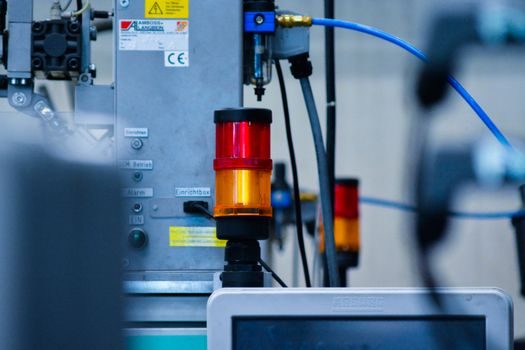
PEEK absorbs small amounts of water, and that pickup shifts both dielectric loss and modulus in high-humidity environments — a known design risk for electrical insulation around pressure sensor housings and for PLC backplane insulators that sit in washdown-rated cabinets [S1]. The absorption is far lower than polyamide, but it is not zero, and datasheets for insulation grades should still be checked at the actual service RH.
Processing demands a melt temperature near 343°C, a mold surface above 170°C to crystallize the part correctly, and drying of the resin at 150°C for 3+ hours before molding — sequence steps that generic injection machines cannot deliver without barrel and heater upgrades [S1]. For thin-wall or long-flow parts, molders typically hold melt between 360 and 380°C and tool temperature at 170–200°C to hit target crystallinity above 30%.
Cost, Recyclability, and Fit-for-Duty Logic
PEEK unit cost is several multiples higher than PA66, POM, and PPS, and that price gap is the single most common reason a design review demotes PEEK to PPS, PEI, or PPA on cost-driven programs [S1]. Recycled PEEK is technically re-processable, but the high resin value and tight application windows make closed-loop reclamation less common than with commodity plastics, so most end-of-life PEEK parts exit as machining swarf or post-industrial regrind.
Fit-for-duty logic is straightforward: PEEK earns its slot where service temperature is above 150°C, where metal-to-plastic wear is required without external lubrication, where flame and outgassing behavior must pass a defined standard, or where biocompatibility is a contractual requirement. It loses to lower-cost thermoplastics on any part larger than a few hundred grams in benign ambient service, on any geometry that does not justify the 343°C melt processing cost, and on any acid/bases exposure above its compatibility envelope [S1].
Material Comparison at a Glance

Lining the main engineering thermoplastics against four decision criteria makes the choice auditable: PEEK scores highest on continuous service temperature (250°C) and on flame/outgassing behavior (self-extinguishing, low smoke), mid-pack on chemical resistance (loses to PTFE against strong acids), and worst on raw-material cost versus PA66, POM, and PPS [S1]. PPS runs cheaper with chemical resistance close to PEEK in non-oxidizing media, but tops out near 200–220°C continuous; PEI sits between, with UL V-0 rating and a 170°C glass transition, and is the usual downgrade when PEEK temperature margin is over-specified.
For wear surfaces, PEEK composites filled with carbon fiber, graphite, or PTFE push the dynamic coefficient of friction toward 0.10–0.20 against hardened steel, which is the operating band spec writers use for unlubricated bearings and thrust washers in servo motor gearheads. The comparison is not a marketing checklist — it is a triage against whether the operating envelope actually demands the upper temperature and wear band, because once the answer is yes, the per-part cost penalty of PEEK becomes a line item, not a blocker.
Limits and Failure Modes to Watch
PEEK's known failure modes cluster around five areas: attack by some acids and bases, hydrolysis in steam above 250°C, UV-driven embrittlement in outdoor service without stabilizers, the cost-driven over-specification trap, and the processing window that punishes under-heated tooling with amorphous parts that distort above 143°C [S1]. Each one is checkable at the design stage with a chemical compatibility chart, a steam-aging test, a UV-stabilized grade, a cost-down review against PPS/PEI, and a crystallinity audit on the molded part.
Specifying PEEK is a positive statement about the operating envelope; the engineering question is always whether the envelope actually needs what PEEK delivers. Where temperature, wear, flame, and biocompatibility requirements are concrete and validated, the polymer is hard to displace; where they are inherited assumptions, the same part usually runs cooler, longer, and cheaper in PPS or PEI. For a parallel spec-driven take on cost-vs-envelope trade-offs in adjacent components, see the manual pallet jack fit-for-duty breakdown and the polycarbonate 30-year TCO line-item map.