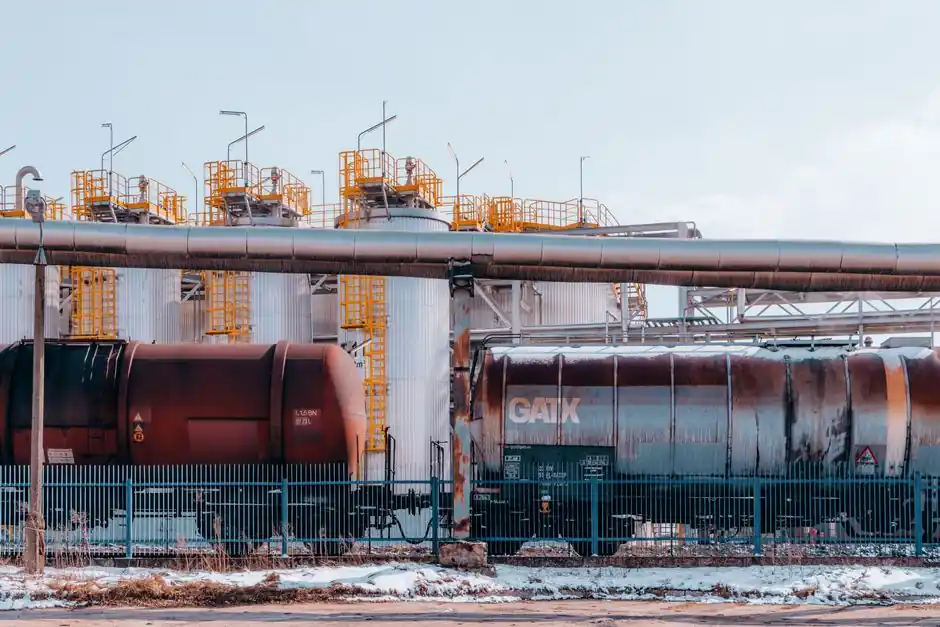
For upstream and midstream oil and gas, unreinforced PEEK runs continuously at 260°C and tolerates short-term peaks above 300°C, withstanding static pressures up to 207 MPa without losing dimensional stability [S2].
The relevant property envelope is unusually wide for a thermoplastic: density 1.3–1.4 g/cm³ (roughly 80% lighter than steel and 40–50% lighter than aluminum), inherent self-lubrication, and verified resistance to crude oil, hydrocarbons, supercritical CO₂, and H₂S-bearing sour fluids [S2].
For reciprocating compressor piston, rider, and packing rings, PEEK is specified to operate continuously at 250°C, with reciprocating-component mass reductions near 50% versus metal, cutting subsea buoyancy and handling loads [S2].
Grade matrix: pure, CF30, GF30, bearing-grade
Four production grades cover the majority of oil and gas applications. Pure PEEK (no additives) is the most widely used baseline and offers the best biocompatibility and balanced mechanicals [S3].
CF30 PEEK (PEEK + 30 wt% carbon fiber) gives the highest strength and the lowest coefficient of thermal expansion among the four grades, and is mainly applied in load-bearing structural components and parts requiring tight dimensional stability [S3].
GF30 PEEK (PEEK + 30 wt% glass fiber) raises strength at a lower cost than the carbon-filled grade, and is the workhorse for static structural housings, insulators, and connector bodies where stiffness matters more than the lowest CTE [S3].
Bearing-grade PEEK is a tribology compound filled with roughly 10% carbon fiber, 10% PTFE, and 10% graphite, and is the default for oil seals, wear rings, bearing cages, and valve seats that must run dry or marginally lubricated [S2][S3].
When choosing between them, the working criteria line up as follows (pure / CF30 / GF30 / bearing-grade): maximum strength and stiffness, CF30 and GF30 both exceed pure, with CF30 highest; lowest thermal expansion, CF30; lowest cost at given strength, GF30; best dry-running wear, bearing-grade.
Sour-service chemistry: H₂S, CO₂, brine, RGD
PEEK shows no cracking or whitening in non-oxidizing acid and low-pH immersion tests, and resists chemical degradation in H₂S-bearing sour environments [S2].
In salt spray and brine immersion, PEEK shows no pitting, corrosion, or degradation, which is why it is specified for offshore platforms and subsea equipment [S2].
Rapid gas decompression (RGD) is the killer of many elastomers in CO₂-rich downhole service. PEEK exposed to supercritical CO₂ and decompression cycling shows stable microstructure and chemistry with only minor crystallinity changes, demonstrating good RGD resistance [S2].
The chemistry picture is straightforward: crude oil, hydrocarbons, CO₂, and H₂S leave mechanical and electrical properties stable after immersion, and NACE MR0175 sour-service environments are within the material's published envelope [S2].
Mechanical and thermal envelope vs. metals

PEEK maintains high stiffness at elevated temperature, with tensile, compressive, and creep performance suitable for high-pressure back-up rings and seal bodies; reinforced grades push load capability higher when needed [S2].
Compared to steel, PEEK is roughly 80% lighter; compared to aluminum, 40–50% lighter, and reciprocating components built from PEEK cut moving mass by about 50%, which directly reduces inertial load, vibration, and subsea buoyancy requirements [S2].
Toughness is the third leg of the case: PEEK exhibits high fracture toughness and impact resistance, resisting brittle failure in the complex stress states that occur downhole, where combined hydrostatic, thermal, and impact loads punish stiffer, more brittle polymers [S2].
Typical oil and gas components specified in PEEK
The current oilfield catalog of PEEK parts spans seals, downhole hardware, and electrical components. Standard seal items include shaft-end combination seals, balancing disc seals, wear rings, plain bearings, labyrinth seals, gear pump seal strips, check-valve seals, ball-valve seats, flanged bearings, composite seals, insulating rings, and water-sealing rings [S3].
Downhole parts regularly machined or molded from PEEK include connectors, check rings, centralizers, wear rings, cable ties, and frac balls, while electrical/electronic items include electrical connectors, insulating couplings, coil bobbins, resin packing rings, solenoid valve parts, support frames, connecting nuts, locking nuts, and contact pins [S3].
For pumps, valves, and reciprocating compressors, PEEK is specified into piston rings, rider rings, packing rings, valve discs, flat gaskets, thrust plates, bearing cages, suction-side seals, and gear components, where the same polymer replaces multiple legacy parts [S2][S3].
Selection criteria and decision flow

Start with the service fluid. For sour H₂S, CO₂, and brine service in downhole or subsea locations, PEEK (any grade) is on the short list; confirm rapid-decompression cycling is within the supplier's test envelope before locking the design [S2].
Next, fix the temperature and pressure rating. Continuous service above 250°C or static pressure approaching 100 MPa points to reinforced grades (CF30 or GF30); continuous 250°C reciprocating service in compressors is documented for PEEK packing rings [S2].
Then choose the grade by the dominant loading mode: CF30 for high load and lowest thermal expansion, GF30 for cost-efficient stiffness, bearing-grade (CF/PTFE/graphite) for dry or marginal-lubrication wear parts such as oil seals, wear rings, and gas detector moving internals [S2][S3].
Form factor follows from there. PEEK is readily available as rods, sheets, tubes, film, filaments, and capillary tubing, and is processed by injection molding, compression molding, 3D printing, and CNC machining, which means prototype geometries and production runs share the same base resin [S3].
Limits, failure modes, and what PEEK is not for
PEEK is not a universal substitute for metal. At very high pressure combined with sharp notches, even reinforced PEEK will creep; the published 207 MPa ceiling is the upper limit of the tested envelope, not a routine design stress, and continuous design stresses should sit well below it [S2].
Oxidizing acids and strong halogens attack PEEK the way they attack most engineering thermoplastics; it is rated for non-oxidizing acids, not for concentrated nitric or mixed acid systems, so material selection in those services should pivot to fluoropolymers or metal [S2].
PEEK's RGD resistance is good, not absolute: under supercritical CO₂ cycling, only minor crystallinity changes are observed, but for the most severe decompression transients the elastomeric backup ring and the PEEK body should be qualified together rather than separately [S2].
Where the design needs optical transparency, low outgassing in vacuum, or resistance to high-energy radiation beyond polymer norms, PEEK is the wrong family; reach for polyimide or thermoset PI instead, both of which are produced as sheet, rod, tube, film, and machined parts by the same Chinese suppliers [S3].
Selection works best when PEEK is paired with the right gas detection and process gas analyzer instruments, so the actual H₂S and CO₂ partial pressures seen by the polymer are measured rather than assumed, and the lighting equipment and electric lamps used in hazardous areas are matched to the same zone classification as the polymer service.
Track two signals in 2026: published RGD test data on reinforced grades (CF30, bearing-grade) under supercritical CO₂, and expanding Chinese-machined PEEK part SKUs for subsea connectors and frac balls, which together set the practical floor on cost and the practical ceiling on qualification for new oil and gas builds [S2][S3].
Background reading: Degassing & refining unit selection for pump and valve foundries: a spec-first guide.