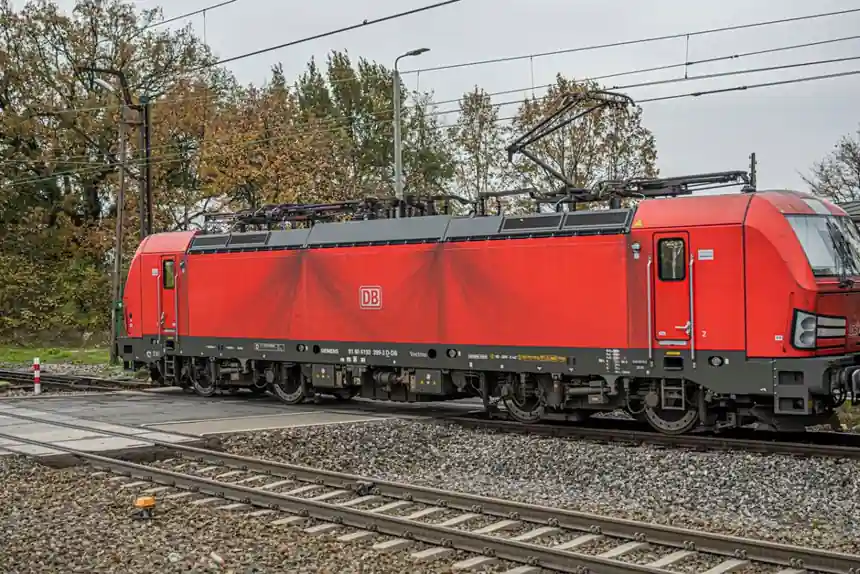
PEEK operates continuously from -40°C to 260°C, maintains dimensional stability at short-term peaks up to 300°C, and meets UL 94 V-0 without added flame retardants, which is why ZYPEEK, ENSINGER and Victrex all target bearing cages, seals, magnet wire insulation and brake components for rail transit applications [S1][S2].
Non-enhanced PEEK delivers an elastic modulus of 3.6 GPa, well above general engineering plastics, and glass- or carbon-fibre-reinforced grades push stiffness close to light alloys while cutting mass, an exchange rail OEMs are using to hit lightweighting and energy-efficiency targets on new EMU, metro and high-speed stock [S1].
What PEEK is, and where it sits in the rail polymer stack
PEEK belongs to the polyaryletherketone (PAEK) family, with a melting point near 343°C and a continuous service temperature of 260°C, putting it at the top of the high-performance polymer (HPP) range for rail use, well above PPS (200-240°C) and PEI Ultem 1000 (~217°C glass transition) [S2][S3].
Unfilled PEEK 450G holds a tensile strength of about 98 MPa, resists acids, hydrocarbons, steam and most rail lubricants, and hydrolyses far less than PA66 or POM, which is why it is specified where PA66 fails in hot, wet underfloor compartments [S1][S3].
For a baseline reading of how PEEK is graded against PPS, PEI and PAI on pressure, thermal range and creep, the high-performance polymer selection page in the SourceBySpec encyclopedia is a useful reference: high-performance polymer.
Where PEEK earns its place on a rail vehicle
Rail applications break into four duty zones, and PEEK is specified differently in each one. In bearings and gear cages, the priority is creep resistance at sustained load combined with a low coefficient of friction; in seals and valve seats, the priority is chemical resistance to synthetic ester oils and Skydrol-type hydraulic fluids at 120-180°C; in brake-system components, the priority is thermal stability plus inherent flame retardancy; and in magnet wire and slot insulation, the priority is dielectric strength at high frequency [S1][S2].
ZYPEEK explicitly lists bearing cages, seals, brake system components and lightweight structural parts as core rail transit applications, and lists elastic modulus 3.6 GPa, continuous -40°C to 260°C service, short-term tolerance to 300°C, and UL 94 V-0 self-extinguishing behaviour as the supporting property set [S1].
Where a polymer must be selected for sliding motion under load, the trade-off between metal-reinforced and self-lubricating grades is similar to the logic used in pillow block bearing selection for automotive production lines, where reinforced-polymer and metal variants are picked by load case rather than by default.
PEEK grades compared: which grade matches which rail job

The four grades a rail specifier will actually evaluate are unfilled PEEK (450G), glass-fibre-reinforced (typically GF30), carbon-fibre-reinforced (CF30), and bearing/wear-modified grades such as PEEK + PTFE + graphite or PEEK + carbon fibre + graphite + PTFE [S1][S3].
On stiffness, unreinforced PEEK 450G sits near 3.6 GPa elastic modulus, while 30% glass-fibre or carbon-fibre grades can roughly double or triple that figure, bringing polymer stiffness into the range of die-cast aluminium, which is the value proposition behind rail underframe and bogie bracket metal replacement [S1].
On tribology, wear-modified PEEK grades (PTFE, graphite, carbon-fibre additions) cut the dynamic coefficient of friction and extend wear life over plain PEEK in dry-running bearing cages, where grease starvation at axlebox temperatures above 120°C is a known failure mode [S1].
On fire safety, unfilled PEEK already meets UL 94 V-0 at thin sections and produces the lowest smoke emission of the engineering plastics commonly compared for rail, which is why PEEK is preferred over PA66, POM and PPS for interior and underfloor parts that fall under EN 45545 hazard levels 2 or 3 [S1][S2].
Selection criteria and EN 45545-style decision logic
Six variables drive the grade choice on a rail vehicle: peak continuous service temperature, peak short-term temperature, mechanical load profile (static vs cyclic), chemical exposure (oil, Skydrol, cleaning agents), flame-smoke-toxicity (FST) requirement under EN 45545, and process route (injection moulding vs extrusion vs additive manufacturing) [S1][S2][S3].
A 260°C continuous service ceiling, combined with UL 94 V-0 self-extinguishing behaviour and the lowest smoke emission in the engineering-plastic set, makes PEEK a default candidate whenever EN 45545-2 R1 (interior) or R7 (underfloor/exterior) hazard level 2 or 3 is specified, and OEMs routinely pair this with glass-fibre reinforcement to recover stiffness lost when walls are thinned for weight reduction [S1].
For parts that carry sensor signal lines, PEEK's stable dielectric properties across a wide temperature range are also relevant to pressure transmitter manifolds and pressure sensor housings on brake and hydraulic lines, where polymer-metal hybrid interfaces must survive thermal cycling.
Additive manufacturing of PEEK for rail spare parts and tooling
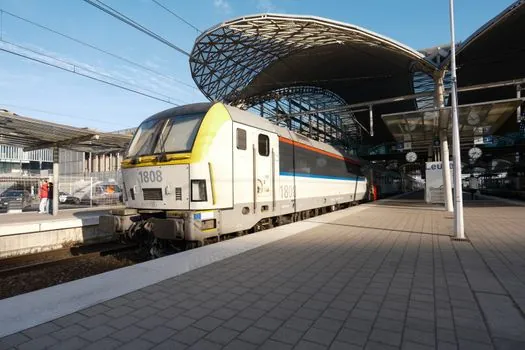
BigRep publishes the practical note that PEEK, PEKK and ULTEM are the print-window high-temperature polymers, and that railway, aerospace, defence and goods transport are high-risk environments where AM-grade PEEK is now specified for low-volume spare parts, jigs and fixtures [S2].
For rail, the practical implication is that an AM-printed PEEK bracket, clip or sensor housing can match injection-moulded PEEK on thermal and chemical behaviour, while letting the workshop skip the hard-tooling lead time that drives 8-14 week spare-part bottlenecks on legacy fleets [S2].
This echoes the same metal-replacement logic used in PEEK selection for automotive manufacturing: a 2026 spec-first guide, where the grade and process decision are made together rather than sequentially.
Limits, failure modes and when NOT to pick PEEK
PEEK loses to PPS on raw material cost, loses to PTFE on coefficient of friction in plain unlubricated seals, and loses to PAI (Torlon) on compressive creep at sustained high load above 200°C, so it is not a universal default [S3].
Three failure modes are rail-specific: UV-driven surface embrittlement on exterior fairings if no carbon-black or UV-stabilised grade is specified, galvanic-style interface stress where PEEK is over-moulded onto aluminium without a compliant interlayer, and steam-pressure blistering on underfloor seals if the part is exposed to repeated pressure-wash cycles above 150°C [S1][S3].
For flow control on brake and pneumatic lines, PEEK seats are often paired with metal industrial valve bodies, and the same thermal-headroom argument used for PEEK is also why flow meter and PLC I/O choices near the bogie lean on the high-temperature end of the polymer and electronics range.
Sourcing, standards and verification before you specify
Before locking a PEEK grade into a rail bill of materials, the specifier should validate four things: a manufacturer datasheet with tensile, flexural and compressive data at the actual service temperature (not just at 23°C); a confirmation of UL 94 V-0 rating at the production wall thickness; an EN 45545-2 test report at the relevant hazard level; and a manufacturing partner who can hold tight tolerances on production-volume moulding rather than prototyping-only [S1][S2][S3].
Cross-check the grade's data against the high-performance polymer selection notes in the encyclopedia and against a published rail-grade PEEK datasheet (for example, Victrex 450G or ENSINGER TECAPEEK), then map the chosen grade to the relevant EN 45545-2 requirement set for the part's R-number and hazard level before signing the drawing [S1][S3].
Trackable signals over the next 6-12 months: new EN 45545-2 test data on carbon-fibre-reinforced PEEK at 1.5-3.0 mm wall thickness, and updated OEM qualification lists from at least two European rolling-stock builders adding AM-printed PEEK to their approved spares catalogues [S2].