PEEK (polyetheretherketone) sourcing in mid-2026 splits cleanly into four supply-format tiers on Chinese B2B portals: raw resin and compounds, semi-finished stock shapes (rod/sheet/tube), precision CNC-machined parts, and finished fluid-handling consumables such as PEEK inline microfilters and fingertight unions [S1][S2][S6].
Supplier concentration sits overwhelmingly in Guangdong (Dongguan, Guangzhou) and Shandong, with Jiangsu (Shanghai-area tel code 021) serving as the entry point for Western-brand chromatography-grade PEEK consumables via the Merck Sigma-Aldrich channel [S5][S6]. Reference catalog data from made-in-china.com lists PEEK ball pricing in a US$ 0.03–0.05 per-piece band at MOQ 10 pieces from Diamond Member audited suppliers, a useful floor for low-precision commodity PEEK parts [S3].
Resin and Compound Suppliers
Resin-level PEEK supply on Alibaba mid-2026 is dominated by Mainland-China factories bundling PEEK raw material with downstream rod, sheet, tube and PEEK-jacketed cable output, with one such Main Products listing tagged at an 87.5% match rate on the Alibaba PEEK-applications search page [S5].
Practically, this means a buyer asking for "PEEK resin" is normally quoted against a five-line SKU set: unfilled natural (typically beige/tan) PEEK, glass-filled, carbon-filled, bearing-grade (PTFE/graphite filled) and pigmented black — the same five grades that downstream Guangdong stock-shape extruders keep on the rack [S5]. CB Index style supplier directories also list PEEK under CAS 29658-26-8-style catalog entries with dedicated Recommend Suppliers panels, though mid-2026 directory pages on ChemicalBook show the resin Product Name field populated while leaving CAS/MF/EINECS blank for many Chinese distributor records [S2].
Stock Shape: Rod, Sheet, Tube and Cable
Stock-shape supply clusters around UHMW-PE, MC Nylon, POM, PTFE, PEEK, PPS, PU, ABS and PVDF as the standard high-performance thermoplastics carried by Guangdong trading-company exporters, with "Natural Color PEEK Rod" and "Customized Size Resistant to Chemicals" appearing as the explicit sub-category copy on these listings [S1].
For a sourcing engineer, the key spec on a PEEK rod RFQ is diameter range (commonly stocked 6–100 mm), length (1000 mm or 3000 mm), and grade (Virgin natural vs. 30% glass-filled vs. bearing-grade). ChemicalBook's mid-2026 Recommend Suppliers panel for Polyetheretherketone (PEEK) lists Chinese distributors with a CB Index of 50 for the generic resin entry, indicating the directory's confidence scoring for resin-side vendors [S2].
CNC-Machined PEEK Components
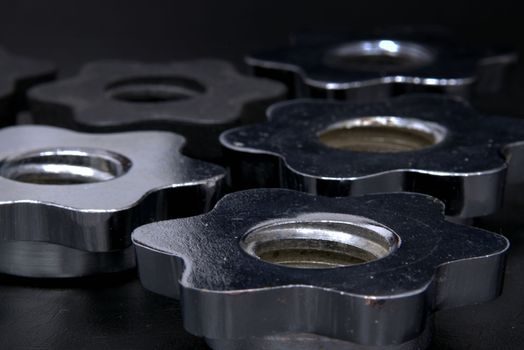
Custom CNC-machined PEEK parts — manifolds, gears, medical and semiconductor fixtures — are quoted by Guangdong manufacturers that bundle the polymer work with mainstream metal and plastic machining, with PEEK, POM, PVC and acrylic appearing together in the same "High Quality Precision Custom CNC Machining" product line [S1].
PEEK's machining behavior is the reason it sits in a precision-machining shop rather than a molding shop: it is a semi-crystalline thermoplastic with a glass transition around 143 °C and a melting point near 343 °C, so machined parts hold tolerance without the warpage that injection-molded glass-filled PEEK shows across the 140–160 °C band. When a buyer is comparing a PEEK hydraulic manifold to an aluminum or brass equivalent, the trade is roughly +5–10× material cost for a 60–70% weight saving and chemical resistance to hydrocarbons, acids and steam that metals cannot match.
Finished Consumables: Microfilters and Unions
Finished PEEK consumables show up in the ChemicalBook mid-2026 catalog as "PEEK Inline Microfilter" and "PEEK MICROTIGHT UNION" — both 100% PEEK wetted-path items targeted at HPLC, IC and bioreactor sampling lines [S4][S6].
The 2026 PEEK Inline Microfilter supplier list is bifurcated: a Western-brand channel via Merck (tel 021-61415566, [email protected]) at CB Index 80, and a parallel China-domestic channel at CB Index 58, indicating two distinct price/quality tiers for the same part number [S6]. The PEEK MICROTIGHT UNION entry sits on a separate Recommend Suppliers page and is similarly tagged to Chinese specialty distributors rather than resin producers [S4].
Price Bands and MOQ Floors

Trade-portal pricing in May–June 2026 sets a transparent floor for commodity PEEK parts: PEEK balls at US$ 0.03–0.05 per piece at MOQ 10 pieces from an Audited Diamond Member on made-in-china.com [S3].
Stepping up the value chain, CNC-machined PEEK components in Guangdong are typically quoted against a per-part or per-batch tooling amortisation model rather than per-gram resin pricing, and finished PEEK inline microfilters carry a 1EA pack structure with no public MOQ floor in the ChemicalBook listing [S1][S6]. For a buyer mapping total landed cost, the practical rule is: resin is priced in RMB/kg, stock shape in RMB/m of rod or RMB/m² of sheet, machined parts in RMB/piece against a drawing, and consumables in RMB/EA with a packaging multiple — mixing these four quoting conventions in one RFQ is the most common error when sourcing PEEK from China for the first time.
Comparison: Supply Format vs. Decision Criteria
Four PEEK supply formats line up against four buyer decision criteria: resin is the right pick when the buyer owns a molding or compounding line and needs material certification; stock shape (rod/sheet/tube) wins on lead time and minimum order value for prototype or low-volume machined parts; CNC-machined PEEK components fit when the buyer has a drawing but no in-house machining; finished PEEK microfilters and unions are the answer for analytical and bioprocess fluid paths where biocompatibility and chemical inertness matter more than mechanical performance. [S1]
Compared against the related engineering-plastics chain — UHMW-PE, POM (acetal homopolymer and copolymer), PTFE, PPS, PVDF — PEEK is the top-of-stack option for continuous service above 200 °C and for exposure to steam, hydrocarbons and most acids, with POM homopolymer vs. copolymer sitting one tier below in temperature and chemical envelope and PTFE sitting above in chemical resistance but below in mechanical strength and melt processability.
Selection, Limits and Sourcing Levers

PEEK is the right pick for pressure transmitter and flow meter wetted parts, semiconductor wafer-handling fixtures, aerospace brackets, medical implant trials and HPLC/IC fluid lines; it is the wrong pick for high-volume commodity housings (use POM or ABS), for strong mineral acid service above 50% concentration at room temperature (use PTFE or PVDF), and for any application needing transparent optics (PEEK is opaque natural-beige). [S2]
Trackable signals for the next sourcing cycle: (1) whether Guangdong CNC shops expand PEEK capacity to bundle with their existing UHMW-PE and POM lines already listed in 2026 catalogs [S1]; (2) whether ChemicalBook's PEEK resin records get CAS numbers filled in for the Chinese distributor entries that currently show "Information Error Report" placeholders [S2]; and (3) whether the Alibaba 87.5%-match PEEK raw-material-and-stock-shape supplier cluster on the PEEK-applications search page consolidates or fragments as 2026 trade-portal audits run [S5].