
PV OEM and ODM sit at opposite ends of the IP-control axis: an OEM builds exactly to the buyer's locked bill of materials, while an ODM ships a pre-engineered module the buyer rebrands, with only skin-deep changes [S8].
The trade-off is concrete — a buyer who needs a custom cell string, a specific backsheet, or a proprietary junction box must stay in the OEM lane; a buyer who can absorb a reference 144-half-cut mono-PERC or TOPCon design with a label swap wins on time-to-market and amortised tooling [S2][S8].
Definition and Scope of PV OEM vs ODM
OEM in PV means the manufacturer produces cells, laminates, or finished modules strictly to the buyer's drawings, BOM, and test plan; design IP stays with the buyer, and the factory executes a process-of-record it does not own [S8]. Enlog's PV-materials positioning — supplying encapsulant, backsheet and frame consumables to module makers under buyer-defined specs — sits squarely inside the OEM procurement workflow [S2].
ODM in PV means the factory contributes a turnkey reference module design (electrical architecture, BOM, encapsulation recipe) and the buyer re-labels it; the ODM retains the underlying design IP and amortises it across multiple white-label customers [S8]. Both modes coexist in Chinese module hubs (Zhejiang, Jiangsu, Anhui, Guangdong) where the R&D-capacity filter on sourcing portals routinely lists both "OEM" and "ODM" against the same legal entity [S1][S5][S6].
Selection Criteria: Who the Model Is For
OEM fits integrators and EPCs that own cell supplier approval, want proprietary cell string layouts, or need to lock the IEC 61215 / IEC 61730 / UL 61730 certificate in their own name — the factory's nameplate is hidden behind the buyer's brand and warranty [S2][S8].
ODM fits distributors, project developers, and trading houses launching a private-label module line without a cell R&D team; the ODM's pre-certified reference design removes 12–18 months of certification queue, and the buyer accepts that the same chassis may ship to a competitor under a different label [S8].
Criteria-Based Comparison: OEM vs ODM for PV Modules

Three decision axes separate the two models, and the axis values are not interchangeable. On IP ownership, OEM = buyer; ODM = factory, with the buyer receiving a non-exclusive label licence [S8]. On certification lead-time, OEM requires the buyer to re-run IEC 61215 and UL 61730 against the factory's BOM (a 4–8 month queue per SKU), while ODM reuses the factory's existing certificate with a label update only [S2]. On encapsulation-stack flexibility — encapsulant (EVA / POE / EPE), backsheet (TPT / TPE / glass), frame (anodised Al 6005-T5 / 6063-T5) — OEM lets the buyer swap any layer; ODM typically locks the stack and offers only cosmetic or connector changes [S2].
On minimum order quantity and tooling amortisation, ODM wins because the factory's existing jigs, layup tables, and laminator recipes are already paid for; OEM tooling — custom stringers, framing dies, junction-box fixtures — is a buyer-borne NRE that only amortises above multi-MW runs [S1][S6][S8].
Use Cases in Photovoltaic Manufacturing
Utility-scale EPCs tendering 100 MW+ blocks almost always run OEM: they specify cell supplier (e.g. mono-PERC or n-type TOPCon wafer source), encapsulant grade, junction-box diode rating, and frame profile, and they require the IEC 61215 / IEC 61730 certificate to be issued in the EPC's name [S2].
Distributors and project developers chasing residential or small-commercial rooftops increasingly run ODM: a reference 410 W half-cut mono-PERC module with a factory-held TUV / UL certificate can be re-labelled and shipped inside a quarter, which is why B&C Lighting's adjacent lighting ODM flow — design-to-finished under one roof, including on-site UL / TUV lab testing — is the structural template many PV ODMs copy [S3]. The cross-over break-even is roughly at 30–50 MW of annual buy volume: above that, OEM NRE amortises; below it, ODM's shared tooling wins [S8].
Limits, Failure Modes, and Common Pitfalls
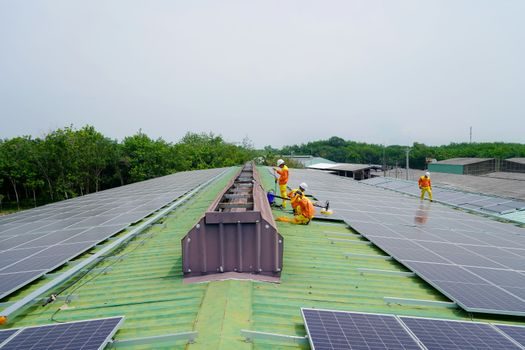
OEM failure modes cluster around the cell-supplier audit — if the buyer's incoming-cell inspection regime is weak, the factory can substitute a lower-efficiency bin without the buyer's QA catching it until field IV-curve traces diverge. The audit depth (bin class, EL defect rate, light-induced degradation budget) is the actual OEM spec, not the contract clause [S2].
ODM failure modes cluster around shared design risk — if the ODM's reference module has a field failure (PID, backsheet yellowing, hotspot), every buyer's private label is exposed simultaneously, and warranty recovery depends on the ODM's financial standing, not the buyer's. Buyers running ODM should demand the ODM disclose all sister-label customers and require a written change-control on the BOM [S8].
Sourcing Signals and Standards to Lock
The decision tree closes on three verifiable artefacts. First, the certificate: IEC 61215-1:2021 (design qualification) and IEC 61730-1/-2:2016 (safety) for IEC markets; UL 61730-1/-2:2017 for North America — the certificate holder's legal name must match the buyer's brand, or it is ODM, not OEM [S2]. Second, the encapsulation-stack declaration: encapsulant chemistry (EVA vs POE vs EPE), backsheet chemistry, and frame alloy/temper must be on the datasheet, not just "as per customer request" [S2]. Third, the supply-chain footprint: an OEM factory with audited sub-tier cell and wafer suppliers in Zhejiang / Jiangsu / Anhui / Guangdong clusters is a stronger OEM partner than a trading desk that sub-contracts the lamination step — the latter is effectively an ODM in OEM clothing [S1][S5][S6].
For a deeper read on how the wafer, encapsulant, and backsheet layers feed the module cost stack, the PV module cost stack breakdown maps the same BOM lines this decision tree depends on.
For the relevant spec sheets and selection criteria, see additive manufacturing material, pressure transmitter, and flow meter.