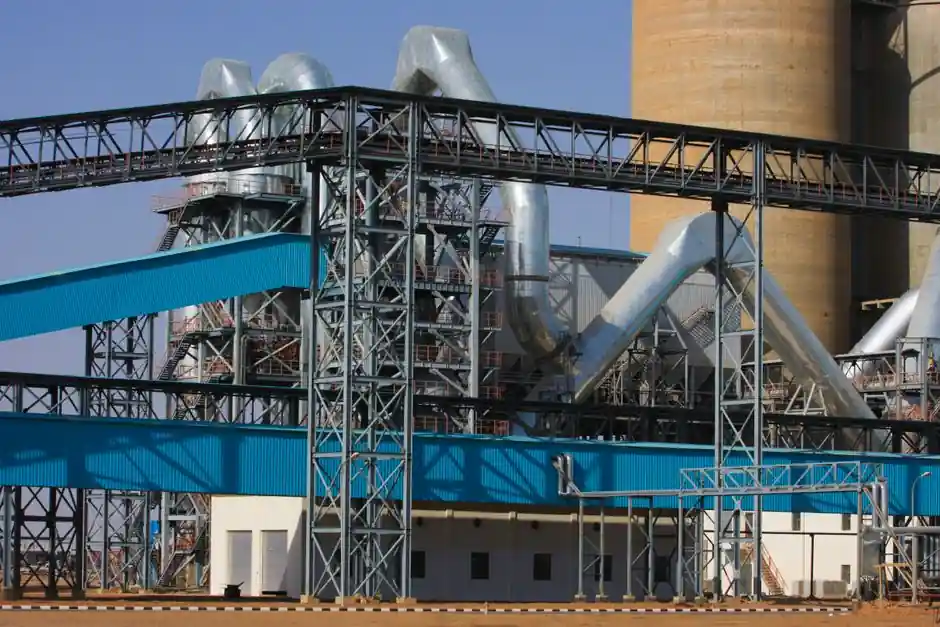
Pipe conveyors can negotiate horizontal and vertical curves designed into the project layout, bypassing obstacles without intermediate transfer points, whereas traditional open belts are generally limited to straight or gently curved routes unless transfer stations are added [S1].
For curved bulk-material routes, the practical divide in 2026 is enclosure and route flexibility against raw mass-flow capacity, and the trade-off now sits inside a single decision matrix that engineers can run from layout, material, and throughput data alone [S1][S2].
What Each System Actually Is
A pipe conveyor wraps the belt into a tubular cross-section using hexagonal idler stations, holding the material inside from the loading point to discharge, while the same belt returns to flat form on the empty run [S5]. The cross-section is round or oval, never an open trough [S5].
A troughed belt conveyor arches the belt sides up to a defined trough angle, typically around 30 degrees, on a line of carrying idlers, and among all belt conveyor types it enables the highest mass flow on straight or gently inclined runs [S4]. It is the reference baseline that all enclosed or specialty belt systems are measured against [S4][S5].
Routing and Curve Capability
Pipe conveyors can follow both horizontal and vertical curves on a single drive string, which removes transfer towers where a conventional open belt would need a directional change [S1][S2]. Reported minimum curve radii reach about 45 m depending on the closed-belt diameter, which is the limit that governs tight terrain and urban right-of-way [S5].
Standard open troughed belts are limited to straight or gently curved routes unless transfer stations are added, but a horizontal-curve troughed design is a separate engineered variant that can also eliminate transfer towers on certain alignments [S1][S3]. A horizontal-curve troughed run keeps the high mass-flow advantage of an open belt while gaining some of the layout flexibility of a pipe system, though with different radius and tensioning constraints [S3].
For an engineer choosing between the two on a curved alignment, the practical test is whether the route can be solved with radii in the tens-of-meters range and a continuous string, which is pipe-conveyor territory, or whether the curves are gentle enough for a horizontal-curve troughed design at higher mass flow [S3][S5].
Throughput, Belt Width, and Energy
A pipe conveyor generally needs about 1.6 times the belt width of a 30 degree troughed belt to deliver the same mass flow at the same belt speed, because the closed cross-section packs less material per unit width than an open trough [S5]. That width penalty is the dominant cost driver on long, high-tonnage curved routes [S5].
On the energy side, the higher drag of the closed belt running through hexagonal idler stations pushes power draw above a comparable troughed belt of the same capacity, which is one of the trade-offs that offsets the savings from eliminated transfer towers [S5].
Open troughed belts, by contrast, are sized primarily for mass flow and length, with the troughed idler geometry giving the best volumetric efficiency of any belt conveyor type on straight runs [S4]. When the route is straight and the project does not need enclosure, the troughed belt is the lower-energy, lower-cost option per tonne conveyed [S4][S5].
Material Suitability and Environmental Control
Pipe conveyors are built for difficult bulk materials: dusty, muddy, or contaminated streams where spillage, dust emission, and weather exposure would defeat an open belt, and they also tolerate steep slopes that an open troughed belt would struggle with [S1][S5]. Because the material stays sealed inside the tube from load to discharge, dust control at transfer points is much simpler than on an open system [S1][S2].
Open troughed belts expose the material on the carrying run, so they generally need additional covers, enclosures, water spray, or dust-collection systems to meet site environmental rules, and they will spill fines on wind, rain, and carryback unless those measures are engineered in [S1][S2].
There are two failure modes worth flagging for pipe conveyors on hot or oversize streams: the closed tube traps heat, so very hot bulk material can degrade the belt cover faster than on an open troughed belt, and the system is sensitive to overload and oversize lumps, which can stall or damage the hexagonal idler stations [S5]. Troughed belts handle hot material and coarse lumps more forgivingly, at the cost of needing external dust and spillage control [S5].
Comparison Matrix: Pipe Conveyor vs Troughed Belt Conveyor on Curved Routes
The matrix below lines the two systems up against the decision criteria that drive a 2026 selection on a curved alignment, drawing on the comparison data in the research [S1][S2][S5].
On enclosure, the pipe conveyor scores as fully sealed from load to discharge, while the troughed belt is open and needs add-on covers or suppression to match [S1][S2]. On routing, the pipe conveyor handles horizontal and vertical curves on a single drive string, and a standard troughed belt is essentially straight unless an engineered horizontal-curve variant is used [S1][S3]. On throughput, the troughed belt delivers the highest mass flow of any belt conveyor on a straight run, whereas a pipe conveyor needs roughly 1.6 times the belt width of a 30 degree troughed belt to carry the same mass flow at the same belt speed [S4][S5]. On steep inclines, pipe conveyors can be designed for steeper angles than open troughed belts, subject to material properties, which reduces overall conveyor footprint [S1]. On dust and spillage, the pipe conveyor gives excellent containment, while the troughed belt shows possible spillage and moderate dust control without add-ons [S2]. On initial cost, the pipe conveyor is the higher-investment option because of the heavier belt, hexagonal idlers, and curve engineering, and the troughed belt is the lower-upfront option [S2][S5]. On operating cost, the pipe conveyor carries higher energy draw from closed-belt drag and more frequent maintenance checks, while the troughed belt is cheaper to run on long, straight, clean material [S2][S5].
Where Each System Fits and Where It Does Not
Pipe conveyors are the right call for dust-sensitive routes, environmentally controlled corridors, urban alignments with multiple horizontal and vertical curves, and difficult materials such as tailings, fly ash, or contaminated fines where a troughed belt would shed material along the run [S1][S2][S5]. They are also the right call where a project wants to eliminate transfer towers entirely on a complex terrain alignment, and they can be specified for steeper inclines than an open troughed belt where ground conditions push for a shorter conveyor footprint [S1].
Troughed belt conveyors, including horizontal-curve engineered variants, are the right call for long, straight or gently curved high-throughput runs in mining, ports, power plants, and bulk terminals where the priority is maximum mass flow per metre of belt width, low first cost, and a simple idler and drive arrangement [S2][S3][S4]. A horizontal-curve troughed design can also remove transfer towers on alignments that are not tight enough to require a pipe system, which keeps the troughed belt in the running for moderately curved projects [S3].
Pipe conveyors are the wrong call for very hot bulk material streams, because heat builds up inside the closed tube and shortens belt life, and they are the wrong call where oversize lumps or chronic overloading are expected, since the hexagonal idler stations are sensitive to both [S5]. Troughed belts are the wrong call where dust, spillage, or weather exposure would push site environmental compliance over budget, and on alignments that demand tight horizontal or vertical curves beyond what an engineered horizontal-curve troughed design can absorb [S1][S2][S5].
Standards, Sourcing, and Selection Signals to Track

Conveyor design in this class typically references ISO 5048 for general belt conveyor design calculations and DIN 22101 for belt conveyor design and calculation of operating power, which engineers will cross-check against vendor curves when sizing either system; project-specific codes such as CEMA in North America also apply on many mining and port builds (industry-standard references for bulk-material belt design). For pipe conveyors, the equivalent sizing work covers belt stiffness, transition geometry from flat to pipe, and hexagonal idler station spacing, which is why pipe-conveyor design tends to be vendor-led rather than fully in-house [S1][S5].
For a 2026 procurement track, the verifiable next nodes are: (1) confirm the minimum horizontal curve radius the project alignment needs and check it against the 45 m radius envelope reported for pipe conveyors at typical closed-belt diameters [S5]; (2) compare the mass-flow requirement against the 1.6x belt-width penalty for pipe conveyors versus 30 degree troughed belts to size the cost premium [S5]; and (3) for moderately curved routes, request a horizontal-curve troughed alternative from the vendor alongside the pipe-conveyor quote, since the open-belt variant can match much of the route flexibility at lower first cost [S3].
Spec-level background on the components involved: belt conveyor, mesh belt conveyor, and belt tensioner.
For related coverage, see Sliding Disc Couplings for Turbine Shaft Axial Float: Spec and Selection.