
A 40 to 45 A inverter plasma unit with a 5/8 inch rated mild-steel cut, dual 120/240 V input, and 50 to 60 percent duty cycle is the working baseline for road maintenance crews cutting guardrail sleeves, sign-post stubs, and patch plate from a service truck [S1][S3].
Road work pulls plasma duty cycles most field welders never see: ten to twenty short cuts a day on dirty, painted, or galvanized steel, often at -10 to 35 °C ambient, with the compressor running off the same genset as the torch. The wrong pick shows up fast as slag that needs a grinder, or as a torch that duty-cycles off mid-cut on a 1/2 inch sign-post base. The specs below separate the truck-friendly units from the shop-bound 480 V three-phase boxes [S2].
Match Rated Cut, Not Severance, to Plate Thickness
Rated cut is the thickness a plasma cutter slices at the speed and edge quality the maker publishes; severance is the maximum it can chew through at very low speed, usually leaving heavy dross that needs grinding. Minesite's 2026 review ranks the Hypertherm Powermax45 SYNC as a 5/8 inch rated mild-steel cut at 20 inches per minute, and that is the number to copy, not the larger "1 inch capacity" number printed on the box [S3][S2].
For road work, 1/4 to 3/8 inch dominates: sign-post bases, u-channel, and patch plate. A 30 A class machine with a 5/16 inch rated cut, such as the Hypertherm Powermax30 Air or the Lincoln Tomahawk 30 Air, will run at the upper end of its envelope on that material, which shortens consumable life and raises dross [S2][S3]. A 40 to 45 A class machine runs the same plate in the middle of its range, where cut charts list the cleanest kerf and the slowest consumable burn-back [S1]. If the crew regularly slices 1/2 to 5/8 inch guardrail sleeve or rebar anchor, jump to the 45 A class; below 40 A, dross on 1/2 inch plate is the most common field complaint and is the symptom that drives premature consumable replacement, not torch failure [S1][S3].
Duty Cycle and Power Input on a 120/240 V Truck
Duty cycle is the share of a 10 minute window the power supply can deliver rated output at a reference temperature, and a 50 percent rating means 5 minutes on, 5 minutes off under the maker's test conditions; real field duty is lower because ambient, dust, and generator voltage sag all cut into thermal margin [S1]. For road crews running ten to twenty short cuts a day with the engine off, a 50 percent unit is fine; for crews doing continuous 1/4 inch slice work on bridge rail, 60 percent at 40 A, like the Hobart AirForce 40i on 240 V, is a more honest spec [S3].
Dual-voltage 120/240 V input is non-negotiable for truck use: 120 V from a small inverter at a remote patch, 240 V from the truck's generator or shop power when back at the yard. The Hypertherm Powermax45 SYNC, the ESAB Cutmaster 40+, and the Miller Spectrum 625 X-TREME all accept 120/240 V single-phase and are listed in 2026 roundups as field-ready for that reason; the 480 V three-phase MAXPRO200 is a shop CNC power supply and will not run from a road truck without a phase converter [S2][S3]. When comparing the plasma cutter options, weigh the generator load too: a 45 A class machine draws roughly 30 to 40 A at 240 V, which fits a 10 kW truck genset, while a 60 A Everlast PowerPlasma 62i at 60 percent duty can push a 12 to 14 kW demand that smaller truck units cannot deliver on the move [S2][S3].
Air Supply: Clean, Dry, and at the Right Pressure
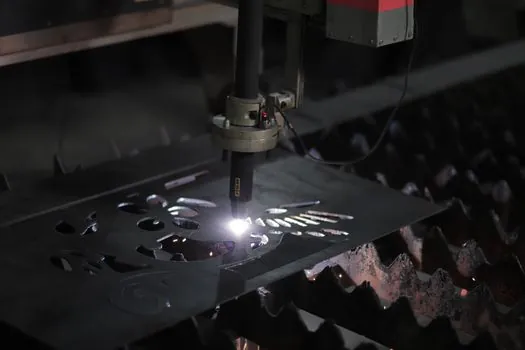
Plasma torch consumables are rated for clean, dry compressed air at roughly 6.0 to 7.0 bar (about 90 to 100 psi) at 4 to 6 CFM, and oil or water in that supply is the single largest cause of short consumable life and unstable arcs on road jobs [S1][S3]. A small road compressor usually delivers volume, not quality, so a desiccant dryer or a coalescing filter on the inlet line is the cheapest consumable-life extension a road crew can buy. The Hypertherm Powermax30 Air and the Lincoln Tomahawk 30 Air both integrate an onboard compressor and are listed as the right answer when a crew has no shop air, but integrated compressors limit duty on 1/4 inch and up because the compressor cycles faster than the torch at the recommended pressure [S2][S3].
For a dedicated road truck, the more useful spec pattern is a 40 to 45 A cutter fed from an external 6 to 8 CFM compressor with a 30 L receiver: the receiver buffers the pulsing draw, the dryer removes the road dust and humidity, and the torch runs at its published pressure rather than the lower limit of an undersized pump. This is also where consumable choice pays back: fine-cut nozzles and shields on 1/4 inch plate cut dross and grinder time, and on a 1/2 inch sign-post base a standard nozzle at the maker's recommended stand-off gives the cleanest result without burning through tips early [S1][S3].
Portability, Torch Lead, and Field Ergonomics
Road work is hand-torch work, so the relevant weights are 20 to 30 pounds for the power supply plus a 20 to 25 foot lead, not the bare datasheet number. The Miller Spectrum 625 X-TREME and the Hobart AirForce 40i both sit near 21 pounds, which one operator can carry to a median cut without a second trip, and the Thermal Dynamics Cutmaster 82 at 43 pounds is the upper limit before a second tech is needed to shuttle the box [S2][S3]. Hand-torch length drives reach: 25 foot leads let the operator stay on the curb side of a guardrail cut while the truck parks on the shoulder, 20 foot leads force a lean over live traffic on narrow lanes.
For mechanized cuts, the rare case in road work is a truck-mounted CNC track for rebar mat or sign stencil. The Hypertherm Powermax45 SYNC with the 25 foot machine torch and CPC port is the documented CNC-ready pattern in the 2026 Welder Supply roundup, and the PrimeWeld CUT60 with a CNC port is the value option for a future table; both need a machine torch swap, a start-signal cable, and a voltage-divider board, which a hand-only "CNC ready" sticker does not include [S2][S3]. For the rest of the fleet, a 75° hand torch is the standard angle, and a 15° hand torch is the option for tight corners and gusset work, not a daily-use tool [S2].
Comparison of Three Road-Maintenance Scenarios

Three real crew profiles cover most road-maintenance plasma buying decisions. Crew A cuts 1/4 inch sign-post bases and 3/8 inch patch plate, ten short cuts a day from a small service truck: a 30 to 40 A class unit with built-in air, such as the Hypertherm Powermax30 Air or the Lincoln Tomahawk 30 Air at roughly 5/16 inch rated cut, 120 V capable, is the right tool; the trade-off is shorter consumable life on 1/4 inch and lower cut speed on 3/8 inch [S2][S3].
Crew B cuts 1/4 to 1/2 inch guardrail sleeve, u-channel, and the occasional 5/8 inch plate, twenty to thirty cuts a day from a larger truck with a 10 kW genset and an external compressor: a 40 to 45 A class unit, 120/240 V dual voltage, 5/8 inch rated cut, 50 to 60 percent duty cycle, fed by an external 6 to 8 CFM compressor with a dryer, such as the Hypertherm Powermax45 SYNC or the Miller Spectrum 625 X-TREME, is the right tool; the trade-off is roughly 25 pounds of power-supply weight and a generator load that needs planning [S2][S3].
Crew C runs a yard-based plate and sign shop plus a road truck, and wants one platform for both: a 60 A class unit such as the Everlast PowerPlasma 62i or the PrimeWeld CUT60 at 60 percent duty, 120/240 V, with a CNC port for a future table; the trade-off is heavier truck weight, a 12 to 14 kW generator demand, and the need to confirm the local service network, which on 60 A class inverter machines is thinner than on 45 A class Hypertherm or Miller units [S3]. For all three profiles, the oxy-fuel cutter is a slower but cheaper alternative only when cuts are above roughly 1 inch and grinding is acceptable; below 1/2 inch, plasma wins on speed, edge quality, and the ability to cut stainless and aluminum without a gas changeover [S1][S3].
Consumables, Ground Path, and When to Stop Repairing
Plasma consumables are the leading operating cost and the leading field failure cause. Electrode wear shows up as a wandering arc and rough kerf; nozzle wear shows up as dross on the bottom edge and a fan-shaped cut; swirl ring wear shows up as unstable arc starts. The Powermax45 SYNC's SmartSYNC consumables, listed in the 2026 roundup, are the documented way to standardize parts across a fleet and to read hours-used off the cartridge, which removes the "is it worn out?" guess that drives most field calls [S2].
The ground clamp is the second most common field failure: a weak, painted, or rusty ground path raises voltage drop, the torch hunts for current, and the operator blames the machine. On road work, grind a clean spot, clamp to bare metal, and re-clamp for every plate if the workpiece is short. When a torch starts cutting at an angle, the shield is wrong for the consumable set, not the machine; when a torch will not pierce without blowing back into the nozzle, the stand-off is wrong or the air pressure is low, not the power supply [S1][S3]. Escalate to replacement, not repair, when the torch lead is cut, when the electrode-to-nozzle gap is shorted by a melted tip, or when the power supply trips its thermal sensor on jobs the same class handled last month; those are end-of-life signs, not adjustment signs [S1].
Two signals to track on the next quarter: whether the rebar cutter on the same truck is sharing cutting duties that a plasma head should own, which is a procurement-mix signal, and whether 1/2 inch plate dross complaints are climbing, which is a consumable-grade or air-quality signal before the torch fails on a live lane. For deeper spec guidance on plate and pipe work in adjacent maintenance trades, the landscaping TIG welder spec map covers the lower-amperage end of the same duty-cycle and material-gate logic.