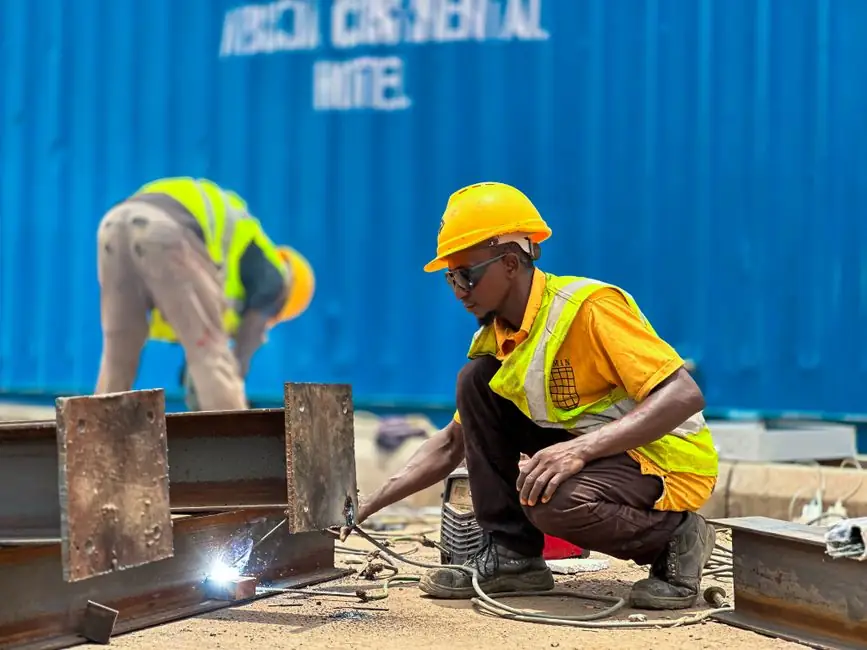
Tunnel construction in 2026 demands a hybrid TIG kit: a 250-400 A AC/DC pulse inverter with water-cooled torch and 100% duty cycle for the workshop, plus an engine-driven GTAW-capable unit for off-grid headings where utility power is absent [S2][S3].
The dominant materials on a tunnel site are carbon-steel rebar cages, stainless reinforcement, structural S355 sections, and increasingly duplex stainless for water-tight segmental linings and drainage, all of which can be welded by DC TIG, while temporary aluminum formwork, ventilation ducting, and cable trays are the AC-side candidates [S1][S2].
Why tunnel work breaks a generic TIG specification
Tunnel headings run 24/7 in shifts, the air is humid and contaminated with hydrocarbons from diesel plant, and the power supply is either restricted three-phase at 400 V or absent entirely, which is why duty cycle and input supply dominate the spec sheet before brand [S2][S3]. The TELWIN SUPERIOR TIG 422 WAVE AC/DC AQUA at 12.9 kW / 17.3 kW on a 230 V single-phase / 400 V three-phase dual input is a typical 2026 platform for this mixed-supply environment [S3]. Water ingress, salt-laden groundwater, and ISO 12944 C4/C5 corrosion classes push procurement toward stainless and duplex filler wires, and the clean, spatter-free arc of GTAW is the process of choice over MIG for these corrosion-sensitive joints [S1][S2]. For a deeper read on the cross-process decision matrix used in structural shops, see the 2026 TIG welder selection guide for plumbing and process pipe.
Output class, current type, and the AC/DC decision
Three classes bracket the 2026 spec lines for tunnel work: a DC-only manual inverter at 200-250 A for steel and stainless rebar ties, an AC/DC pulse inverter at 300-400 A for mixed-metal ducting and aluminum formwork, and an automatic longitudinal seam welder such as the Schnelldorfer ELENA ONE for ventilation-tube production lines [S3]. DC TIG is sufficient for stainless and carbon steel and is the workhorse for rebar and segmental-ring tack welds, but the site also welds aluminum formwork, temporary shelters, and cable trays, so an AC output is needed to break the oxide layer and produce a cleaning action that DC cannot deliver [S2][S7]. For reference, a 200-250 A AC/DC unit is the consensus sweet spot when a single bench covers steel, stainless, and aluminum on a tunnel site [S6]. The encyclopedia TIG welder reference gives the process fundamentals behind that AC/DC split.
Duty cycle, torch cooling, and the 200 A threshold
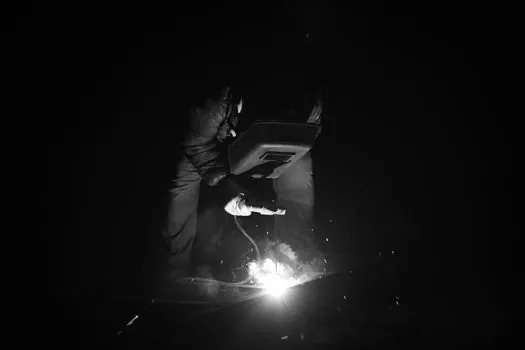
Air-cooled torches (around 150 A at the 17 series, 200 A at the 26 series) cover most manual work, but sustained welding above roughly 200 A or any mechanised orbital pass on a tunnel segment ring requires a water-cooled torch (250 A at the 20 series, 350 A at the 18 series, both rated 100% duty) plus a recirculator [S2]. The TELWIN 422 WAVE AC/DC AQUA is shipped trolley-mounted with water-cooled configuration, which is the right baseline for site welding bays [S3]. Burn-through risk on thin stainless (under 2 mm) is controlled by pulsed DC plus Advanced Thermal Control (ATC) and synergic curves, both standard on the 2026 AC/DC platform [S3]. For related construction-tool selection criteria, the construction tools overview covers adjacent categories on the same spec discipline.
Power input: site three-phase, generator three-phase, or engine drive
Tunnel headings rarely have clean mains; they run on generator three-phase at 400 V with high harmonic distortion, and ventilation drifts can be 5-10 km from any fixed substation, so the TIG kit must accept 400 V three-phase plus tolerate generator waveform [S3]. Where utility power is unavailable, an engine-driven welder/generator is the only option and the right class is one that covers SMAW, GTAW, and GMAW independently of the grid, with the Lincoln Ranger / Vantage family cited as the engine-driven reference for remote site welding [S5]. A 2026 manual AC/DC pulse inverter with a 400 V three-phase input draws 12.9-17.3 kW, which translates to roughly 30-40 A at the generator side per welder and must be derated for cable length and converter losses [S3]. The welding and cutting tool reference lists the broader power-source classes that bracket this decision.
Arc start: HF for clean strikes, lift-arc where EMI is regulated
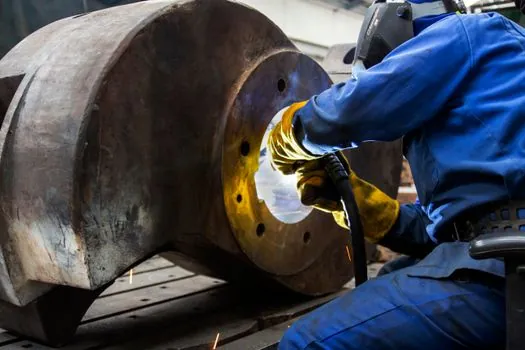
HF start gives non-contact arc ignition, which avoids tungsten contamination and is mandatory for AC aluminum work, but the high-frequency burst can interfere with tunnel SCADA, leak-detection cabling, and the radio systems used by the boring crew, so procurement must check EMI on the datasheet rather than assume HF is acceptable [S2]. Lift-arc is the fallback where HF interference is restricted, at the cost of a slightly less clean start, and most 2026 AC/DC inverters offer both as user-selectable modes [S2][S9]. In tunnel headings with methane or diesel particulate, the consensus is HF start with a documented EMI filter on the mains side, not lift-arc as default [S2].
Process coverage and shielding gas logistics
Argon is the default shielding gas for TIG on a tunnel site, and bottled argon in 200 bar cylinders is the practical choice because bulk liquid argon requires fixed vacuum insulated storage that headings cannot host [S1][S2]. A typical stainless root pass on a 3-4 mm segmental ring runs 8-12 L/min argon, so a 200 bar, 50 L cylinder delivers roughly 7-8 hours of arc time, and site consumables planning should assume 1-2 cylinder changes per welder per shift [S1]. For carbon-steel rebar ties, argon is still used but the cost case is weaker; on non-code structural steel, FCAW (flux-cored) is faster and tolerates the surface contamination typical of cut rebar ends [S5]. ISO 14175 shielding-gas designation governs the gas-class spec on the bottle, and ISO 9606-1 governs welder qualification, both of which the procurement spec should reference rather than leave to the contractor [S2].
Comparison: three 2026 classes against tunnel-site criteria
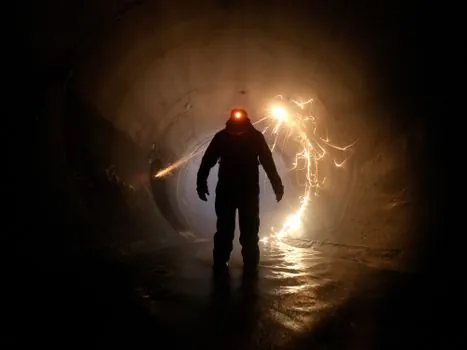
The three classes line up as follows against the four decision criteria that actually drive cost on a tunnel project: input supply, output type, duty cycle, and field mobility. The DC-only manual inverter (TELWIN SUPERIOR TIG 421 DC ACC, 8 kW, 400 V three-phase) is the cheapest at roughly 8 kW and covers steel/stainless on a fixed bench but fails on aluminum and on the over-200 A water-cooled demand [S3]. The AC/DC pulse manual inverter (TELWIN SUPERIOR TIG 422 WAVE AC/DC AQUA, 12.9 kW / 17.3 kW, dual 230/400 V input, trolley-mounted water-cooled) is the spec-floor for any site bench that welds mixed metals, because it covers the full material matrix, holds ATC on thin stainless, and runs on either site or generator three-phase [S3]. The engine-driven GTAW-capable unit (Lincoln Ranger / Vantage class) is the only answer for the heading itself, where the decision criterion is independent of grid power rather than process mix [S5]. For tube-mill duty (ventilation ducting, drainage pipe), the Schnelldorfer ELENA ONE longitudinal seam welder (600/1100/1300 mm welding lengths) replaces the manual TIG entirely and is the correct tool for production runs above about 200 m of seam [S3].
Consumables, electrodes, and welder qualification
Tungsten selection is governed by AWS A5.12: a 2.4 mm thoriated (red, WT20) or ceriated (grey, WC20) electrode is the workhorse for DC steel/stainless, while a 2.4-3.2 mm lanthanated (gold, WL20) or pure tungsten (green, WP) is the safer pick for AC aluminum on a site where the electrode may be used for both [S2]. A 100% argon shield works for most tunnel metals; helium blends (ISO 14175 I3) raise heat input for thicker stainless but raise gas cost and should be reserved for code welds [S2]. Welder qualification to ISO 9606-1 is the contract standard on most European tunnel projects, and the procurement spec should require evidence of operator certification rather than leave qualification to the subcontractor [S2].
Track these signals next: published IEC 60974-1 inverter-topology updates from TELWIN and Schnelldorfer through Q4 2026, and any change to tunnel-corrosion class specifications (ISO 12944 C4/C5) that would push more joint work from carbon steel to duplex stainless, with a knock-on demand shift from DC-only to AC/DC pulse platforms.