
Factory-gate quotes for plastic containers on Chinese B2B platforms in May-June 2026 span four orders of magnitude, from US$0.03-0.05 per unit for medical-grade small containers at 5,000-piece MOQ to US$900-1,030 per ton for raw container-grade resin, with most of the variance driven by MOQ, polymer grade and supplier audit tier [S1][S6].
The same dataset shows household acrylic display cases at US$6.50-7.00 per piece at a 50-piece MOQ [S4], woven shade mesh at US$0.15-0.25 per square metre at 800 m² MOQ [S8], and standard storage containers at US$30-150 per piece depending on size [S7] — a clean inversion of the per-unit-economics curve that procurement teams must internalise before sending an RFQ.
Resin and raw material cost anchors
Shandong Qinglin New Materials lists container-grade plastic at US$900.00-1,030.00 per metric ton, MOQ 1 ton, audited Diamond Member from Shandong — a tight ±7% price band across three repeat listings that points to a stable spot market rather than a moving benchmark [S6]. The 1-ton MOQ is the practical floor for direct-from-mill pricing on this platform; below that, the buyer is paying distributor margin of typically 15-30% on top of factory list, based on the gap between raw-resin and finished-container quotes.
For comparison, the same Made-in-China ecosystem shows finished medical containers at US$0.035-0.044 per unit (Zhejiang Gongdong, 10,000-piece MOQ) and US$0.03-0.05 per unit (Shanghai SNWI, 5,000-piece MOQ) — a per-kilogramme finished-goods price that, for thin-walled PP/PE, sits comfortably above the resin-only cost line once mould amortisation and certification overhead are included [S1]. The selection of polymer family (PP, PE, PET, acrylic) is the first cost lever and is treated in detail in the Plastic Container Selection: Resin, Capacity and UN Rating Map reference article.
MOQ and price-per-unit trade-off
Audit-tier suppliers (Diamond / Gold Member, ISO 9001:2015 audited) cluster at MOQs between 800 square metres and 10,000 pieces, with the unit price falling roughly 20-40% as MOQ climbs from sample volumes to pallet quantities — a curve visible in the S1 medical-container listings where the 10,000-piece quote (US$0.035-0.044) undercuts the 5,000-piece quote (US$0.03-0.05 floor but wider spread) on the lower bound [S1].
Acrylic display cases from Wenzhou Daoqin break this rule: 50 pieces MOQ at US$6.50-7.00 per piece reflects the labour-heavy hand-bonding and hot-bending forming process, where mould changeover cost is amortised across far fewer parts than injection-moulded containers [S4]. Procurement teams specifying acrylic should expect a flat per-unit price down to about 100-200 pieces, then a step-down at the 1,000-piece threshold where fabricators move to a dedicated production slot.
Material and product-type price bands
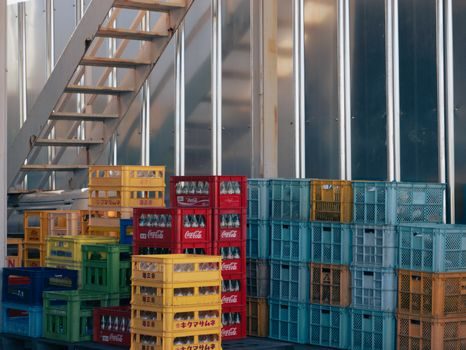
Four material families dominate the May-June 2026 China listings, each with a characteristic price band per piece at typical MOQ: thin-walled injection-moulded PP/PE containers at US$0.03-0.10 (medical and food packaging) [S1][S2], thermoformed PET/PVC clamshells and blister packaging at US$0.01-0.20 per piece (Guangdong thermoformers) [S2], woven HDPE shade mesh at US$0.15-0.25 per square metre [S8], and cast or bonded acrylic display cases at US$6.50-7.00 per piece [S4].
Container-housing units — steel-framed modular buildings with sandwich-panel walls — sit in a different cost universe, quoted per set rather than per piece, with an MOQ of 3 sets, supply capability of 300 sets per month, and Tianjin loading port [S3]. For buyers scoping general-purpose material handling, the heavier-duty plastic pallet category follows the same resin-cost-plus-mould amortisation logic and is a useful cross-check on raw-material assumptions.
Audit tier, certification and supplier risk
Supplier audit tier correlates with price but also with documentation depth: ISO 9001:2015 is the floor for Binzhou Hongyuan Chemical Fiber (woven mesh) and several Diamond Members on the Made-in-China medical listing [S1][S8], while container-house fabricators carry ISO 9001, ISO 14001, CSA, CE, AU and UL certifications as a stack — necessary because the end product is a permanent structure rather than a consumable [S3].
Buyers should treat the audit tier as a non-fungible cost item: Gold and Diamond Members command a 5-15% premium over unranked suppliers on the same SKU, recovered through Secured Trading escrow, on-site audit reports and documented QC procedures. The negotiation playbook is to request the same SKU from one unranked, one Gold and one Diamond supplier, then triangulate on the median — a procurement pattern that surfaces in the Industrial Vacuum Cleaner Price and Cost Guide: 2026 Spec-to-Price Map for adjacent capital-equipment categories.
Sourcing channels and platform mechanics
Three channels dominate 2026 China-sourced plastic containers: Made-in-China (the bulk of the price data in this guide, with Diamond and Gold Member audit tiers), Okorder (heavier emphasis on B2B project goods such as container housing, with TT/LC payment and 3-set MOQ) [S3], and tradeKorea (Korean OEM listings such as MSC-S1111) [S5]. Each platform charges a different commission and escrow structure, which is already embedded in the visible per-unit price.
For raw resin and engineering-grade polymers, the engineering plastic reference page covers the upstream material families (PA, POM, PC, PBT) that share the same per-ton price band as the Shandong Qinglin container-grade listing [S6]. Buyers specifying food-contact, pharmaceutical or UN-rated hazardous-goods containers should request the relevant migration-test report and UN certification (where applicable) before issuing a purchase order — the cost of that documentation step is small relative to the per-shipment rejection risk.
Action items for procurement teams
Track the Shandong Qinglin US$900-1,030/ton container-grade resin band [S6] as the input-cost reference; if spot resin moves outside ±10% of this band, expect finished-container quotes to lag by 30-60 days. Audit-tier premium of 5-15% is consistent across the Made-in-China medical and storage listings [S1][S7], so a three-supplier triangulation (unranked / Gold / Diamond) is the lowest-cost way to validate a target price. MOQ-driven price breaks of 20-40% between 5,000-piece and 10,000-piece tiers [S1] mean a consolidated annual RFQ at one supplier often beats split-volume sourcing — a pattern that also holds for the related Workbench Price & Cost Guide 2026 capital-equipment category.
For component-level specifications, see tank container.