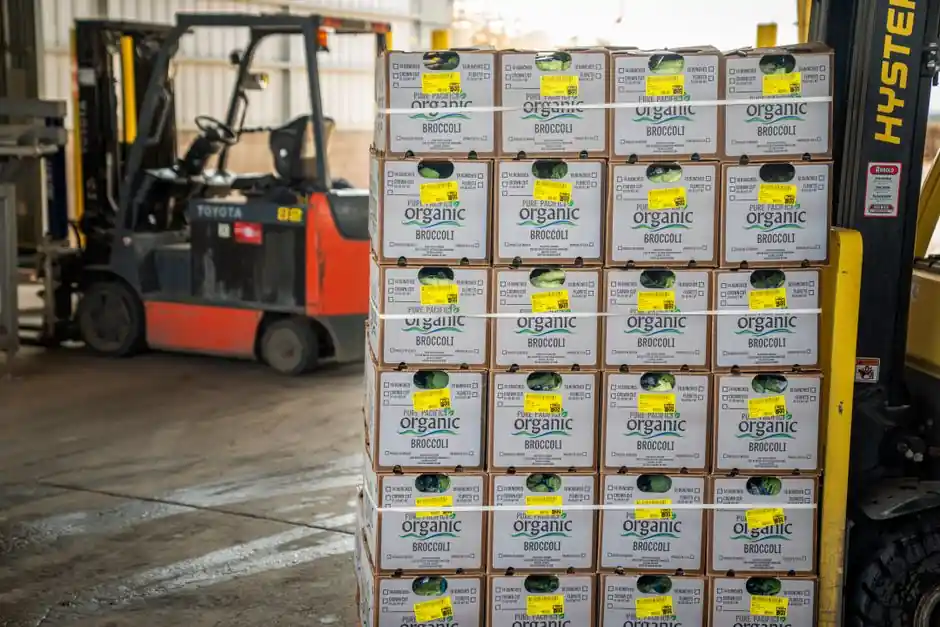
Plastic pallet static load typically ranges 15,000–30,000+ lb on a flat floor, while the same pallet's dynamic rating collapses to 2,000–5,000 lb during forklift handling and its racking rating drops further to 1,000–3,000 lb on steel beams [S9][S2].
The three ratings are not interchangeable: static governs warehouse stacking, dynamic governs forklift travel and conveyor moves, and rack governs open-beam span support, and the lowest number always sets the operating ceiling for a given duty cycle [S1][S4].
What the three ratings actually measure
Static load is the maximum weight a pallet can carry while fully supported on a flat, level surface, including stacked-on loads from identical pallets above it; the iGPS and NetZero guides both call this out as the floor-resting condition [S1][S2].
Dynamic load is the maximum weight the pallet can carry while being lifted by a forklift, carried on a conveyor, or driven on/off a truck deck; the load sees shock, vibration, and tongue-jerk forces that the static number does not, which is why published dynamic numbers sit one-third to one-half of static for HDPE and PP pallets [S1][S2][S3].
Rack load (sometimes called "edge rack" or "beam rack" capacity) is the maximum weight the pallet can carry while supported only on the two or three steel rack beams running under its stringers or blocks; with the deck surface open, the deck and bottom rails see bending rather than compression, so the rating drops again, often 1,000–3,000 lb for a 48×40 GMA-format plastic pallet [S9][S4].
Plastic vs wood vs metal: typical capacity ranges
Wooden GMA 48×40 pallets typically rate 4,600 lb static, 2,500 lb dynamic, and 2,000–2,500 lb racked, per a 2026-08 industry guide, putting wood in the same dynamic/rack band as entry-level plastic but well below premium plastic on static stack height [S5].
Plastic pallets shift that profile: virgin-HDPE structural foam pallets run 15,000–30,000+ lb static, 3,000–5,000 lb dynamic, and 1,000–3,000 lb rack; nested-export HDPE pallets drop to roughly 2,000–4,000 lb static and 1,000–1,500 lb dynamic because of the thin-wall, hollow-footprint geometry [S9][S2].
Metal and composite pallets (steel-reinforced, aluminum, or fiberglass-faced) push static past 30,000 lb and rack past 5,000 lb, but the upfront cost runs 4–10× plastic; for most food, beverage, and pharmaceutical lines, a virgin-HDPE structural-foam pallet gives the best static-to-cost ratio, while a rackable PP pallet with internal steel rods is the only plastic option for serious beam-rack duty above 2,500 lb [S9].
Why dynamic and rack ratings are so much lower than static
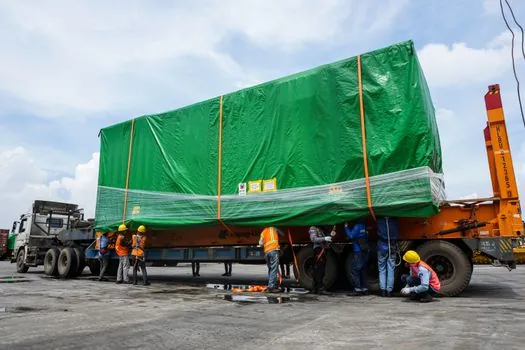
Dynamic load is governed by impact, fork-jerk, and corner-bending stress rather than uniform compression: a forklift tip-drop of even 50 mm, a pothole at 5 km/h, or a misaligned pallet on a chain conveyor introduces a 1.5–2.0× instantaneous force multiplier on the load the pallet actually feels [S1][S2].
Rack load is governed by beam span and pallet bottom stiffness: a 48×40 pallet spanning two 96-inch rack beams loads the bottom rails in 4-point bending, and HDPE/PP creep under sustained load drops long-term capacity by another 20–40% versus the short-term test number, especially in warehouses running above 30°C ambient [S4][S9].
Material behaviour also matters: HDPE creeps more than PP at the same stress, glass-filled PP holds its rack rating better over time, and recycled-content HDPE loses 10–20% of its short-term rating versus virgin resin of the same wall thickness [S2][S9].
How the ratings are tested: ASTM D4169, D1185, and ISO 8611
Plastic pallet ratings in North America trace back to ASTM D1185 (now largely superseded) and the current ASTM D4169 / ISO 8611 family, which specifies the test block dimensions, load distribution plates, fork-pockets engagement, and the 1.0–1.8 g shock pulse used during the dynamic test; the rack test is a 96-hour sustained-load bend on simulated beams [S5][S6].
The Virginia Tech Unit Load white paper (unitload.vt.edu) makes the point that published capacity is a function of ultimate load, stiffness, and time-dependent behaviour (creep), so a pallet that tests 30,000 lb in a lab at 23°C and 50% RH for one hour can still deform visibly under a 5,000 lb static load held for six months in a 35°C DC [S6].
Reputable suppliers publish all three numbers with their test method and ambient conditions stamped next to the rating; if a datasheet only shows "load capacity: 10,000 lb" with no static/dynamic/rack split, the number is almost certainly a marketing-grade static figure and should be derated for any moving or racking use [S1][S2].
Selecting a rating: decision matrix
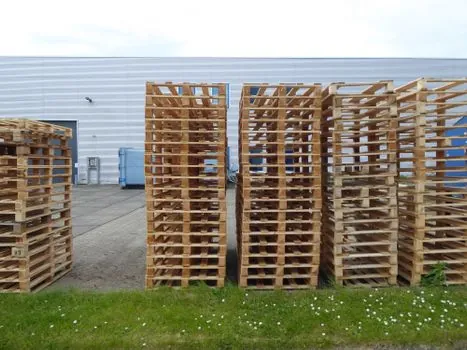
For floor-stacked warehouse storage with 3–4 high stacks of identical product, static is the governing rating and a 6,000–10,000 lb-rated plastic pallet is the most cost-effective pick; dynamic and rack numbers do not matter in this duty cycle [S2][S9].
For mixed dock-to-DC handling (forklift every cycle, no rack): target a dynamic rating 1.5–2.0× your heaviest SKU so a single mis-handled pallet does not fail, and ignore rack number; this is the standard GMA plastic pallet use case [S1][S4].
For selective or drive-in rack storage, the rack rating is the only number that matters, and most standard plastic pallets will not pass; specify a rackable plastic pallet with internal steel reinforcement or step down to a wood block pallet rated for the same span, and check the rack upright and beam capacities separately against the pallet rack prelims layout [S4][S9].
For export one-way or pooler loops, the relevant question is not load at all but dimensional conformance to ISO 6780 and ISPM 15, plus tare weight for air-freight math; nested HDPE export pallets at 1,000–1,500 lb dynamic are typically over-spec for this duty [S5].
Failure modes and limits the spec sheet will not tell you
HDPE pallets loaded above their dynamic rating in cold rooms (below 0°C) can fail by brittle cracking at the fork-pocket welds rather than the bottom rails, because HDPE's impact toughness drops sharply below its glass-transition zone; this is one of the most common cold-chain pallet failures and rarely shows up in catalog data [S2][S9].
Static over-stack failure on plastic pallets usually starts as deck sag rather than outright collapse, so a pallet can be visibly bowed yet still carry the load for months; this is a problem in ASRS pick-face replenishment, where a bowed pallet jams the extraction mechanism before the load itself fails [S6][S9].
Sourcing and standards to pin on the PO
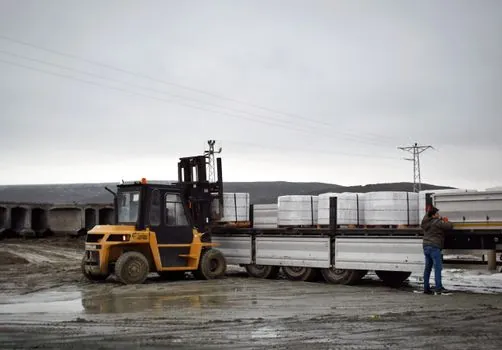
Require a datasheet showing all three ratings with the test method (ASTM D4169, ISO 8611, or equivalent), the ambient conditions, the resin grade, and the rack span used in the test; reject any quote that ships only a single "capacity" number without the static/dynamic/rack split and the test method [S5][S6].
For food, beverage, and pharmaceutical lines, add FDA 21 CFR or EU 10/2011 food-contact compliance and, where the pallet enters a racked environment, confirm the rack upright and beam capacities against RMI/ANSI MH16.1 or the local equivalent before sign-off; for cold-chain duty, ask specifically for low-temperature impact data rather than 23°C room-temp numbers [S5][S9].
Track the next revision of ISO 8611 (expected to tighten the dynamic shock envelope) and any 2026 updates to RMI/ANSI MH16.1 cycle-load guidance, as both will shift published ratings and may require re-qualification of pallets already on site.
For component-level specifications, see plastic pallet, dynamic compactor, and dynamic balancing machine.