
Open-market polyethylene storage tanks in the 1 to 20,000 gallon range are dominated by rotationally molded HDPE and XLPE, with polypropylene as the higher-temperature alternative [S1]. Snyder Industries' published vertical tank matrix alone spans 22 to 1,500+ gallons in HDLPE, with molding tolerance listed at +/- 3% on diameter and height [S2]. NTO Tank publishes an Emergency Tanks price band of 100-500 gallons at 30" diameter, confirming the sub-500-gal tier as the most actively quoted residential/commercial segment [S4].
Poly tanks remain the low end of bulk-liquid storage versus stainless, fiberglass, or carbon steel because raw HDPE resin is cheaper per pound than 304/316 stainless and rotomolding produces a seamless one-piece shell with no weld inspection cost [S1][S5]. Inside-plant trade-offs around footprint, fittings, and pump integration are covered in our storage rack and IBC tank reference pages, both useful when sizing alongside plastic tanks in a chemical or water treatment bay.
Price Bands by Capacity and Material Grade
List-price banding for open-market poly tanks in mid-2026 is heavily capacity-driven: sub-100 gallon utility/rectangular open-top tanks sit in the $40-$300 range, mid-tier 100-500 gallon vertical water tanks list $200-$1,200, 500-2,500 gallon chemical verticals sit $900-$6,000, and 2,500-20,000 gallon industrial verticals and double-wall tanks run $5,000-$25,000+ before fittings and freight [S1][S4]. Vertical HDLPE black or natural white is the default and cheapest SKU; XLPE carries a 15-30% premium over linear HDPE for the same gallonage due to longer cycle times in the rotomold [S1][S2]. Polypropylene rectangular open-top tanks (B-Series) cost 25-40% more than equivalent A-Series polyethylene and are rated to 212 deg F versus 140 deg F for PE [S3].
Double-wall containment tanks, which are essentially a primary tank inside a secondary HDPE shell with interstitial monitoring, run 1.8-2.5x the price of a single-wall tank of the same working volume, reflecting the second rotomolded part and factory assembly [S1].
Cost Drivers That Move the Quote
Resin is the single largest material input, and global HDPE supply remains concentrated: China produced 31% of global plastic resin output in 2020, a structural factor that still anchors North American spot pricing in 2026 [S7].
Total cost of ownership is favorable relative to steel: HDPE never needs repainting, is rust-immune, and tolerates a pH 1-13 chemistry window for most acids and caustics including sodium hypochlorite, sodium hydroxide, sulfuric (dilute), hydrochloric (dilute), and phosphoric acid [S1]. Failure modes to budget for are UV embrittlement on thin-wall residential tanks beyond 10-15 year service, and fitting-side leaks at bulkheads that get over-torqued on startup. For a process engineer comparing poly to a steel alternative on installed cost alone, the pressure vessel price 2026 reference lays out the certification and plate-cost side of that same trade-off.
HDPE vs XLPE vs Polypropylene: Decision Criteria
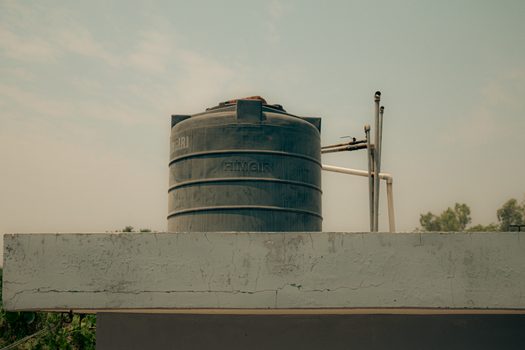
HDPE (high-density linear polyethylene) is the default: rotomolded, FDA-grade virgin resin for potable water, chemically compatible with most fertilizers, sodium hypochlorite at <=12.5% active chlorine, diesel exhaust fluid, and dilute mineral acids [S1]. XLPE (cross-linked polyethylene) adds cross-link bonds during molding, giving better impact resistance at low temperatures, better stress-crack resistance, and a slightly higher continuous-service ceiling (~150 deg F vs ~140 deg F for HDLPE); spec XLPE for outdoor installs in cold climates, for tanks that get moved, or for chemistry with elevated oxidizer exposure [S1]. Polypropylene is the heat and solvent pick: rectangular Chem-Tainer B-Series PP tanks are rated to 212 deg F operating temperature, versus 140 deg F for A-Series PE, and PP resists a wider organic-solvent spectrum (ketones, aldehydes, some chlorinated solvents) that would swell or stress-crack HDPE [S3].
Three concrete decision criteria line the materials up for specification: (1) maximum continuous operating temperature — HDPE ~140 deg F, XLPE ~150 deg F, PP ~212 deg F; (2) SG rating headroom — HDPE up to 2.0, XLPE up to 1.9 typical, PP up to 1.7 typical; (3) potable certification — NSF/ANSI 61 listings are most common on HDLPE and XLPE, less common on PP [S1][S3]. Rectangular open-top PP at 1,800 gallons (84" x 84" x 60") is a typical Chem-Tainer stock SKU in this class [S3].
Who Should and Should Not Specify a Plastic Tank
Plastic tanks fit cleanly into: potable water storage (residential, rainwater, emergency reserves), agricultural fertilizer and pesticide day tanks, light chemical service (bleach, caustic, dilute acids), plating and anodizing process baths where stainless contamination is a concern, and any site where corrosion or repaint lifecycle cost is the dominant pain point [S1][S3]. NTO Tank's emergency-water category (100-500 gal, FDA-grade polyethylene, food-grade certified for potable use) is the canonical residential/community reserve SKU [S4]. Poly is also the right pick for indoor chemical rooms and any site with strict no-spark requirements, since HDPE is non-conductive and won't arc if fittings are bonded.
Plastic tanks are the wrong pick for: petroleum service above diesel flash-point concerns, hot oils or thermal fluids above 212 deg F, vacuum service (rotomolded tanks are not rated for full vacuum without internal bracing), high-pressure process service, and any chemistry that aggressively permeates HDPE — strong solvents like aromatics, ketones, and chlorinated hydrocarbons. For those services, step up to double-wall stainless IBCs (covered separately under IBC tank and tank container references) or carbon steel with FDA-grade epoxy liner. Also avoid poly where a third-party ASME-stamped pressure vessel is mandated — rotomolded HDPE carries no ASME Section VIII stamp and is built to ASTM D1998 or PFI fabricator standards, not pressure-vessel code [S1].
How to Read a Plastic Tank Quote
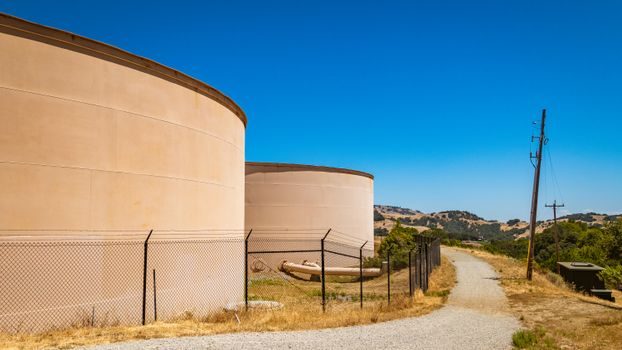
A clean quote for a 1,000-2,500 gallon chemical vertical HDPE tank in 2026 should resolve into five line items: tank shell (resin, SG rating, color, FDA/NSF status), fittings (size, count, material — PP or PVDF bulkheads cost more than PP), accessories (tie-down lugs, gallon indicators, vent, ladders, level sensors), freight class and FOB point, and lead time (stock vertical HDLPE 100-550 gal typically 1-3 weeks, larger custom XLPE or PP builds 6-12 weeks) [S2]. Snyder's published spec sheet caps standard molding tolerance at +/- 3% on dimensions, which is the practical figure to enforce on an incoming-inspection drawing review [S2].
Two verifiable signals to track in the next buying cycle: (1) NSF/ANSI 61 certified SKU expansion — Protank notes "many are NSF 61 approved" rather than universal certification, so confirm the part number before specifying for potable service [S1]; (2) resin-spot delta versus Q1 2026 — China still produces 31% of global plastic resin, so any Asia-Pacific cracker turnaround or feedstock shift will move HDPE spot price and quote validity windows [S7]. A 2,500-gallon SG 1.5 chemical HDPE tank from a major US rotomolder is a reasonable baseline benchmark SKU to re-quote each quarter for trend tracking.