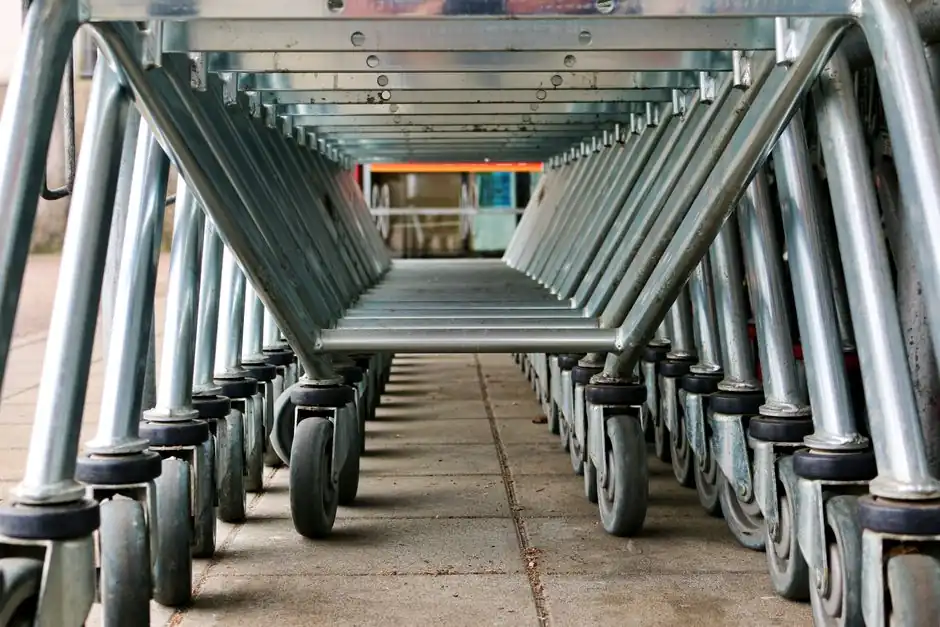
Chemical shipping demands platform trolleys rated 150-300 kg in 316L stainless or hot-dip galvanized steel with polyurethane or nylon wheels, because bare mild steel and aluminium both fail in chloride and acid service [S1][S2].
The four-wheel, flat-deck format suits palletised drums, IBC totes and loose cartons, while two-wheel sack trucks handle single stacked items only [S3]. Ningbo Okapi Logistics, an ISO 9001 factory established in 2007 with roughly 10,000 m² of floor area and an 81-90% export rate, lists chemical industry explicitly among its served sectors [S1].
Load Capacity Tiers and What Each Means in Chemical Service
Capacity tiers used across the industry map cleanly to common chemical payloads: light-duty 45-90 kg for parcels and small containers, medium-duty 150-250 kg for most drum and tote moves, heavy-duty 300-500 kg for appliances or full drum stacks, and industrial 500-680 kg for commercial fleet use [S2]. For chemical shipping, the 150-300 kg bracket covers most single-IBC or 205 L drum moves, while 500 kg+ units are specified where two IBCs or a pallet of 4 drums travel together.
A 205 L steel drum weighs 18-25 kg empty and 220-280 kg full, so a single full drum already sits in the medium-duty range; two full drums on one deck push the spec into heavy-duty. A standard IBC tote at 1000 L weighs roughly 60 kg empty and 1,000-1,200 kg full, which means an IBC almost always requires its own heavy-duty or industrial platform rather than a generic cart. Over-spec by 25-30% on capacity when the deck will see shock loads during forklift transfer, because a 1 m drop event can briefly double the static force on the castors [S2].
Frame Material and Finish: Why 316L and Galvanizing Dominate
Three material families compete in chemical-shipping trolleys: mild steel with powder coat, hot-dip galvanized steel, and 304 or 316L stainless steel. The 316L grade is preferred for chloride exposure because 316L contains 2-3% molybdenum, which improves pitting resistance against chlorides compared with 304 stainless. For acid and offshore chemical service, chemical material guidance consistently points to 316L over 304. [S1]
Hot-dip galvanized steel is the workhorse choice for indoor chemical warehouses, where the zinc coating handles occasional splash and humid storage at lower cost than stainless. Powder-coated mild steel is acceptable only in dry, non-corrosive zones; once the coating is nicked, the underlying steel will rust aggressively in a chemical shed. Aluminium alloy frames are widely available, but aluminium is incompatible with most strong acids and with chloride-rich wet environments, so it should be excluded from chemical-shipping service even when suppliers offer it as a lightweight option [S1]. For pharmaceutical and adjacent clean rooms, see the parallel platform trolley spec map for pharmaceutical distribution.
Wheel Selection for Chemical Floors and Spill Zones

Wheel choice is the single most failure-prone decision in chemical-shipping trolleys. Three families compete: pneumatic, solid rubber, and flat-free foam-filled. Pneumatic tyres ride softest and survive outdoor yards, but they are flat-prone and lose integrity around chemical solvents [S2]. Solid rubber is the workshop default and cannot go flat, yet it transmits floor vibration and can mark sealed concrete.
Polyurethane and nylon wheels are the chemical-shipping default for indoor epoxy or vinyl floors. Polyurethane carries 150-500 kg per wheel, rolls quietly, and resists most acids, bases, and solvents; nylon is harder, carries heavier loads, but transmits more shock. For spill zones, specify sealed bearings (2RS or ZZ) and avoid grease-lubricated castors, because hydrocarbon and solvent attack will wash out standard lithium grease. High-strength nylon and polyurethane wheels are noted for long life and low noise in [S1], matching the typical spec sheet for chemical warehouses.
Configuration: 2 Fixed + 2 Swivel vs All-Swivel Castors
Two castor layouts dominate: 2 fixed + 2 swivel, and 4 swivel. The 2 fixed + 2 swivel layout gives straight-line tracking under heavy loads and is the default for 300 kg+ chemical trolleys, because four swivels under a 300 kg load are very hard to control on a smooth floor [S2]. All-swivel layouts are reserved for light-duty 45-90 kg carts where tight turning in narrow aisles matters more than tracking. For drum cradles, look for a fifth wheel or a centred caster to spread the 220-280 kg load across four contact patches rather than two.
For cold rooms and freezers, the chemistry shifts to low-temperature grease and crack-resistant polyurethane; the cold chain platform trolley spec map covers that branch in detail. Standard load ratings are typically rated at 20 °C, and polyurethane hardens below -10 °C, so cold rooms require low-temp polyurethane or phenolic wheels to avoid flat-spotting under static load.
Foldable vs Rigid Frames and the Footprint Trade-Off

Foldable platform trolleys, including 300 kg commercial warehouse units in steel, dominate export catalogues because they cut return-shipping volume by roughly 60-70% versus rigid frames [S1]. For chemical shippers moving empties back to a port, this volume reduction is a meaningful logistics saving. Rigid frames win on impact resistance and are preferred for repeated drum drops, where the welded joints on a rigid trolley survive abuse that would fatigue a folding hinge.
For drum and cylinder handling, dedicated trolleys exist: drum trolleys for 205 L oil drums reduce a two-person lift to a one-person job, and cylinder trolleys carry oxy-acetylene and MIG bottles in a chained cradle [S2]. These are not the same product as a flat platform trolley; chemical shippers handling compressed-gas cylinders should specify cylinder trolleys rather than improvising with a flat deck. A flat platform trolley is the right tool for palletised drums, totes, and carton stacks; a cylinder trolley is the right tool for pressurised gas.
Standards, Sourcing and Red Flags When Buying
For chemical-plant buyers, the relevant baseline standard is ISO 9001 for quality management at the factory, and material traceability to EN 10088 for stainless grades or ASTM A123 for hot-dip galvanizing. Buyers should request mill certificates for 304 or 316L stainless, because the visible grade stamp is not a proof of composition. Wheel load ratings should carry a documented safety factor, commonly 1.5x the static rating, to cover shock loads during forklift transfer. [S1]
Red flags in chemical-shipping trolley sourcing include: aluminium frames offered as "stainless equivalent", bare mild steel with no finish callout, generic "stainless steel" without 304 or 316L designation, and pneumatic wheels as standard on chemical-floors spec. Sourcing from a factory with a documented export rate above 80% and a multi-process capability (stamping, resistance welding, wire cutting, precision machining) is a reasonable quality proxy [S1]. For a parallel look at the slewing bearings that ride underneath many chemical-plant cranes and conveyors, the slewing bearing spec map for material handling is a useful adjacent read.
Track, on the next spec cycle, whether the supplier provides a documented chemical compatibility chart for wheel and frame materials, and whether the trolley is rated for washdown or only dry service; these two data points typically separate a general-purpose platform trolley from a true chemical-shipping unit. Buyers should also confirm castor temperature range, since chemical sheds near reactors often run above 40 °C in summer.
The underlying component specifications are covered under chemical anchor.