Material-handling slewing rings span roughly 200-6,000 mm in diameter, with four structural families (single-row four-point contact ball, crossed roller, double-row ball, three-row roller) covering the duty range from light rotary tables to port-crane rings above 6 m [S4][S2].
Selection is governed simultaneously by axial load, radial load, and tilting moment, with bearing type, gear arrangement, and bolt pattern decided per application rather than copied across platforms [S5][S1]. For background on the component family, the slewing bearing overview and the related slewing ring bearing entry cover geometry and load paths.
Four Structural Types and Their Load Bands
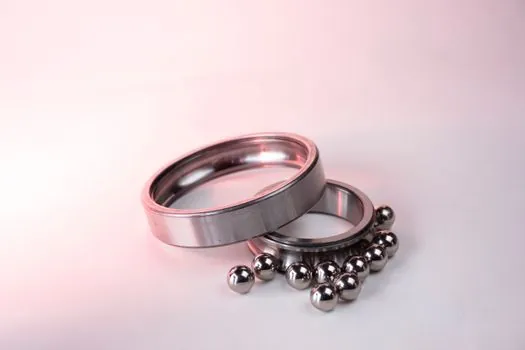
Single-row four-point contact ball slewing bearings are the compact, lightweight option, with each ball contacting the raceway at four points to carry axial load from either direction, plus radial and moderate moment loads, which is why they dominate medium-duty crane and excavator swing positions [S1][S3]. Crossed roller slewing bearings use cylindrical rollers on alternating 90 deg axes in a 1:1 arrangement, giving higher stiffness and runout accuracy for industrial robots, rotary tables, and radar pedestals where installation envelope is tight [S2][S5].
Double-row ball slewing bearings add a second ball row for higher static load capacity with a simple structure, commonly used in deck cranes and mining equipment [S2][S3]. Three-row roller slewing bearings are the largest and most robust design, with two roller rows handling axial and radial loads while a third row takes the overturning moment, and are the default for bucket-wheel reclaimers, ladle turrets, and large port or shipyard cranes where rings can exceed 6 m in diameter [S2]. Roller-type slewing rings on excavators are commonly rated for service life beyond 8,000 operating hours under combined dig-cycle loads [S2].
Sizing on Axial Capacity Alone Is the Most Expensive Mistake
The single most common selection error on material-handling slewing rings is sizing on axial capacity alone, which leaves tilting moment and dynamic load under-checked and is described in supplier guidance as the costliest mistake in slewing-bearing selection [S4]. A crane boom with a heavy load at radius generates a downward axial force, a radial component from boom extension, and a forward tipping moment that the same bearing must resist simultaneously, so a ring rated for the weight but undersized for moment will fail prematurely in service [S1].
For each candidate, the static and dynamic loads must be calculated together with the maximum operating moment, then the operating cycle, rotation angle, speed, acceleration, shock loads, and required positioning accuracy applied as further modifiers [S9][S5]. Buyers should also confirm preload versus operating clearance, rotational accuracy class, continuous versus intermittent motion, ambient temperature, contamination level, grease-versus-oil lubrication, seal arrangement, and relubrication access before the model code is frozen [S5].
Criteria-Based Comparison of the Four Types
Lining the four families up against the criteria a material-handling buyer actually weighs, four-point contact ball rings score best on cost and short lead time for moderate combined loads, but lose on moment capacity; crossed roller rings score best on stiffness and rotational accuracy at small diameters, with a cost premium and stricter mounting-flatness demands; double-row ball rings sit between single-row and three-row on capacity while keeping a simple structure; three-row roller rings win on raw load and moment capacity for diameters above roughly 1,500 mm, at the price of larger section height and longer manufacturing cycle [S2][S3][S5]. For excavator and crane swing positions, roller-type slewing rings are favored because they handle combined loads and hold smooth operation beyond 8,000 hours [S2].
Gear arrangement is the second decision axis: external gear on the outer ring, internal gear on the inner ring, or no gear at all, each tied to a different ordering check (gear module, tooth count, drive position, pinion access, or a separate drive method) [S5]. Two crossed roller rings with similar boundary dimensions can carry different bolt patterns or have gear teeth on opposite rings, so the full designation plus drawing must drive every inquiry rather than the product name alone [S5].
Material, Lubrication, and Manufacturing Constraints
Standard slewing rings are cut from carbon-chromium bearing steel or 50Mn surface-hardened steel, with raceways induction-hardened to carry the combined load spectrum and resist brinelling under shock [S7]. The rings are large-diameter, often with integral gear teeth machined into one ring, which makes forging stock size, quenching uniformity, and tooth quality the limiting factors for very large diameters [S7][S1].
For a deeper look at how these rings interface with the driven gear reducer package, the slewing drive entry covers the integrated bearing-plus-worm-gear arrangement used when a self-contained actuator is preferred over a bare ring. Material-handling buyers also need to know how the ring sits in the wider material handling system, since the slewing bearing is only one element in the load path between upper structure and undercarriage [S1].
Mounting, Preload, and Field Failure Modes

Preloaded crossed roller rings deliver stable rotation and higher rigidity but place stricter demands on support stiffness and mounting-face flatness, so a flatness check on the mating structure is part of the order, not a site afterthought [S5]. Bolt grade, hole pattern, and adjacent structure stiffness must be confirmed alongside the bearing designation because two rings of the same boundary size can carry different mounting provisions [S5].
Common field failure modes trace back to the three selection shortcuts buyers most often take: undersized moment capacity on long-boom cranes, contamination ingress through inadequate sealing on outdoor or mining duty, and insufficient relubrication access on rings specified as "sealed for life" but run on continuous shifts [S4][S5][S1]. For packaging and pallet-handling cells, the related slewing bearing selection for packaging lines spec map covers the lower-diameter, higher-cycle end of the same family, while the broader storage handling context frames the upstream conveyor and stacker-crane decisions that feed into the slewing-ring specification.
Application Fit and Where Each Type Is Wrong
Crossed roller rings are wrong for very large diameters (above about 1,500-2,000 mm) where the sectional height, cost, and lead time of a three-row roller alternative become competitive, and they are also wrong where the mounting structure cannot be machined to the flatness the preload class demands [S5][S2].
Double-row ball rings suit deck cranes and mining equipment with high static load but modest speed and accuracy needs, while three-row roller rings are overkill (and overpriced) for handling-system rotary tables below about 800 mm diameter where a four-point contact ball or crossed roller ring is the right answer [S2][S3].
Sourcing, Standards, and What to Verify Before Order

Buyers should send the full operating data set (maximum axial, radial, and moment loads, duty cycle, rotation angle, speed, acceleration, shock, accuracy class, environment, lubrication, seal arrangement, gear module and tooth count, mounting hole pattern) with every RFQ for a slewing ring, not just the bore and outer diameter [S5][S9]. For wind turbine yaw and pitch positions, diameters typically fall in the 2,000-4,000 mm range and require separately specified moment and fatigue ratings, which is a different duty profile from material-handling cranes [S2].
Track for the next design cycle: the move toward higher moment-capacity three-row roller rings above 4 m diameter for offshore and port handling, the gradual replacement of grease-only "sealed for life" rings with relubricatable seals on continuous-shift mining duty, and the standardization of crossed-roller model codes that allow buyers to order by gear arrangement plus bolt pattern rather than by drawing number [S5][S2].