Manual pallet jacks in the 2026 market cover a 2,200-5,500 lb load range, with the Dayton 493X19 manual-operation model rated at 5,500 lb currently listed as new-old-stock on aftermarket channels [S2], while Chinese OEM platforms such as HUGO offer a manual stacker and manual pallet jack lineup out of dedicated pallet-jack production lines [S1]. Buyers should treat capacity, fork size, pump type, and steer-wheel material as the four non-negotiable spec gates before quoting.
The category has matured into a clearly segmented tool: entry 2,500 lb units for retail back-room use, mainstream 5,000-5,500 lb workhorses for warehouse and dock work, and heavy-duty 6,000+ lb variants for industrial and cold-chain operations. Crown Equipment positions the manual pallet truck as the base tier in a broader pallet-handling range that scales up to electric rider pallet trucks [S3], which is the correct reference frame for a buyer deciding whether to stay manual or jump to powered — see the electric pallet truck spec cut for that decision boundary.
Capacity Tiers and Fork Geometry
Standard manual pallet jacks in 2026 ship in three load classes: 2,200-2,500 lb light-duty, 5,000-5,500 lb standard-duty, and 6,000 lb+ heavy-duty. The Dayton 493X19 at 5,500 lb is representative of the standard-duty tier, sold as a manual-operation hand truck with multiple units in channel inventory [S2]. Forks on a standard 27 in. wide x 48 in. long pallet truck are the most common geometry; non-standard fork widths (20 in., 24 in.) and extended lengths (60 in., 72 in., 96 in.) are available for specialty pallet footprints but typically add 10-20% to the unit price and 4-6 weeks to lead time.
Buyers serving European pallet pools (1200 x 800 mm EUR-pallet) should confirm fork length in millimeters; Chinese OEM catalogs such as HUGO and the Made-in-China pallet-jack category list manual stackers at 1-ton and 2-ton capacities, indicating the same metric-ton class is widely available in pallet-jack form factors for cross-region sourcing [S1][S8]. Under-speccing the capacity is the single most expensive mistake in this category — a 2,500 lb jack loaded to 2,400 lb wears the pump seal in 6-9 months rather than 3-5 years.
Pump, Handle, and Hydraulic Specs That Actually Matter
Three pump architectures dominate the 2026 manual pallet jack market: single-stage standard lift, two-stage fast-lift, and chrome-plated piston with integrated overload bypass. Fast-lift (also called "quick-lift") pumps require roughly half the handle strokes to clear the floor on unloaded pallets, cutting operator fatigue by 30-40% in high-cycle dock work. Standard single-stage pumps remain the lowest-cost option and are sufficient for under-50-pallet-per-shift operations. [S1]
Handle geometry is a measurable spec: ergonomic grips, three-position control (raise / lower / neutral), and a spring-return handle that self-centers in neutral reduce pinch-point injuries. Buyers should confirm the handle shaft is one-piece forged steel, not welded tube — welded handles are the dominant failure mode in units over 5 years old. The 5,500 lb Dayton 493X19 is sold as a complete manual-operation unit, meaning pump, handle, and frame are matched at the factory [S2], which is the right procurement model versus mixing aftermarket pumps onto OEM frames.
Wheels, Steer Radius, and Floor Compatibility
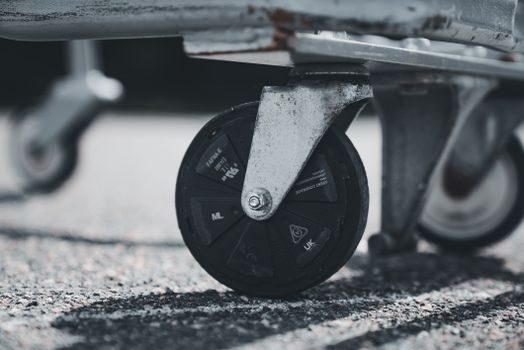
Steer-wheel and load-wheel selection drives both floor damage and rolling resistance. Polyurethane (PU) is the 2026 default for warehouse concrete; nylon suits cold-storage and wet floors; rubber is specified for tile and noise-sensitive environments (hospitals, retail back rooms). A complete wheel kit for legacy manual pallet jacks is a real aftermarket category — the Lift Rite LR2055 wheel kit ships with bearings, axles, and fasteners as a direct-replacement set carrying a 1-year warranty [S5], demonstrating that mid-life wheel replacement rather than whole-unit retirement is the standard maintenance path.
Steer-wheel diameter (typically 7 in. or 8 in.) and load-wheel diameter (typically 2.5 in. or 3 in.) are the two numbers to lock on a spec sheet. Larger steer wheels roll over dock plates and expansion joints with less operator effort but raise the overall unit height, which can be a problem on low-clearance trailers.
Frame Material, Forks, and the Load-Bearing Wheel Frame Subsystem
Manual pallet jack frames are welded steel, with fork thickness, fork width, and the load-bearing wheel frame as the three stress-critical features. The Made-in-China pallet-rack-frame price index lists Noblelift-spec load-bearing wheel frame components for manual forklift pallet jacks at US$1.60-3.00 per piece at MOQ [S4], confirming that the wheel-frame subassembly is a separately sourced component for OEM assembly lines — a useful reference point when negotiating spare-parts pricing with a vendor.
Fork steel typically runs 3 mm (light-duty) to 6 mm (heavy-duty) wall thickness on 50-60 mm wide fork profiles. Buyers should request the fork steel grade (Q235 / Q345 for Chinese frames, ASTM A36 / A572 for North American supply) and the welded-seam procedure. For cold-storage or food-grade applications, galvanized or stainless fork finishes add 20-35% to the unit cost but are mandatory for wash-down environments.
Selection Criteria: Light-Duty vs Standard vs Heavy-Duty
Three decision axes separate the 2026 manual pallet jack tiers. (1) Load class: 2,500 lb / 5,500 lb / 6,000+ lb directly correlates with frame weight, pump size, and wheel diameter. (2) Cycle rate: under 50 pallets/shift justifies a single-stage standard pump; 50-150 pallets/shift requires fast-lift; 150+ pallets/shift should trigger a review of electric pallet truck alternatives covered in the 2026 electric pallet truck buying guide. (3) Environment: ambient warehouse, cold-store below -20°C, or wash-down food-grade dictates wheel material and frame finish. [S2]
For buyers staying within manual operation, the standard 5,500 lb / 27 in. x 48 in. / PU wheels / fast-lift pump configuration is the 2026 default spec and matches the mainstream OEM offering on the Crown pallet-trucks page and HUGO's manual-pallet-jack line [S1][S3]. Specialty forks (extra-long, extra-wide, low-profile) and stainless/galvanized finishes are real cost drivers but real differentiators — see the 5 engineering gates that lock the model before RFQ for the full gate sequence.
Sourcing Channels, Standards, and What to Verify at RFQ
The 2026 sourcing map splits into four channels: (a) tier-1 OEM direct (Crown, Toyota, Hyster, Nissan, Noblelift), typically 30-45 day lead time and 2-3 year warranty; (b) Chinese OEM export platforms on Made-in-China and Alibaba, including BF-series pallet jacks in the Alibaba heavy-duty manual-handling category [S6] and the HUGO catalog [S1]; (c) aftermarket/legacy resellers offering new-old-stock like the Dayton 493X19 [S2]; (d) parts and wheel-kit channels such as the LR2055 aftermarket wheel kit [S5]. Lead times range from same-week (aftermarket) to 8-12 weeks (custom-configured Chinese OEM).
At RFQ, lock these items: rated capacity with safety factor stated, fork dimensions in mm, pump type (single-stage vs fast-lift), steer-wheel and load-wheel material and diameter, handle ergonomics, frame finish (painted / galvanized / stainless), and warranty terms. Operator documentation is a real procurement line — the Barrett SGN4 pallet-jack operator's-guide manual is sold as a separate used-book item [S7], confirming that OEMs treat the operator manual as a discrete deliverable; buyers should include operator-manual availability in their RFQ.
Failure Modes, Maintenance Windows, and Total Cost
The five most common manual pallet jack failures in 2026 field data: (1) pump seal blowout from overload or contaminated hydraulic fluid, (2) handle return-spring fatigue, (3) steer-wheel bearing failure, (4) fork-tip bending from drop incidents, (5) frame weld cracking at the king-pin junction. Items 1-3 are addressable by mid-life wheel-kit replacement (the LR2055 kit pattern [S5]) and pump rebuild; items 4-5 typically retire the unit.
Buyers should also reference the pallet stacker selection path when operations grow vertically — a manual pallet jack plus a 1-2 ton manual stacker covers most of what an electric pallet truck does, at a lower unit cost but with operator effort. For baseline background on the broader category including pallet rack integration, that encyclopedia entry covers the receiving-side spec context.
Trackable signals over the next 6-12 months: Chinese OEM minimum-order-quantity movement on the Made-in-China pallet-rack-frame price index [S4], new Crown or Hyster manual-truck model releases [S3], and any regulatory update on EN 1757-1 or ANSI/ITSDF B56.1 hand-truck standards that govern the load-testing and labeling of these units in European and North American operations.
For component-level specifications, see manual pallet jack, and linear guide.