
The ID MC02-110HQ delivers 1250W at 220–240V, 13000 RPM no-load speed, 30mm max depth on a 110mm blade, integrated water cooling, and Class II double insulation, the four items that matter most on a wet plumbing site [S2]. The Ronix 3411 sits one tier up at 1500W and 14000 RPM for heavier stone sleeves and granite trim [S3].
Wet vs dry cutting on plumbing sleeves and chases
Wet cutting is mandatory for natural stone, ceramic and porcelain sleeves in plumbing runs because diamond blades generate enough heat at 13000–14000 RPM to crack the workpiece or glaze the segment bond, and airborne silica on a dry cut is a documented respiratory hazard on enclosed bathroom and riser work [S2]. The ID MC02-110HQ ships with an integrated water input and feed pipe, so the water film reaches the cut zone continuously rather than as a manual hose drip [S2].
Dry cutting should be reserved for occasional abrasive or concrete trimming where a vacuum extraction shroud is fitted, and never for marble or granite. A handheld 45° chamfer guide such as the YWBL-WH 25 x 17.5cm aluminium-steel jig is a useful companion for bevelled sleeve edges on visible plumbing penetrations, but it is a positioning aid, not a power tool [S4].
Motor class and RPM matched to duty cycle
For a single-bathroom retrofit with 4–8 sleeve cuts per day, the 1250W / 13000 RPM class is sufficient and lighter on the wrist during overhead work; the 1500W / 14000 RPM class earns its keep on a multi-storey plumbing riser where the operator may make 30+ cuts per shift on 20mm porcelain [S2][S3]. RPM matters because peripheral blade speed, not torque, drives clean stone cutting: at 110mm diameter, 13000 RPM gives roughly 75 m/s surface speed, which sits in the band recommended for continuous-rim diamond blades on marble.
Both machines run on single-phase 220–240V / 50–60Hz, so a standard site transformer is not required on GCC, UK and European jobs [S2]. Watch the supply lead: a 1500W tool on a long thin extension drops voltage and stalls the motor mid-cut, glazing the blade. For runs beyond 10m, upsize to 2.5mm² cable.
Depth, blade diameter and what they actually let you cut

A 110mm blade with 30mm depth-of-cut handles standard 20mm porcelain tile plus 8–10mm adhesive bed in one pass, which is the typical plumbing-sleeve stack-up in a tiled wet room [S2]. Anything thicker, such as a 40mm stone countertop notch around a basin waste, needs either a step cut (two passes at half depth) or a 125–150mm blade machine.
Blade choice inside the same cutter matters as much as the machine: a continuous-rim diamond blade for marble and porcelain, a segmented blade for granite and concrete. The ID MC02-110HQ auto-stop carbon-brush set protects the motor if the operator forces a too-hard cut, a real failure mode on plumbing sites when the blade hits a hidden pipe clip or rebar [S2].
Electrical safety on a wet plumbing site
Wet cutting plus a 220–240V mains tool is a real shock risk around baths, shower trays and ungrouted tile screeds where standing water is common. Class II double insulation, which the ID MC02-110HQ carries, removes the need for an earthed supply and adds a fault-tolerant isolation layer between live parts and the outer housing [S2]. An RCD (residual-current device) on the site distribution board remains mandatory regardless of tool class, rated 30mA or better for personal protection on wet work.
Compare the three product tiers a plumbing contractor typically sees in a 2026 catalogue: the 1250W wet marble cutter (110mm blade, 30mm depth, Class II) at the entry-professional level [S2]; the 1500W wet marble cutter (110mm blade, ~30mm depth, higher RPM) for daily all-day stone work [S3]; and a manual 45° chamfer jig for finish bevels that no powered cutter can place accurately freehand [S4].
What a marble cutter is NOT for in plumbing work
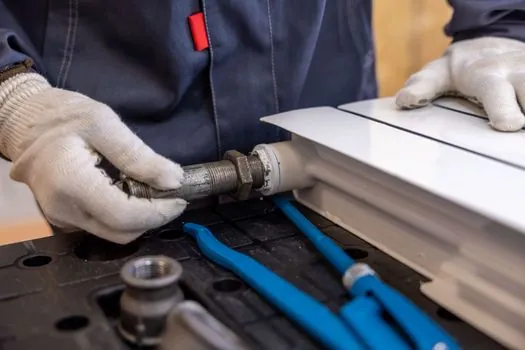
A marble cutter is the wrong tool for cutting copper, PEX, PB or stainless steel supply pipe, and for cutting cast iron or PVC soil pipe, even though the 110mm diameter and 30mm depth look superficially suitable. For metal pipe use a proper rebar cutter or a dedicated plasma cutter; for plastic soil pipe use a hand saw or a reciprocating saw with a fine-tooth blade. The high RPM and diamond segment geometry that make a marble cutter clean on stone will either shatter a plastic pipe or grab a metal one, creating a kickback hazard. [S2]
Likewise, a marble cutter should not be used as a general-purpose concrete groove cutter for chase cutting in masonry walls; the 110mm blade does not have the segment geometry or the dust extraction shroud for sustained masonry work, and the motor will overheat. Step up to a purpose-built wall chaser with a dust port for chase work, and reserve the marble cutter for the finished tile and stone sleeve cuts that follow.
Acceptance check before the first cut on site
Before any wet cut on a plumbing job, run this 5-point check: (1) diamond blade fitted, continuous-rim for marble/porcelain, no chipped segments; (2) water feed running and reaching the cut zone, not just dripping at the housing; (3) carbon brushes inspected, the auto-stop cut-out functional on machines so equipped [S2]; (4) RCD confirmed tripped-tested on the supply; (5) Class II double-insulation symbol visible on the rating plate, so the operator knows the tool is safe to run on an unearthed socket if no earth is available [S2].
For a wider look at how the 110mm wet marble cutter fits against bigger blade classes and other stone-cutting geometries, the marble cutter types and spec map article lays out the full power-class breakdown. For the metal and plastic cuts that surround every plumbing sleeve, the cut-off machine selection guide covers the abrasive and cold-cut options a fitter needs on the same site visit.
