
OSHA-published data shows the injury rate for multi-shot contact triggers runs roughly twice the rate of single-shot sequential triggers, which is why framers are being retrained to leave sequential-trip tools set as default [S1].
Pneumatic nailers are the dominant fastening tool on residential framing and sheathing crews, and about two-thirds of nail-gun injuries happen during those two tasks; hands and fingers absorb more than half of all reported trauma, with one-quarter of hand cases involving tendon, joint, nerve, or bone damage [S3].
Trigger Selection: Sequential vs. Contact-Bump
OSHA's published comparison of trip mechanisms is unambiguous: a sequential trigger requires the safety contact to be depressed before the trigger pull will fire a fastener, while a contact-bump (multi-shot) trigger fires each time the contact is held in and the trigger is bumped, producing higher unintentional discharge rates [S1]. NC DOL reinforces this by noting that "sequential tools have reduced risk of accidental and double firing" and calls them out as the lower-risk default for most production work [S2].
For tasks with awkward body position, tight spaces, or ladder climbs, NIOSH/OSHA guidance moves from "prefer" to "require" full sequential trip: a bump-fire tool can double-fire or slip off the workpiece, and on a ladder a single bump against a leg is enough to drive a fastener into the operator [S3]. Toe-nailing deserves the same treatment because the nose cannot sit flush; a safety contact with teeth that bite into the lumber, plus a sequential trigger pulled only after the contact is seated, is the documented mitigation [S3].
Air Supply: Pressure, Hose, and Disconnect Rules
NC DOL sets the two hard rules: power the tool only with compressed air, never with bottled gas, and never exceed the manufacturer's specified air pressure for that specific tool [S2]. A regulator on the supply manifold is the practical way to enforce the second rule, since unregulated shop air commonly runs 100-120 psi while most framing nailers are rated for 70-120 psi depending on model.
Disconnect the air hose for every one of these transitions: leaving the tool unattended, climbing or descending a ladder or stairs, handing the tool to a co-worker, clearing a jam, and performing any maintenance [S3]. The same source adds an exclusion that often gets ignored: "never clean or clear jams or adjust a nail gun when it is connected to the air supply" [S6]. The pneumatic energy stored in the tool and the residual line pressure between the regulator and the nailer are both enough to fire a fastener during a jam clear, which is the dominant mechanism for the puncture and blow-through injury patterns NC DOL lists under hazards [S2].
PPE and Workpiece Inspection
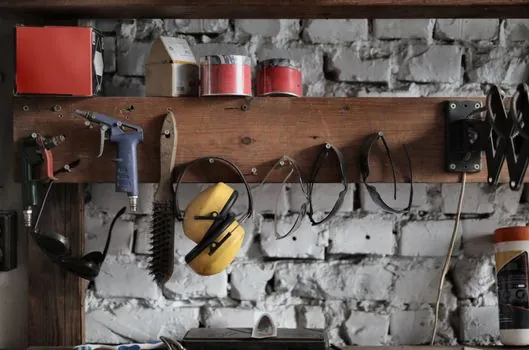
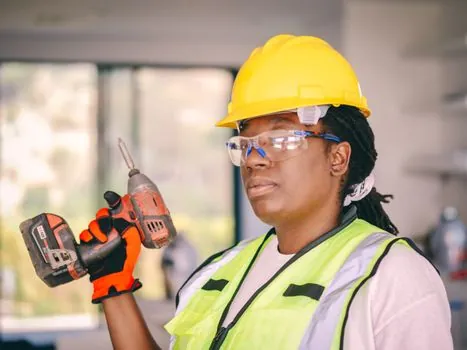
Minimum PPE per the Canadian Centre for Occupational Health and Safety: safety glasses or goggles, or a face shield worn over safety glasses or goggles, plus hearing protection where sound levels warrant, and consideration of cut-resistant or impact-resistant gloves and arm protection [S4]. Weekly Safety's 2026 jobsite refresher adds steel-toed safety shoes, a hard hat, and high-impact eye protection marked to the ANSI Z87.1 standard [S8]. For framing, ANSI Z87.1+ (the high-impact "+" marking) is the right call because fragments blown out the back of the lumber travel at fastener velocity.
Inspect the workpiece before every trigger pull: knots, embedded nails, straps, joist hangers, and metal joinery all change the recoil/ricochet profile [S3]. CPWR's hazard page adds the same rule from a different angle, telling operators to "avoid nailing into knots and metal; nails are more likely to ricochet" and to switch to a hammer or a positive-placement nailer when metal joinery or irregular lumber is in the way [S6]. Hand placement is also a specification: keep the free hand at least 12 in (about 300 mm) from the nailing point, and use clamps to brace stock instead of fingers [S3].
Operating Geometry and Line-of-Fire Control
Two geometry rules eliminate most framing-deck injuries. First, "always shoot nail guns away from your body and away from co-workers" applies to both the operator's primary hand and the free hand, and to the area directly behind the workpiece, since nails can puncture the back face and continue with enough energy to injure a worker standing behind the wall [S3]. NC DOL's hazard list calls out four failure modes: splinter or blow-out fragments, puncture through the back of the material, complete through-firing into workers behind the surface, and contact with hidden electrical services [S2].
Second, the "12-inch hand rule" pairs with a trigger-finger rule: keep the finger off the trigger until the nose is seated on the workpiece, and never defeat or modify the safety contact [S2][S7]. EMC Insurance's six-step summary condenses the geometry into "check tools and power sources before operating," "keep hands at least 12 inches away from the nailing point at all times," and "always disconnect" the air supply during the five transitions listed above [S7]. Pneumatic tools also deserve a short procedural reference from the pneumatic nail gun encyclopedia entry, which lines up the regulator, hose, and coupling specs that the OSHA rules assume are already correct.
Common Failure Modes and Their Triggers
The three failure modes that drive the 37,000 ER visits per year are predictable from the data: unintended firing from a bump-trigger, double-firing from a contact trigger on recoil, and through-firing into the operator's free hand or a co-worker [S1][S2][S3]. Mitigation maps directly to mode: switch to a sequential trigger, keep the free hand 12 in away and braced with a clamp, and stand offset from the line of fire rather than directly behind the workpiece [S3][S7].
Recoil-driven double fires concentrate in three situations: face/head height work where the gun cannot be braced, tight-space nailing where the safety contact is held in against an adjacent stud, and toe-nailing where the nose slips [S3]. The fix in all three is a full sequential trigger, a hammer substitute, or repositioning, and SENCO's five-key guidance adds the always-on discipline of pointing the tool down, finger off the trigger, and treating the air hose as the master switch when the tool is not in active use [S5]. The wider pneumatic actuator reference page documents the same energy-control logic that makes "disconnect before service" the single highest-leverage rule on a nailer.
Training, Standards, and What an Audit Will Check
NC DOL states the tool "must meet applicable OSHA guarding standards" and requires training on safe operating procedures, proper body placement, and correct PPE use [S2]. OSHA's nail-gun page and NIOSH's review are the two source documents most U.S. inspectors cite; in Canada, CCOHS's powered-hand-tools page is the equivalent reference [S1][S4]. Documentation a competent person should be able to produce on request: the tool manual on site, a written trigger-selection policy (sequential default, contact-bump only with documented justification), a regulator set-point record, and a PPE issuance log that includes ANSI Z87.1+ eye protection [S2][S3][S8].
For crews moving between framing, siding, and finish work, the same PPE and trigger rules apply, but the geometry of the task changes, so the daily pre-task talk should name the trigger mode, the regulator set-point, the hand-distance rule, and the air-disconnect transitions for that specific shift [S3][S7]. The construction machinery and equipment encyclopedia entry is a useful cross-reference for supervisors who need to align pneumatic-nailer procedure with the broader air-tool fleet on site.
Trackable signals for the next safety committee review: the OSHA/NIOSH nail-gun guidance page revision date on osha.gov/nail-gun-safety, any new CCOHS update to the powered-hand-tools nailing page, and state-OSHA adoption notices for the NIOSH sequential-trigger recommendation; compare those against internal injury logs to verify the sequential-default policy is being followed on every shift [S1][S4].
See also our earlier report, Warning Tape Selection for Laboratories: Spec Map by Zone, Substrate, and Message.