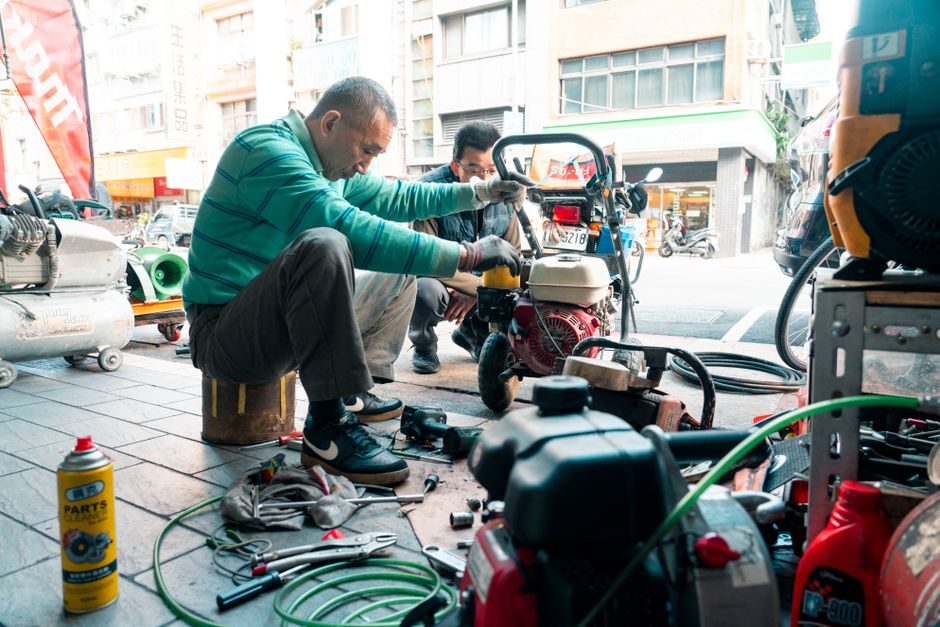
A framing-grade pneumatic nail gun such as the SENCO A20 drives 101 mm (4 in) collated nails into dimensional lumber at 70-120 psi shop-air pressure, while a pneumatic air pick consumes a comparable 90 psi inlet to deliver repeated percussive blows for concrete chipping, scaling, and weld spatter removal.
Both tools share a 3/8 in NPT air inlet, an in-line lubricator, and a die-cast aluminium or magnesium body, but the working end, energy delivery, and consumable path differ completely. The 2026 trade listings on Made-in-China, eBay, and Yiwugo show framing nailers priced from US$31 to US$106 per piece at 1-100 piece MOQ [S2][S6][S3], while pneumatic chipping hammers occupy a parallel SKU range with chisel and point bits as the wear items rather than nails or staples.
Working Principle and Energy Path
A pneumatic nail gun converts compressed-air flow into a single linear piston stroke that drives a collated nail, staple, or brad into the workpiece; the fastener is the consumable, the workpiece is the target, and recoil is along the fastener axis [S1]. The SENCO A20 framing configuration is rated for 101 mm (4 in) nails and accepts a 21-degree or 28-degree collation angle, depending on magazine geometry [S6].
An air pick, by contrast, converts the same shop-air supply into a reciprocating hammer stroke delivered through a hex or round retainer to a chisel or point bit. The bit strikes the substrate roughly 1500-3000 blows per minute depending on model, and the energy at the tip is what does the work, not a fastener. Pneumatic chipping hammers therefore have no magazine, no collation, and no trigger safety in the fastener-driving sense; their trigger is a throttle valve feeding a self-actuated or trip-valve piston.
Operating Pressure, Air Consumption, and Hose Size
Framing nailers in the 2026 sourcing channels are published at 70-120 psi (4.8-8.3 bar) working pressure with a 1/4 in NPT inlet and a recommended 3/8 in ID hose at 7.6 m or less to keep pressure drop below 10% at 60-70 CFM peak demand [S2][S3]. Continuous cycling on a framing deck pulls 4-6 SCFM at 90 psi on average, with peak instantaneous demand closer to 8 SCFM per gun.
Air picks sit in a comparable pressure window, 80-100 psi typical, but the air-per-stroke figure is what matters: a 1-1/8 in hex chipping hammer on a 90 psi supply consumes roughly 18-25 CFM under continuous-on use. Compressor sizing for a fleet of picks must therefore account for 4-5x the SCFM of a nailer of similar inlet size, and a 3/4 in ID hose is commonly specified for hand-held chipping work to keep pressure drop down over 15 m runs.
Fastener Type vs Bit Type: The Consumable Decision
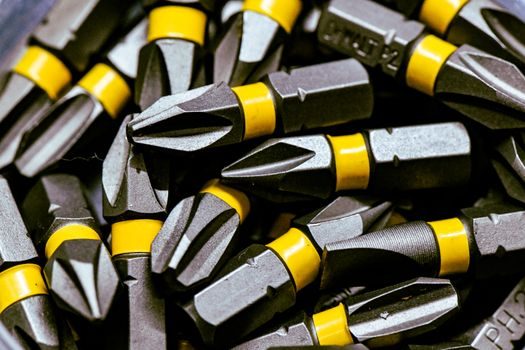
Nailer consumables are defined by collation angle, shank type, and head style: 21-degree plastic-sheet collated framing nails, 28-degree wire-collated framing nails, 18-gauge brads, 22-gauge pins, and 1/4 in crown staples are the dominant SKUs in the 2026 Made-in-China and Yiwugo trade data [S2][S3]. F30, F50, and T50 staple designations refer to specific Senco-type wire crown widths and leg lengths and remain the de-facto reference for cross-brand fitment on pneumatic upholstery and packaging staplers [S4].
Pick consumables are 1-1/8 in hex or .580 round shank chisels, scaling tools, and weld spatter needles; they are specified by shank geometry, tip profile, and length (typically 150-450 mm), not by shank diameter or collation. The pneumatic U-gun category sits between the two, driving U-shaped staples for rattan, aluminium trim, and insulation retention, with a magazine geometry closer to a nailer than a pick [S5].
Use-Case Fit: Who Buys Which
Framing crews, carpenters, roofers, pallet manufacturers, and crating shops buy nailers; the decision pivots on nail length (50-130 mm), magazine angle (straight, 21-degree, 28-degree, 34-degree), and depth-of-drive adjustability. The 2026 trade price floor for an export-grade framing nailer sits at US$31-36 per piece at 1-piece MOQ from Liaoning-based suppliers, with retail NuMax units at US$106 on eBay US listings [S6][S3].
Foundry cleaning crews, shipyard welders, bridge maintenance teams, demolition contractors, and concrete restoration outfits buy air picks; the decision pivots on bit shank (1-1/8 in hex, .580 round, 1 in hex), blow frequency, and vibration-dampened handles for ISO 28927 compliance. A pneumatic pick is the wrong tool for fastening, and a nailer is the wrong tool for removing a weld pass, and choosing the wrong one wastes a shift and a consumable budget.
Safety, Maintenance, and Serviceability Differences

Framing nailers are governed by fastener-driving tool standards covering accidental discharge (often a work-contact safety yoke plus a sequential-trip trigger), and modern export units ship with anti-dry-fire mechanisms that lock the trigger when the magazine runs empty [S6]. Routine service is 1-2 drops of pneumatic tool oil per shift through the air inlet and a daily magazine wipe-down.
Air picks carry different safety exposure: vibration-related hand-arm injury is the dominant operator risk, and modern chipping hammers are specced to meet ISO 28927 hammer-class vibration limits, with handles isolated by elastomer mounts. Maintenance centres on bit-retainer spring replacement, valve-bushing lubrication, and silencer element cleaning; the fastener-feed path that defines nailer service simply does not exist on a pick.
Comparison Table: Nailer vs Pick on Five Decision Criteria
On the five criteria that actually drive a 2026 purchase decision, the gap is clear. Working pressure bands overlap (70-120 psi nailer vs 80-100 psi pick), but air consumption per shift is 2-5x higher on a pick. Consumable cost per cycle is fractions of a cent on a nail, several cents on a bit. Operator-vibration hazard is low on a nailer and material on a pick. Fastener-or-bit magazine complexity favours the pick for simplicity; depth-of-drive and cycle-rate control favour the nailer. [S1]
For procurement teams that also spec air impact wrenches and pneumatic actuators on the same shop-air ring, the same 90 psi / 1/4 in NPT standard applies, and a solenoid valve on the drop manifold lets one compressor feed both fastening and chipping tools without manual re-plumbing. An air quality monitor on the receiver is worth the spend when picks and nailers share a line, because moisture carryover corrodes the nailer's rubber O-rings and starves the pick's throttle bore in different ways.
Trackable signals for 2026: monitor whether your framing-nailer fleet cycles above 4-6 SCFM average per gun for a 70-psi receiver setting, and whether pick operators are logging vibration exposure per ISO 28927.9 trigger-time. Both numbers feed straight into a compressor-upgrade decision and a hand-arm-vibration compliance review. For crews that also drive fasteners with a cordless option, the Impact Drill vs Sander spec cut for 2026 power-tool buyers lays out the corded-vs-cordless decision for the drilling side of the same job site.