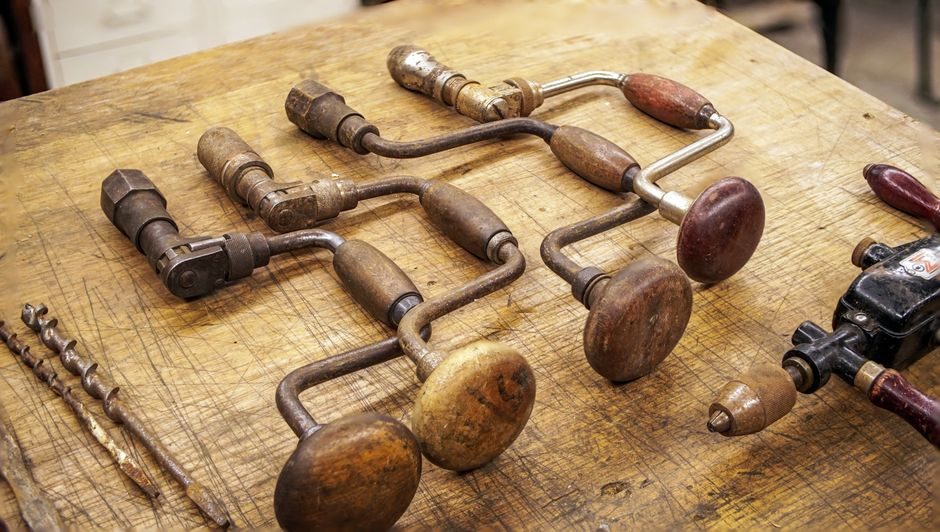
Impact drills and sanders sit on the same corded/cordless platform but solve different jobs: an impact drill combines rotation with a percussive hammer action (typically 0–3000 min⁻¹ no-load speed, 13 mm keyless chuck) to bore into masonry and steel, whereas a sander — random-orbital, belt, or detail type — drives abrasive media across a surface at 4000–12,000 OPM for finishing work only.
Source listings for corded impact drills cite 230 V / 50 Hz mains input, 1050 W motor input, 0–1140 min⁻¹ low / 0–3000 min⁻¹ high speed range, 13 mm chuck, 16 mm concrete / 13 mm steel capacity and 16.5 kg per 5-piece export carton [S4]. A 7.5 A / 120 V corded model running 0–2800 RPM is also listed at the consumer-professional crossover [S3]. Cordless 18 V impact drills ship with 1.5 Ah packs, 20+1 torque settings, 10 mm shank and single-sleeve chucks [S5].
Core Function and Mechanism
Impact drilling works by stacking a rotational axis with a coaxial hammer cam that engages two clutching jaws, delivering short axial impacts (typically thousands per minute) on every revolution. Mfrbee's 1050 W / 230 V listing is a representative of the corded form factor: two mechanical speed ranges, 13 mm keyless or keyed chuck, 16 mm max in concrete and 13 mm in mild steel [S4]. The Bosch UniversalImpact 18V replaces the mains cord with an 18 V Li-ion pack but keeps the same dual-mode drill + impact action, with a 10 mm shank sized to consumer-grade bits and screws rather than the 13 mm industrial chuck [S5].
Sanding, by contrast, is a pure rotary or eccentric motion without axial percussion. Random-orbital sanders typically spin a hook-and-loop pad at 4000–12,000 OPM with a 2.5–6 mm orbit; belt sanders run a continuous abrasive loop; detail sanders use triangular or finger pads for corners. None of those motions create percussive force, which is why a sander cannot substitute for an impact drill on masonry and an impact drill will destroy a sanding pad in seconds.
Selection Criteria: Power, Speed, Chuck and Capacity
Power: 500 W corded impact drills cover light masonry and 6–8 mm wood holes; 800–1100 W covers 13 mm steel and 16 mm concrete — the 1050 W Mfrbee unit sits at the upper consumer / lower professional tier [S4]. 18 V cordless platforms deliver 30–60 Nm of torque, with peak impact rates often undisclosed by DIY brands [S5]. Industrial buyers should match wattage to the maximum bit diameter in the hardest intended substrate.
Speed range: a two-speed gearbox (e.g. 0–1140 / 0–3000 min⁻¹) lets the operator keep torque high for large hole saws and low speed for screw-driving [S4]. Single-speed corded drills up to 2800 RPM exist at the budget end [S3]. Sanders don't expose RPM to the user; they expose OPM (orbits per minute) on the pad, and the meaningful spec is orbit diameter (2.5 mm = aggressive, 6 mm = fine finish).
Chuck and shank: 13 mm keyed or keyless chucks accept 1/2-inch impact-rated bits for masonry and metal — see the impact drill reference for the full bit-shank and CFM-impact geometry [S2]. Cordless DIY drills at 10 mm shank are limited to light-duty HSS bits under 10 mm [S5]. Sanders use pad-specific hook-and-loop or clamp attachments, not rotary chucks.
Who It Is For — And Who It Is Not For
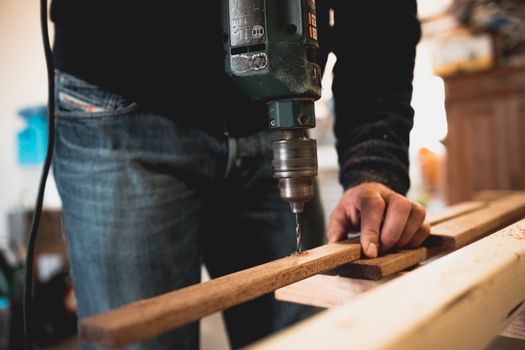
Impact drill buyers are electricians, fitters, MRO technicians, scaffolders, light-construction crews and serious DIY users who need to anchor into brick, concrete or structural steel. A buyer specifying an impact drill needs at least 600 W, a 13 mm chuck, an impact-rated bit set in HSS or carbide-tipped geometry, and (for masonry ≥ 10 mm) hammer mode engaged [S4][S2].
Sander buyers are finish carpenters, cabinetmakers, automotive refinishers, floor-sanding contractors and surface-prep crews in metal fab. A buyer specifying a sander needs to choose orbital vs random-orbital vs belt vs detail, match dust extraction to OSHA/EH40 or equivalent local limits, and pair abrasive grit to substrate (60–80 grit for stock removal, 120–180 for between-coat sanding, 220+ for finish). Buyers who need to bore holes should not buy a sander — no sander variant can replace an impact drill on masonry, and forcing a drill bit into a sander pad destroys the bearing.
Cross-functional buyers — the cabinetmaker who also hangs cabinets, the electrician who sands junction boxes — should plan for two separate tools, not one hybrid. Hybrid "sander-drill" tools do exist at toy grade but are not present in the May–June 2026 OEM listings reviewed here [S1][S4].
Comparison: Impact Drill vs Sander on Four Decision Criteria
Lining the two tool families up against the same four criteria makes the choice mechanical. (1) Primary function: impact drill = hole-making in masonry/metal/wood, sander = surface abrasion/finishing. (2) Motion type: impact drill = rotation + axial percussion, sander = pure rotation or eccentric orbit, no percussion. (3) Key spec to compare: impact drill = chuck size in mm + watts + max RPM + max hole in concrete, sander = orbit diameter in mm + OPM + pad size + dust port diameter.
By those four criteria, the two tools don't overlap on a single axis. The only shared spec is "rotary hand-held power tool" and the answer there is to spec them separately rather than try to consolidate. For buyers building a small-shop tool kit, the Angle Grinder Selection: 6 Spec Gates for 2026 Industrial Buyers guide covers the third major rotary tool family in the same 230 V / 1000 W class as the 1050 W impact drill listed here [S4].
Real Use Cases and Failure Modes
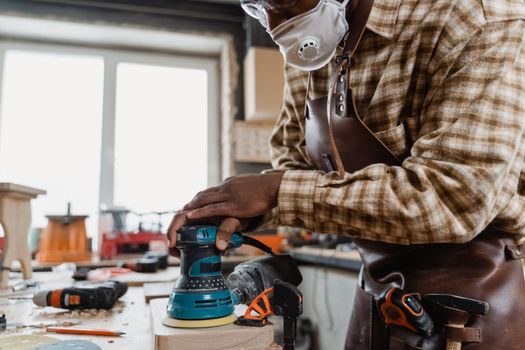
Impact drill, on-tool use cases: 6–16 mm anchor holes in concrete, 1–13 mm holes in structural steel, 1–32 mm holes in wood with hole saws, mixing thinset and paint with paddle attachments (low speed, no impact). Failure modes: burning out the motor by stalling in engaged hammer mode on a 16 mm bit in 30 MPa concrete without rated capacity, snapping small-shank bits in 13 mm chucks (always use impact-rated bits [S2]), and chuck slip on keyed chucks that are under-tightened.
Sander, on-tool use cases: paint removal at 40–80 grit, between-coat sanding at 180–220, fine finish at 320+, denibbing clear coats at 400+ with interface pads, metal surface prep at 60–120 before coating. Failure modes: dished sanding (operator pressure too high on random-orbital), swirl marks (too-fine grit used for stock removal), premature bearing failure from fine dust ingestion when dust extraction is disconnected, pad burn-through on belt sanders when the belt is tracked off-centre.
Cross-substitution failure modes: using a sander to "drill" a hole produces a polished, slightly dished circular burnish — no through-hole, ruined pad. Using an impact drill with a sanding disc converts the tool into a destructive grinder: the percussive action shatters the abrasive disc, throws fragments, and in seconds damages the bearing and the workpiece.
Sourcing, Standards and Trackable Signals
OEM impact drills in the May–June 2026 sourcing window include Tiankon Machinery&Electric (Zhejiang), 500-piece MOQ, 100,000-piece annual capacity, supporting L/C and T/T, with sander, angle grinder, rotary hammer and cordless drill on the same production line [S1]. Mfrbee lists a 3000-piece run from a generic 1050 W / 13 mm model out of China [S4]. Bosch DIY sells the 18 V UniversalImpact through consumer retail channels at 1.5 Ah pack size, 20+1 torque settings, 10 mm shank, single-sleeve chuck [S5].
Standards: corded impact drills in this class typically carry CE / EN 60745 (hand-held motor-operated electric tools safety), EMC EN 55014, and RoHS; cordless platforms add UN 38.3 for the Li-ion pack and IEC 62133 for cell safety. IEC 62841 is the umbrella standard for the newer combined hand-held tool family, but the exact applicability to a given SKU must be confirmed against the manufacturer's declaration of conformity rather than inferred from the listing. ATEX-rated impact drills exist for zone-1/2 use but are not present in the May 2026 OEM listings reviewed.
Trackable next nodes: (1) whether the Tiankon 100,000-piece annual capacity expands to 150,000+ in the second-half 2026 production plan, (2) whether Bosch DIY ships a 2.5 Ah or 4.0 Ah pack option for the UniversalImpact 18 V chassis, (3) whether any 2026 H2 listing surfaces an SDS-plus impact drill in the sub-150 USD retail band (currently dominated by 13 mm keyed/keyless chuck models only). Buyers pairing an impact drill with site power should also review the Plasma Cutter 2026 Buying Guide and the Oxy-Fuel Cutting Torch 2026 Buying Guide for adjacent metal-fab tool specs, since site power, duty cycle and dust extraction overlap across the tool kit.
For component-level specifications, see air impact wrench.