Select a multistage centrifugal pump for irrigation when the system requires high total dynamic head: multiple impellers in series can reach 816 m head in published UN D-series configurations [S2].
The correct selection depends on design flow, static elevation, pipe friction, suction conditions, and water chemistry, not on pipe diameter alone [S8].
Multistage Pumps Match High-Head Irrigation Duty
A multistage centrifugal pump uses two or more impellers mounted in series, with the discharge from one stage feeding the next stage; pressure rises stage by stage while flow remains essentially constant [S3][S4]. This series arrangement allows a single multistage unit to reach heads or pressures that a single-stage pump cannot manage on its own [S3].
That makes multistage equipment the practical choice for long irrigation mains, elevated reservoirs, sprinkler systems requiring sustained pressure, and booster duties. Published UN D-series multistage configurations extend to 816 m head, depending on model and configuration [S2]. For a broader pump-class comparison, see multistage pumps and centrifugal pumps.
The stages do not create additional flow. They distribute the pressure-building load across multiple impellers, with pressure increasing as the liquid moves from one impeller to the next [S4]. The tradeoff is a longer rotor, more wear rings, more interstage clearances, and more alignment sensitivity [S3][S4].
Build the Duty from Flow and Total Dynamic Head
Calculate total dynamic head, TDH, as static lift plus pressure requirements, pipe and fitting losses, and any required discharge pressure; irrigation pump selection should use both flow and TDH rather than the existing pipe size alone [S8].
Define the design flow from the irrigation area, crop demand, irrigation method, and operating schedule. Then select a pump whose performance curve covers that flow at the calculated TDH, with the duty point close to the manufacturer’s best efficiency point rather than at the extreme end of the curve [S1][S7]. Available impeller trimming and future system growth should be represented in the comparison, but the pump must still deliver the required flow and head at the worst planned operating condition [S1][S7].
Do not size the motor from pump nameplate power alone. Use the maximum absorbed shaft power across the anticipated operating range, including the effect of water density, viscosity, impeller diameter, and motor efficiency. The selected motor must cover that load without overloading, while maintaining adequate margin for the site’s voltage variation and starting method.
Compare Horizontal, Vertical, and Single-Stage Options
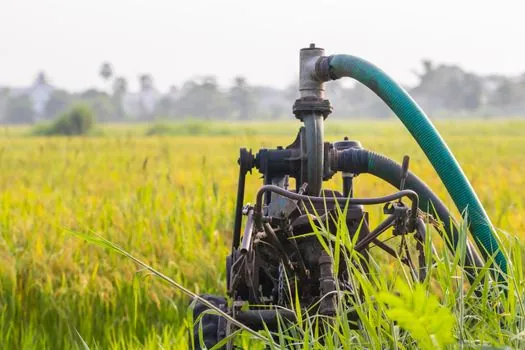
Horizontal multistage pumps generally suit high-flow service and are identified by a segmented casing, while vertical multistage pumps use a vertical shaft with stacked impellers and smaller installation footprints [S4]. The following comparison applies the selection criteria that matter most for irrigation:
For most open irrigation systems requiring moderate flow and low head, a single-stage pump may be simpler and less expensive. For high-pressure sprinkler or long-pipeline service, a horizontal multistage pump generally gives the better balance of head, flow, and serviceability [S4][S5].
Verify Suction Conditions Before Selecting the Stages
Net positive suction head available must exceed the pump’s NPSH requirement with a suitable margin at the minimum suction pressure and maximum flow condition [S1][S7].
Calculate suction losses from the source-water level, suction pipe length and diameter, fittings, and screen or strainer resistance. For a tank or pond, include the minimum drawdown level rather than the highest water level. For a well, include seasonal water-level variation and the effects of alignment. If the calculated margin is inadequate, reduce suction losses, lower the pump, modify the suction design, or select a pump with a lower NPSH requirement rather than accepting cavitation risk.
Cavitation is not the only failure mode. The final pump should therefore have a documented thrust-control arrangement, aligned coupling or shaft system, and suitable bearing and vibration monitoring provisions.
Match Materials and Sealing to Irrigation Water
Specify wetted materials from the actual water analysis rather than from a generic irrigation label. Parameters to request include suspended solids, hardness, total dissolved solids, chloride, pH, temperature, and treatment chemicals [S1][S7]. Galvanized, carbon steel, stainless steel, and polymer options each have different limits, but the material grade must be checked against the specific water and installation conditions.
Mechanical seals and packing are additional wear items in multistage machinery because more stages create more interstage pressure boundaries and clearances [S3][S4]. Review seal-face material, elastomer compatibility, flush arrangement, and whether the pump can be drained or isolated during non-irrigation periods. A seal that suits clean freshwater may not remain compatible with chlorinated water, fertilizers, pesticides, or variable temperature.
For systems carrying fertilizers or treatment chemicals, obtain the complete wetted-material schedule and compatibility declaration with the quotation. If solids are present, check the manufacturer’s permitted particle size and specify appropriate suction screening rather than relying on undocumented clearances [S1][S7].
Account for Parallel Duty, Controls, and Irrigation System Components
For large networks or variable demand, compare a single pump with multiple pumps in parallel and duty/standby arrangement. Parallel operation can provide redundancy, but all pumps on a common header must have compatible head and flow curves, and non-linear or steep curves can cause unstable operation or excessive flow from the smaller pump. Include check valves, isolation valves, gauges, and pressure-control equipment in the system assessment. [S3]
Variable-speed control can reduce throttling losses and match output to irrigation demand, but it does not eliminate the need to select the pump for minimum flow, maximum head, and NPSH margin. If downstream pressure must remain within a controlled band, review control valve selection for irrigation systems alongside pump selection because valve authority and system friction determine how the pump and controls interact.
Installations also need a means to isolate, drain, and protect the pump. Confirm suction and discharge pressure gauges, a non-return valve where reverse flow is possible, a drain path, motor protection, and a disconnect arrangement. For a detailed comparison of flow control and shutoff behavior, review butterfly valve selection for irrigation systems.
Use a Procurement and Acceptance Checklist
A defensible irrigation pump specification should state the required flow, calculated TDH, minimum and maximum operating conditions, suction source details, NPSH available, water chemistry, required materials, motor voltage, and applicable installation standard [S1][S7]. Pipe size may reveal friction losses, but it cannot independently establish pump capacity or TDH [S8].
Request the manufacturer to identify the exact pump model, stage count, maximum impeller diameter, trimmed impeller options, certified performance curve, guaranteed operating point, NPSH curve, absorbed power, motor rating, seal arrangement, and materials of construction. Check that the quoted point falls within the certified operating range and lies near the best efficiency point [S1][S7].
During installation, verify foundation or baseplate support, pipe strain, suction and discharge alignment, valve position, and motor rotation. After commissioning, compare measured flow and head against the purchase specification and inspect vibration, bearing temperature, seal leakage, and motor current. The shortlist logic is straightforward: use a single-stage pump for modest head and simple duty, a horizontal multistage pump for high-head or high-flow networks where service access is available, and a vertical multistage package where floor space is constrained and the flow duty is suitable.