
A poker vibrator head's length is the ceiling for a single concrete lift: the layer being compacted should never be deeper than the head itself, since only the immersed head transmits vibration energy into the mix [S6]. For eccentric-electric heads, the practical limit stretches to roughly 1.5x the head length, beyond which lower concrete receives no useful fluidization and trapped air stays locked in the bottom of the lift [S1].
Where structural elements are deeper than 300-500 mm, the lift must be poured in successive layers with the vibration zone of each pass overlapping the one below, so the consolidation front advances upward without leaving a cold joint or a void band between layers [S1]. Common head diameters span 25-75 mm, with commercial 28, 38, 45, 50, 60 and 75 mm sizes dominating catalogues [S2][S1]. Standard site frequency sits around 10,000-13,000 vpm, with amplitude scaling from roughly 0.65 mm on a 25 mm head to about 1.6 mm on a 50-60 mm head, and centrifugal force rising from approximately 800 N to 7,000 N across the same range [S1].
Why head length, not shaft length, sets the layer-depth ceiling
The shaft only transmits rotation; it does not vibrate. The vibrating bottle, typically a steel cylinder 350-500 mm long depending on diameter, is the only part that fluidizes the mix, and that fluidized zone sits in a roughly hemispherical cloud centred on the immersed head, not along the hose above it [S6][S2]. This is why transmission length is a separate decision (commonly 0.5 m to 16 m, with at least 1 m of head submersion margin recommended beyond the pour depth) and is not interchangeable with head length when calculating lift thickness [S4].
Two practical rules come out of the geometry. First, the layer depth should be less than or equal to the head length for standard electric pokers, and less than or equal to 1.5x head length for eccentric-electric high-frequency types because their slightly wider influence radius reaches a bit further vertically [S1]. Second, when a slab or wall is deeper than 300-500 mm, plan to pour in two or more lifts and re-poke into the top of the prior lift at each insertion point so the new layer fuses with the one below; this is the standard remedy for the head-length ceiling on deep pours [S1][S6].
Influence radius, spacing, and how they interact with layer depth
Every head size has a measurable influence radius around the bottle where the concrete temporarily liquefies. The widely cited commercial rule is that influence radius equals roughly 10x the head diameter, with a more conservative 4x figure used in some guidelines, so working spacing typically lands at 1.0-1.5x that radius with insertions overlapping [S1]. Translated to common sizes: a 25 mm head gives a roughly 250 mm influence diameter, a 38 mm head roughly 380 mm, a 50 mm head roughly 500 mm, and a 60 mm head roughly 600 mm, with 50 cm spacing cited as a typical default for an ordinary site poker [S1][S2].
This radius is horizontal as well as vertical, which is why closely spaced insertions in a single lift are as important as correct lift thickness. A 50 mm head with insertions placed at 250-375 mm centres will consolidate a 300-400 mm deep lift in a single pass, while the same head asked to consolidate a 700 mm deep pour needs the work split into two lifts with the upper insertions overlapping the prior lift's pattern [S1]. Concrete slump and aggregate size shift the effective radius: dry, stiff mixes shrink the influence zone and demand closer spacing, while high-slump flowable mixes widen it [S3][S4].
Matching head diameter to rebar, slump, and lift thickness
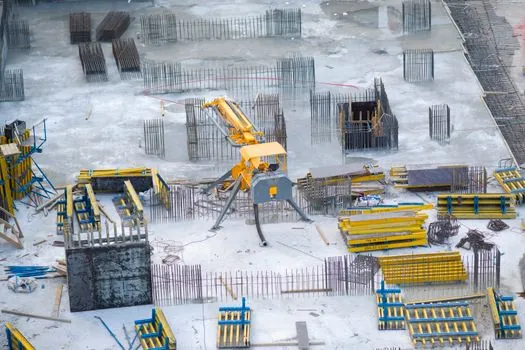
Head diameter is the variable that most often forces a compromise between layer depth, rebar clearance, and output rate. The practical brackets in the research line up as follows: 25-35 mm for thin walls, precast moulds, dense rebar columns, and lifts under 300 mm; 35-45 mm for general slab work, medium beams, and light columns at 300-500 mm depths; 50-60 mm for standard beams, slabs, moderate reinforcement, and heavy pours where high-slump mixes are used; 60-90 mm (often pneumatic) for mass pours, large footings, pile caps, and very thick lifts where the operator wants to minimize insertion count [S1][S3][S4].
Selection criterion interactions are worth stating plainly. Dense rebar and narrow formwork force the operator down to 25-35 mm heads even on a 500 mm thick wall, and on a stiff, large-aggregate mix those same small heads will clog, so the practical compromise is the larger of the two constraints [S1][S4]. For pours over 500 mm thick with normal rebar spacing, the 50-60 mm head wins on productivity because each insertion consolidates roughly 0.2-0.28 square metres of plan area (based on a 500-600 mm influence diameter) and the head length clears the full lift in a single pass [S1][S2]. Larger heads also carry operator-fatigue cost: 50-60 mm electric heads run heavy, and on sustained pours the trend is to drop to pneumatic 75 mm heads or engine-driven 50 mm systems with a harness to take the load off the operator [S1].
Recommended approach by lift depth, with explicit numbers
For lifts up to 300 mm (typical floor slabs, thin walls, patches): a 25-35 mm head at 12,000-13,000 vpm, insertion spacing 150-250 mm on centres, single-lift pour is standard, and no overlap into a previous layer is required [S1][S4]. For lifts in the 300-500 mm band (general beams, columns, moderate slabs): a 38-50 mm head at 10,000-12,000 vpm, spacing 250-400 mm, single-lift pour works because head length still covers the full depth, and 1.0-1.5x radius overlap between insertions is sufficient to fuse the entire layer [S1][S4].
For lifts of 500-750 mm (deep beams, thick pile caps, heavy foundations): either a 60 mm head poured in two lifts of roughly the head length each, or a 75 mm pneumatic head poured in a single lift with insertion spacing around 500-600 mm, with every pass overlapping the previous one by 1.0-1.5x radius [S1][S2]. For lifts beyond 750 mm (mass pours, large pile caps, deep foundation walls): split the work into multiple lifts of approximately head length each, use a 60-75 mm head for productivity on the lower lifts, and verify that the upper insertion pattern re-penetrates the top of the prior lift at every point, not just at the edges [S1][S6]. For more on how diameter and frequency trade off across the rest of the concrete tooling chain, the ENAR guidance ties the same diameter bands to slab, wall, and column use cases [S4].
Common failure modes when head length and layer depth are mismatched
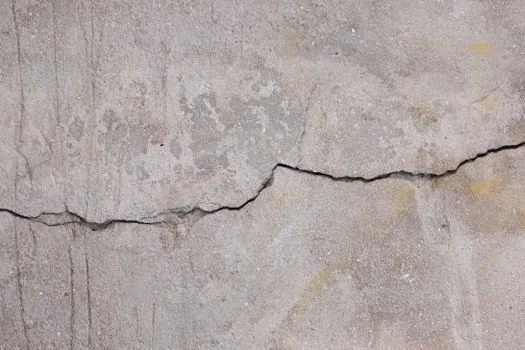
Three failure modes show up on site when the rule is ignored. Bottom-of-lift honeycombing occurs when the lift is deeper than the head's influence zone can reach, leaving a consolidated crust over a void-rich base that the next layer's vibration cannot fully re-fluidize [S1][S3]. Cold joints form between lifts when the lower layer has already begun initial set before the upper layer is poured and poked back into it, and the head-length rule interacts with this because deeper-than-head lifts take longer to place and vibrate, eating into the working time [S1]. Operator over-reliance on surface vibration shows up when the head cannot reach the bottom of a deep lift; crews compensate by running a surface vibrator on top, which only consolidates the upper 100-150 mm and does nothing for the base of a 500 mm+ pour [S3].
Working concrete for slab pours also means tracking how slump, aggregate size, and ambient temperature shift the influence radius in real time: a mix that poured cleanly at 100 mm slump at 20 C will consolidate with a noticeably smaller zone at 50 mm slump at 10 C, so spacing and lift thickness should be tightened, not held at the lab values [S5][S4]. Where admixture selection or fiber dosing is pushing the mix into a stiffer window, the same caution applies, and head size may need to step up one band to keep the influence radius in spec.
Standards, sourcing, and what to verify before specifying
No single ISO or ACI clause in the research material pins the head-length-equals-layer-depth rule to a specific numbered standard; it is presented as field practice drawn from manufacturer guidance and contractor handbooks [S1][S6]. Concrete vibrator machine selection on site is therefore driven by manufacturer datasheets (Lievers, ENAR, Minnich, Excalibur, Masterpac via All States Africa) plus the project's own mix design, rebar schedule, and lift plan [S2][S3][S4][S5]. Three verifiable numbers to lock in before placing a head on a pour: the head's nominal length (typically 350-500 mm for standard 25-60 mm electric pokers, longer for some 75 mm pneumatics), its rated frequency (10,000-13,000 vpm for electric, up to 16,000 vpm for some pneumatics), and its measured amplitude at the tip under no-load conditions [S1][S2][S5].
Trackable signals for the next planning cycle: confirm whether the 2026 Excalibur table on eccentric-electric 1.5x head-length allowance is being adopted by ENAR or Minnich in their printed datasheets, and whether the ENAR transmission-length guidance of "at least 1 m longer than insertion depth" is being enforced on the deep-lift projects in your 2026-Q4 pipeline [S1][S4].
See also our earlier report, Mag-Drive vs Canned Motor Pump: Zero-Emission Spec Cutoff.