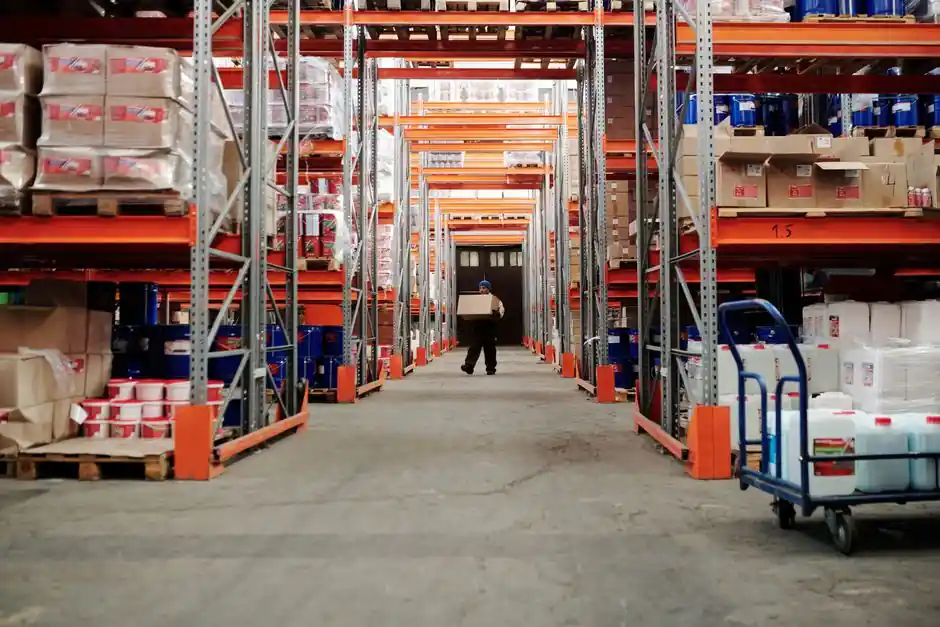
Port-side pallet rack design is governed by three hard gates: bay capacity in the 8,000–12,000 kg/frame band common to heavy-duty selective systems [S6], salt-air corrosion protection beyond standard powder coat, and pallet footprint compatibility with the 1,200×1,000 mm ISO module used through most container terminals.
Operators running mixed import/export SKUs through berth-side CFS sheds typically pair selective teardrop frames with hot-dip galvanized (HDG) beams, while high-density full-pallet stock is moving to drive-in or two-way shuttle ASRS cells for last-in-first-out container stripping cycles [S2][S3].
Load class and frame geometry for berth-side duty
Heavy-duty selective frames documented in the supply base carry up to 12,000 kg per frame pair, with beam thicknesses in the 3 mm range welded at three points with locating tabs and safety pins as the standard connection detail [S6]. Frame depth commonly runs 800–1,500 mm to match the 1,000–1,200 mm pallet depth used in ISO container handling, which keeps the load centroid inside the frame's vertical plane and limits beam twist under dynamic forklift impact [S6].
For mixed-port SKUs, selective teardrop remains the default because it accepts 100% of pallet types and lets counterbalanced forklifts work from both aisles, a throughput-critical factor when vessel cut-off windows compress receiving cycles [S3]. Where a port operator runs higher rack heights than 6 m, the spec typically shifts to VNA (very narrow aisle) wire-guided turret trucks and corresponding rack frames rated for that geometry, since standard counterbalanced trucks cannot safely index above that height in seismic or high-wind coastal zones [S2].
Corrosion protection: HDG, pre-gal, and powder-coat selection
Within 500 m of a salt-water berth, atmospheric chloride exposure pushes designers toward HDG frames (typical coating 70–85 microns) or pre-galvanized beams, rather than the post-fabrication powder coat common in inland warehouses. Hyperack's SIRIM-certified Malaysia production line, serving Klang and Penang port hinterland, ships HDG and pre-galv options as standard, with conventional medium/heavy lines, boltless rack, cantilever for timber, and the full selective / double-deep / VNA / drive-in / push-back / gravity-flow / two-way shuttle / four-way shuttle ASRS family under one engineering roof [S2].
Inspection regimes matter as much as the coating: dedicated rack-inspection service providers in 2026 publish risk-based reporting tied to beam deflection limits, anchor torque, and column damage ratios, with compliance audits against the operator's safety standard built into every visit [S7]. Used-rack buyers in the port sector are cautioned that a re-galvanized beam after cut-down does not recover the original coating thickness at the cut edge, so HDG-fabricated-then-cut racks carry a hidden corrosion risk at the cut zone in marine air [S8].
Pallet footprint compatibility and the 1,200×1,000 mm ISO module

The 1,200×1,000 mm ISO pallet footprint is the de facto standard through European and Asian container terminals, and frame depths of 1,000–1,200 mm give the best fit, with 1,500 mm reserved for two-pallet-deep cells where drive-in or push-back racking is in use [S6]. For North American port sheds handling 1,219×1,016 mm GMA pallets, frame depth lands at 1,067–1,219 mm, which is the reason port-zone racking is rarely cross-spec'd without a footprint re-check [S3].
When operations handle both ISO and GMA pallets, the prudent path is a frame at 1,067 mm depth with adjustable beam levels in 76.2 mm increments (the teardrop standard pitch), which lets a single bay accept either footprint without dedicated cells. Plastic pallets are increasingly specified in chilled-port applications for hygiene and weight reduction; the plastic pallet category has grown as reefer container stripping needs lighter tare and easier wash-down than wooden blocks.
Density options: selective, drive-in, push-back, and two-way shuttle
Selective teardrop delivers ~35% storage density relative to floor-stack but 100% SKU accessibility, which is the right trade for a port's mixed manifest. Push-back uses 2–5 deep pallet lanes on inclined roller rails, recovering ~80% density with near-FIFO discipline and is common for dated import stock awaiting customs clearance [S3].
For berths feeding automated container yards, the two-way shuttle ASRS cell (pallet racking + battery-powered shuttle cart) has become the highest-density option at ~85% net volume utilization, and pairs naturally with pallet stacker intake conveyors at the quayside end [S2]. Choosing between these is a rotation-policy decision: LIFO/aging-stock flow goes to drive-in, near-FIFO goes to push-back, full-FIFO with high SKU count goes to selective, and high-throughput low-SKU goes to two-way shuttle.
Seismic, wind, and anchorage at coastal sites

Coastal rack installations must combine the rack's own seismic design category (commonly SDC C or D in West Coast North American ports, lower in sheltered Asian harbors) with wind loading for outdoor yards and wind-uplift checks for any covered rack-supported platform. Base-plate anchor bolts at port sites are typically M12×100 mm or M16×125 mm chemical anchors into 150 mm minimum slab, with torque verification during the annual inspection cycle [S7].
Where the storage rack is part of a rack-supported mezzanine or platform (a common footprint-saver in port-CFS mezzanines), the platform deck load, column point loads, and rack frame must be engineered as one assembly rather than separately, since the column point load can double versus a free-standing frame and the frame schedule must be upsized accordingly [S2][S3].
Inspection, lifecycle, and used-rack caveats in port duty
Port-duty racks see roughly 2–3× the impact event count of an inland DC because reach-stackers, empty container handlers, and counterbalanced forklifts all converge at the quayside shed. Independent inspection providers in 2026 publish annual audits against the operator's safety standard, with photographic condition reports that flag column deflection > 3 degrees, beam-end connection distortion, and missing safety pins as immediate-downgrade items [S7].
Used rack trade is active in the port sector because operators turn over bays faster, but a 2010-vintage teardrop frame re-used in marine air without recoating will typically need beam replacement within 5 years versus 12–15 for HDG-fabricated new stock [S8]. Operators weighing buy-versus-rent for pallet rack capacity should price a 10-year lifecycle: HDG new at higher first cost and 12–15 year life, versus used-and-recoated at lower first cost and 5–8 year life before first major beam replacement.
Selection checklist for port-logistics pallet rack
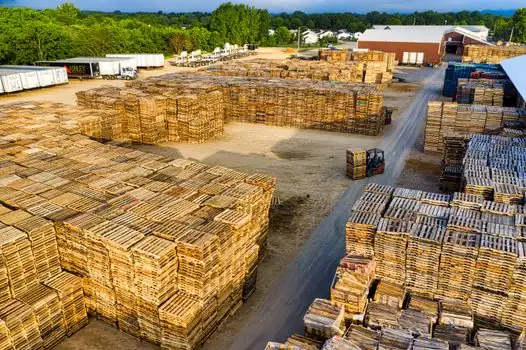
Run the following gates before signing a PO: (1) pallet footprint and required frame depth, (2) maximum bay load and beam section modulus, (3) coating specification (HDG / pre-galv / powder) matched to distance from saltwater, (4) rotation policy (FIFO/LIFO) and matching density family, (5) seismic + wind design category and anchor spec, (6) inspection regime frequency and contract terms, and (7) integration with material handling equipment, since electric pallet truck compatibility and aisle width are coupled and a 100 mm aisle shift can force a rack family change. Operators with prior electronics-handling experience will recognize the same teardrop / capacity / code-gate logic from the Pallet rack selection for electronics handling: 2026 spec map reference, where ESD-safe beams and white powder coat replace HDG and the floor load per square meter is lower but the same five-gate logic applies. For a full port build, the practical next nodes are: confirm a third-party inspection contract before commissioning, and lock the coating spec on the PO rather than leaving it as "galvanized" without a micron callout, because the two supplier readings of that word differ by a factor of three in real salt-spray performance. [S2]