
A positive discharge bucket elevator mechanically inverts each bucket through a snub-wheel pair over the head sprocket, deliberately dumping the load for sticky, sluggish, or wet materials that would otherwise cling to bucket walls [S1][S4]. Operating speeds sit well under 120 ft/min, with end-hung buckets carried between a double-strand engineering-class chain [S4].
A centrifugal discharge bucket elevator relies on high head-pulley speed to throw material out of the bucket, suiting free-flowing, durable, non-fragile bulk solids such as grain, sand, cement clinker, and crushed ore [S2][S4]. The trade-off is the same one that drives fragile-material failures: faster discharge velocity means more fines, more dust, and more product loss when the wrong material is fed in [S2].
How the Two Discharge Methods Diverge on Fragile Loads
Positive discharge elevators carry end-hung buckets between twin chain strands, then route the chain around a pair of snub wheels at the head to fully invert each bucket above the discharge spout; material is tipped out by geometry rather than by speed, which is why pulverised coal, powdered feldspar, and wet sugar beet pulp are listed as typical loads [S4]. A continuous-discharge (gravity) elevator runs at 100-125 ft/min with overlapping buckets that act as chutes for the bucket behind them, giving nearly twice the capacity of a positive unit at the same footprint while still handling fragile material [S4].
Centrifugal discharge units scoop directly from the boot or hopper and sling material out by head-pulley speed, which is why their bucket lips are reinforced (e.g. AC-style) and why this geometry is documented as unsuitable for fragile product: the same forces that clean the bucket also fracture the load [S2]. Engineers who must move friable chemicals, food-grade powders, or pelletised feed therefore select positive or continuous designs rather than centrifugal, even at the cost of capacity [S1][S3].
Decision Matrix: Cost, Capacity, Speed, Material Fit
Selecting between positive and centrifugal discharge is a four-criterion trade, and the research aligns them as follows. Operating speed is fast for centrifugal, slow for positive (well under 120 ft/min), and moderate for continuous (100-125 ft/min) [S2][S4]. Capacity runs higher on centrifugal and continuous designs, lower on positive, with positive units generally more expensive than other conveying equipment because of the chain-and-snub-wheel mechanism [S4][S8]. Material fit places centrifugal on free-flowing, durable, powdered bulk solids, and positive on powdery, sluggish, sticky, or damp loads that need total bucket emptying [S1][S2][S4].
For a side-by-side view, the FEECO comparison pairs centrifugal against continuous on operating speed (fast vs slow), capacity (higher vs lower), loading (direct scoop vs chute-fed), discharge (centrifugal force vs gravity), material suitability (free-flowing/durable vs fragile/friable/abrasive), and best applications (sand/gravel/ore/terminals vs fertilisers/potash/light fluffy materials) [S2]. The C-type bucket profile extends the centrifugal family into lighter, free-flowing, fragile material, but it is still a centrifugal geometry, so it does not solve the sticky-or-sluggish problem that a positive discharge is designed for [S7].
Use Cases That Lock In the Choice
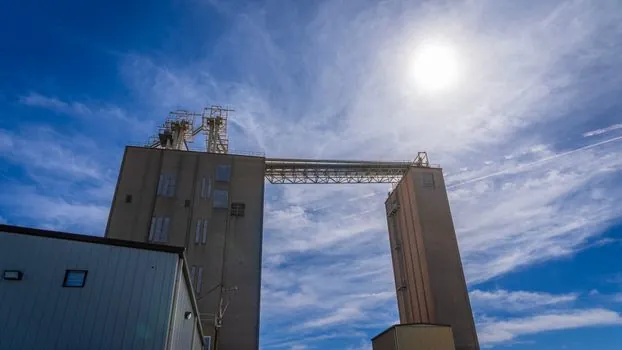
Positive discharge is the right call when the load is powdery, damp, or cohesive enough to retain in a bucket after the head pulley, with KC Supply listing sticky, damp, and cohesive materials, specialty chemical and food applications, and any duty that requires total bucket emptying as the target use cases [S1]. The Renold/World Cement reference adds pulverised coal, powdered feldspar, and wet sugar beet pulp to that list, all of which share a tendency to compact or cake inside a bucket [S4].
Centrifugal discharge is the right call for high-volume, free-flowing material where the cost of a broken pellet or a missing gram of product is low, including grain terminals, sand and gravel plants, ore handling, cement clinker cooling, and shipping terminals [S2][S5]. For genuinely fragile material with no stickiness issue, the third option, a continuous (gravity) bucket elevator, often beats both: KWS notes the slower speed gently discharges fragile bulk material, reducing degradation, while FEECO lists fertilisers, potash, and light or fluffy materials as the canonical continuous-duty applications [S2][S3]. Bucket profile also matters here, and a 2026 review of bucket elevator bucket selection flags the C-type as a shallow-profile option for fragile, lightweight, free-flowing bulk material inside the centrifugal family [S7].
Failure Modes When the Wrong Type Is Installed
Specifying a centrifugal unit for a fragile product causes measurable harm, not just a small yield loss: crushing, fines, dust, product loss, degradation, and fugitive material are all documented consequences of forcing a high-speed discharge on a low-tolerance load [S2]. Running an abrasive material through the same fast system accelerates wear on buckets, belts, and head pulleys, compounding the maintenance burden [S2].
The reverse error is also costly. A continuous elevator on a high-throughput duty bottlenecks production and inflates unit cost, and a positive elevator outside its design envelope drives excessive downtime and component replacement [S2]. The C-type shallow profile is offered as a gentler centrifugal option, but it still depends on centrifugal discharge, so it does not address cohesion or stickiness [S7]. For an adjacent material-handling decision, an engineer weighing bucket and liner polymers can compare polyurethane vs nylon vs HDPE bucket elevator material alongside the discharge choice, since the bucket polymer affects both degradation and residue release on fragile loads.
Spec and Sourcing Notes Engineers Should Anchor
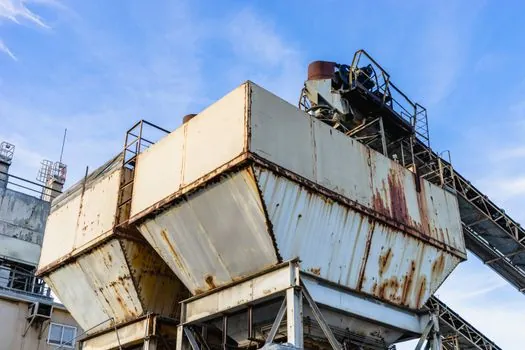
Documented operating envelopes worth carrying into a spec: positive discharge runs well under 120 ft/min, continuous runs 100-125 ft/min, and centrifugal runs faster than both, with the chain-and-bucket assembly built around an engineering-class chain for heavy-duty service [S4]. Super-capacity elevators built on the same chain platform are rated up to 750 tph of 125 lb/ft³ material at 120 ft lift when high-tonnage fragile-handling is required [S4].
On sourcing, IQS Directory notes that positive discharge bucket elevators are generally more expensive than other material-conveying equipment but offer superior reliability, which is the explicit trade engineers should price into a capital-cost comparison [S8]. For background on the broader machine class, the bucket elevator encyclopedia page collects the four canonical types (centrifugal, continuous, super-capacity, positive or perfect discharge) and the head/foot/intermediate-casing layout that all four share [S4]. When pilot data is needed before locking the spec, a structured material test trial ahead of pneumatic conveying design is a useful parallel discipline, since the same bulk-solid characterisation work (particle size, moisture, angle of repose, friability) drives both decisions.
Trackable signals worth watching over the next buying cycle: any 2026-2027 OEM catalogue updates that quote a fragile-product breakage-rate percentage for C-type centrifugal vs positive discharge, and any chain-pricing movement on double-strand engineering-class chain, since chain cost is the main reason positive units sit above the conveyor baseline [S4][S8].
For the relevant spec sheets and selection criteria, see centrifugal pump, and advanced material.