
Plastic pallet capacity numbers stamped on spec sheets assume a uniformly distributed load (UDL) across the deck, and the same number becomes unsafe the moment a reel, drum, or partial-height box shifts the weight to one runner [S2][S5].
Wooden pallets typically support 2,000 to 3,000 lbs, while plastic pallets span 1,500 to 5,500 lbs, and metal pallets run higher, but all of those static numbers are UDL figures derived from ISO 8611 or ASTM D1185 lab tests with the load spread evenly across the full deck [S8][S1]. Point loading concentrates that same mass onto a fraction of the contact area and changes the failure mode from deck bending to runner shear, which is the difference between a rated 1,000 kg UDL and a real-world limit that engineers commonly mark down by 40 to 60% [S3][S5].
Why the UDL Number Is the Only Number on the Sticker
ISO 8611, ASTM D1185, and AIAG RC9 are the three U.S. standards used to certify pallet load capacity, and each one runs the test with the load applied as a uniformly distributed flexible or rigid load, a rigid line load, or a point load depending on the support condition, but never with arbitrary mid-dek contact [S1]. The laboratory setup ties load capacity directly to the strength and stiffness of the blocks and stringers, so the published UDL is really a property of the bottom frame, not of the deck [S1].
Plastic pallet capacity ratings are determined using evenly distributed loads, which means a product should be spread uniformly across the pallet for the rating to hold in service; a 48 in. x 40 in. rackable plastic pallet rated at 1,000 kg UDL can drop to 400-600 kg effective capacity once a single point takes the load [S2][S5]. For more on how pallet structure drives this, see the reference entry on plastic pallet design and materials.
Point Load vs UDL: Same Mass, Different Deflection
A point load is a weight significantly concentrated in one or more places on the rack's beams or decks, while a uniformly distributed load is one whose weight rests evenly over the entire surface of the rack's beams or deck; placing a point load on a beam engineered to only support the weight of a uniformly distributed load increases the risk of failure [S3].
The deflection limit for selective rack beams equals the horizontal length of the beam divided by 180 (L/180) under ANSI MH16.1, and a point load can push a beam past that limit even when the total mass matches the UDL rating [S3]. RMI's separate document, ANSI MH26.2 for welded wire deck, repeats the same rule: deck design must match the specific load type, and a UDL-rated deck fails early under concentrated foot or coil contact [S3]. This is also why load cell instrumentation under racking shows a much higher bending moment per kg of payload when the load is concentrated versus spread.
Three Real Failure Cases, Not Hypotheticals

Case 1, partial-coverage box: a 1,000 kg UDL-rated plastic pallet loaded with a single 800 kg coil of steel pushes the entire reaction through the coil's footprint, roughly 12 in. x 12 in., and the runner bending stress rises by a factor of 3 to 4 over a flat UDL of the same mass [S6][S4].
Case 2, footed pallet on rack beams: totes, wire container bins, and footed pallets have one or more point positions where their weight is focused, and when those feet miss the beam centerline the load transfers through a single contact point per corner, doubling or tripling the localized stress on a beam that was designed for a UDL spread across the full deck surface [S4].
Case 3, line load on stringer pallet: a line load occurs when the load fits on a portion of a stringer pallet or skid, causing the weight to rest on a single or a few lines, and the result is sagging in the unsupported span between stringers, even when the total mass is well under the UDL rating [S4][S9].
How the Bottom Frame Changes the Math
A 2-runner wood pallet sitting on two rack beams has only 4 beam contact points, while a 3-runner plastic pallet on the same two beams has 6 contact points, and the extra points spread the load more evenly into the deck [S5]. For deeper racks, a 1,200 mm pallet on a 900 mm rack frame leaves the rear 300 mm unsupported, which converts a UDL into a cantilever bending case regardless of the plastic pallet's rated capacity [S5].
Runner count, runner height, and deck thickness together set the plastic pallet's effective stiffness, and stiffness is the variable that controls deflection under a point load even when the ultimate strength number on the spec sheet is unchanged. The reference notes on engineering plastic selection cover the resin choices (HDPE, PP, recycled blends) that drive that stiffness delta at a given wall thickness.
Spec-Sheet Numbers vs Real-World Allowable

Common published capacity bands: rackable plastic pallets run 1,000 to 1,500 kg UDL, nestable stackable plastic pallets run 1,500 to 5,500 lbs static but drop into the 500 to 1,000 kg range for racking, and a 3-runner HDPE rackable pallet typically lands near 1,000 kg UDL on standard 96 in. beams [S8][S5][S2]. For dynamic forklift handling the same pallets drop to 1,000 to 2,500 lbs single-trip, and for static floor storage they can hold 5,000 to 30,000 lbs, so the ordering is always racking UDL < dynamic < static [S8].
A 40% to 60% de-rate is the rule of thumb engineers apply when a single point or line contact replaces a UDL on the same pallet, and that de-rate is what should be written on the warehouse floor spec, not the clean ISO 8611 number from the catalog [S3][S5][S6]. For facilities that need to verify the live load, a load cell module under each rack position can record the actual reaction and confirm whether a point-loaded bay is staying inside the derated limit.
Selection Checklist Before You Buy
Match pallet to rack depth: the pallet's runner span must equal or exceed the beam-to-beam clear distance, with a 1,200 mm pallet on a 900 mm rack frame ruled out for racking service [S5]. Match pallet to load type: a 9-block or perimeter-plus-center pallet handles a point load better than a 2-runner stringer pallet because the load has more paths to the beams [S4][S1].
Match pallet to environment: cold stores below 0 deg F push HDPE below its ductile-to-brittle transition and a point load in a cold warehouse can crack a runner that would only bend at room temperature, so PP or glass-filled PP is the conservative pick for freezers [S2][S8]. Match pallet to handling: a 4-way entry rackable plastic pallet lets forklifts approach from any side without torquing a partially loaded bay into a point-load condition [S4].
When the UDL Rating Is Fine, and When It Is Not
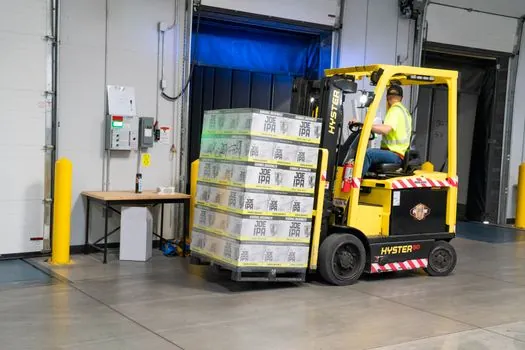
The UDL rating is fine for cross-stacked corrugated cases, shrink-wrapped bagged goods, and any product where the pallet footprint is fully covered and the load height is roughly uniform across the deck, because in those cases the load transfers through the deck into multiple runners in parallel [S2][S4].
The UDL rating is not fine for steel coils, single-drum loads, reels of paper, machine tools, partial-fill totes, footed bins, and any load that concentrates more than about 30% of the total mass on less than 25% of the deck area, and these cases need either solid surface decking, drum cradles, wire decking, or a re-rated pallet with a higher point-load capacity [S4][S3][S9]. For a broader view of how point and distributed loads play into warehouse safety, the load switch and electronic load reference entries cover the related electrical-control side of the same problem.
Trackable Signals and Next Verification Step
Two signals worth tracking over the next quarter: revised ISO 8611-1 test method notes on point-load rigs, since current ISO 8611 covers UDL but leaves point-load rig details to the test house, and any 2026 update to ANSI MH16.1 or ANSI MH26.2 deflection language that tightens the L/180 rule for concentrated loads [S3][S1].
Related analysis: S355JR vs S355J2: Charpy Temperature, Chemistry, and When Each Grade Fits.