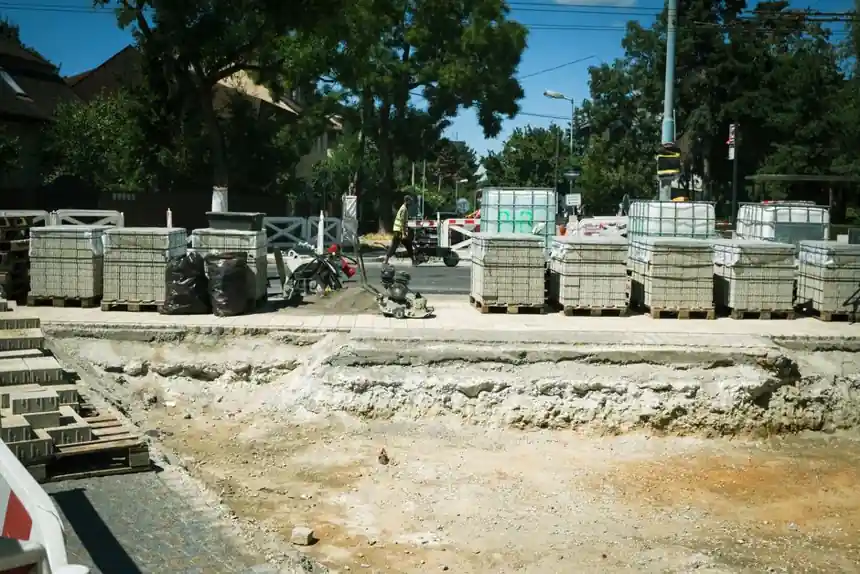
A 24-inch walk-behind power trowel handles tight detail and patch work, while 36-inch walk-behinds remain the standard for most residential and small commercial slabs, per a 2026-08-20 buying guide [S1]. For road maintenance, where crews frequently transition between utility cuts, kerb returns, and full-lane patches, the rotor diameter choice has more impact on hourly output than engine brand.
Engine power is the second decision axis, and the public guidance is explicit: small residential work needs 3–5 HP, standard walk-behinds need 5–9 HP, heavy-duty walk-behinds climb to 9–13 HP, single-rotor ride-ons sit at 20–35 HP, and double-rotor ride-on units run 30–60 HP for warehouses, airports, and large concrete surfaces [S2]. Road-maintenance fleets rarely need the top of that range, but they do need a unit that holds blade speed under continuous load on a stiff patch.
Sizing the Rotor to the Patch, Not the Brochure
The 2026 walk-behind guide ties rotor diameter directly to job scale: 24-inch units for tight spaces and detail work, 36-inch units for most residential and small commercial applications, with larger diameters reserved for broader slabs [S1]. For road maintenance, the smaller rotor pays off around manholes, drainage gratings, and kerb transitions where a 36-inch or 46-inch machine cannot physically reach without leaving unworked edges.
Concrete consistency sets a hard floor on rotor selection. A 5-inch-slump or wetter mix responds to a full float pan, while a 4-inch-slump or stiffer mix responds better to individual float shoes, which distribute less weight per square inch and reduce the risk of sealing the surface prematurely [S4]. On a road patch where the mix is often stiffened by retempering and ambient heat, float shoes are usually the safer first pass.
Horsepower Bands vs. Working Area
The published 2026 horsepower table lines up cleanly with working-area brackets: 3–5 HP walk-behinds for under 500 m², 5–9 HP walk-behinds for 500–2,000 m², 9–13 HP heavy-duty walk-behinds for larger slabs and industrial repair, 20–35 HP single-rotor ride-ons for medium-to-large industrial floors, and 30–60 HP double-rotor ride-ons for warehouse and airport decks [S2]. Road-maintenance crews working a series of 50–400 m² patches fall mostly in the 5–9 HP band, with one heavier unit reserved for full-lane reconstructions.
Horsepower is not the only variable, and the same source warns that a lightweight trowel with excessive horsepower may not transfer enough force to the slab, while a heavy machine with insufficient power may stall during operation [S2]. The practical rule is to size engine output to the rotor: a 36-inch walk-behind under-powered at 3 HP will bog on a stiff patch, while a 24-inch machine over-powered at 13 HP simply burns fuel without finishing faster.
Blade Sequence: Float Shoe, Combination, Finish
Float shoes are flat steel blades that clip or bolt onto the arms to flatten, level, and float fresh concrete during the initial finishing pass before final troweling, and they sit between screeding and finish troweling in the workflow [S4]. On road patches, the float-shoe pass is where aggregate gets embedded and high spots are knocked down, and skipping it with a finish blade tears the surface and pulls aggregate to the top.
The blade hierarchy is strict: float shoe first, combination blade second, finish blade last, with float shoes working during the first 30 to 90 minutes after screeding and finish blades reserved for the final passes when the slab supports the machine's full weight without leaving footprints [S4]. Mounting choice matters operationally: clip-on float shoes install in approximately 30 seconds per blade, while bolt-on float shoes require approximately 2 minutes per blade with a wrench, and most power trowels accept 4 float shoes per rotor head [S4].
For most residential jobs over 200 square feet, a walk-behind power trowel is the standard choice because it covers more ground faster and produces a more consistent result than hand troweling, but a hand trowel always has a role on the job because power trowels cannot reach corners, edges, or tight areas around columns or walls [S5]. On road maintenance, that hand-trowel reserve translates to a plan for hand-finishing around drainage grates, expansion joints, and kerb upstands regardless of machine size.
Lubrication Intervals That Decide Uptime
Published 2025-12 maintenance guidance treats the main-shaft bearing as the most critical and frequent lubrication point, requiring high-temperature resistant (≥120℃) extreme-pressure lithium-based grease such as molybdenum disulfide grease, with re-lubrication after every 8–10 hour shift and a methodology that pumps grease until clean new grease is completely squeezed out from the old grease at the bearing seal [S3]. Road crews running 10–14 hour shifts in summer heat sit right at the edge of that interval, and skipping the purge step is the most common cause of premature bearing failure.
Gearbox service follows a different clock: first oil change at 20–30 hours to remove run-in debris, then a regular change every 300–500 hours or annually, using SAE 80W-90 GL-4 gear oil to the specified level, with the change performed while the oil is still hot so the old oil drains completely [S3]. Traveling wheels and steering linkage use the same high-temperature lithium-based grease on a 50-hour or weekly cycle, while the gasoline engine takes a daily dipstick check and a separate engine-oil schedule [S3]. On a road-maintenance fleet, bundling these checks into a single weekly service window keeps the units on the truck and out of the workshop.
Who the Walk-Behind Fits, and Who Should Rent a Ride-On
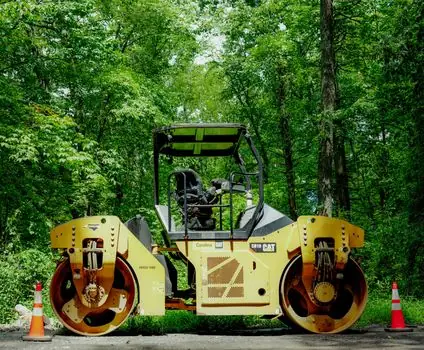
The walk-behind is the right call for crews doing patch repairs, manhole frame resets, and kerb returns where the work area is fragmented and a ride-on cannot manoeuvre between traffic management cones. A power trowel in the 5–9 HP, 36–46 inch class covers the bulk of that workload, and the 24-inch unit is a sensible second machine for confined reinstatements. [S3]
Ride-on power trowels earn their keep on continuous pours larger than roughly 2,000 m², which is uncommon in routine road maintenance but routine on bus terminals, depot hardstandings, and airport apron tie-ins. For those jobs, the road roller fleet typically works the same site, and trowel selection should be made alongside power mixer capacity to keep concrete supply matched to finishing speed.
Failure Modes and When to Stop Repairing
Surface tearing during the first pass is almost always a blade-sequence error (finish blade applied before the float-shoe stage) or a slump error (mix too wet or too dry for the chosen rotor), and it is corrected by re-sequencing and re-mixing, not by adjusting the machine [S4][S5]. Bearing overheating after a shift usually traces to a missed grease purge, and the corrective action is to replace the bearing and adopt the 8–10 hour re-lube cycle rather than to over-grease the next shift [S3].
Gearbox whining that persists past an oil-and-filter service is a sign the helical gears have picked up debris from a missed 300–500 hour change, and the unit should be escalated to a workshop rather than run to failure on a public road [S3]. Blade deflection visible as uneven track on the slab is a stop-work signal: finish quality on a road patch is a warranty issue, and the cost of re-pouring a lane outweighs the cost of a blade set.
For mixing and placement support on the same site, the power mixer class and power distribution layout determine how many trowels can run simultaneously without voltage drop on a 30 m cable run, while a power meter on the generator set lets the foreman catch under-voltage before the trowel motors start drawing excess current.
Two signals to track over the next quarter: any revision to the walk-behind selection guidance around 36-inch vs 46-inch units for commercial slab work [S1], and any update to the 300–500 hour gearbox interval or the ≥120℃ grease specification [S3].
Related analysis: UHMWPE Selection for Construction: 2026 Spec Boundaries and Product Match-Up.