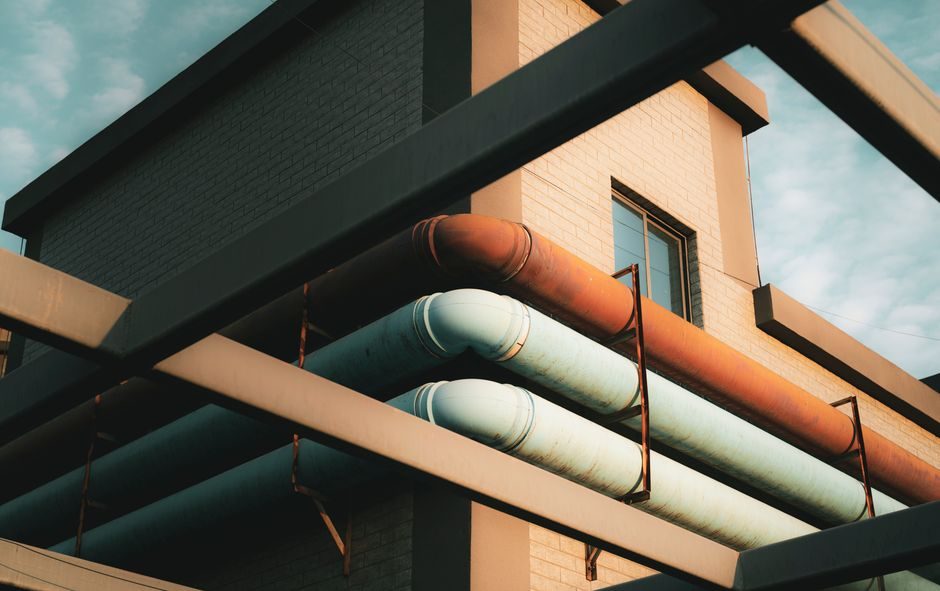
PPR (Polypropylene Random Copolymer) and PVC-U (unplasticised Polyvinyl Chloride) are the two workhorse thermoplastics on most 2026 plumbing take-offs, and the selection between them is fundamentally a temperature-and-jointing decision rather than a brand decision.
Both families sit under the broader plastic pipe umbrella, but their operating envelopes diverge sharply: PPR is the default hot-water and potable service pipe in most Chinese, European and Middle-Eastern residential stock, while PVC-U dominates cold-water risers, soil-and-waste stacks, electrical conduit and irrigation laterals. The pipe fitting ecosystem reflects the same split — PPR uses socket fusion with matching PP-R fittings, whereas PVC-U uses solvent cement (and, for buried drainage, elastomeric ring joints).
Material Behaviour and Long-Term Hydrostatic Strength
PPR is a random copolymer of propylene with a long-term hydrostatic stress capability typically rated for 70 °C service at 10 bar in the S3.2 / S2.5 series, and 95 °C transient peaks — the value that makes it the default for domestic hot-water risers and radiator-side underfloor heating. PVC-U is a rigid amorphous polymer with no such hot-water rating: its design envelope is generally capped around 45 °C for pressure duty and 60 °C for non-pressure drainage, because the glass-transition and Vicat-softening behaviour of unplasticised PVC collapse above that band. [S1]
The mechanical contrast is just as sharp. According to a 仪器网 reference on PVC-U pipe [S3], PVC-U pressure pipe has tensile strength above 45 MPa, a smooth bore that reduces head loss by more than 30% versus cast iron of the same nominal size, and a unit weight roughly one-sixth of cast iron pipe. PPR is softer, with a lower modulus and a higher coefficient of thermal expansion (roughly 0.15 mm/m·K versus 0.07 mm/m·K for PVC-U), which is why PPR runs need expansion loops or off-sets in long straight risers, while PVC-U is dimensionally stable enough to be used as above-ground soil stack without expansion compensation.
Jointing Method and Site Reality
Jointing is where the two systems fail or survive in the field, and the methods are not interchangeable. PPR uses a socket-fusion welder: pipe and matching PP-R fitting are heated to around 260 °C on the tool's die, then mated within a 4-second window to form a homogeneous, leak-proof joint that is, in effect, the same material all the way through. This is the technology [S1] and [S2] both list as their core competency for hot-water service pipe, and it eliminates rubber seals, thread sealant and the corrosion cells they create.
PVC-U uses solvent-cement welding for pressure and cold-service lines — a one-step gap-filling cement that chemically fuses the spigot into the socket — and push-fit elastomeric ring joints for buried drainage runs where differential soil settlement would crack a rigid solvent joint. Pressed fittings and threaded brass adaptors exist for transition points, but no manufacturer offers a PPR-to-PVC-U solvent joint: the two are always coupled mechanically, typically via a brass male-thread adapter, and that mechanical transition is the standard source of leaks in mixed-material retrofits [S1].
Pressure, Temperature and Service-Life Comparison
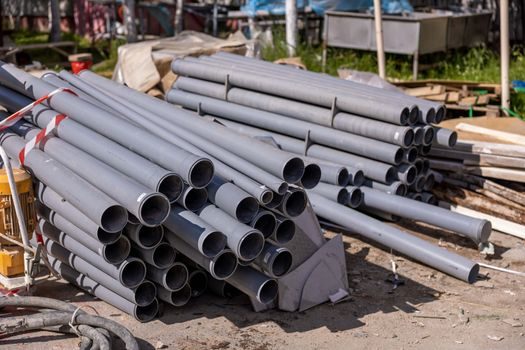
The decision matrix a spec engineer should write into the BOQ lines up cleanly across four criteria: [S2]
Temperature: PPR is rated for continuous 70 °C service and 95 °C short-term peaks, with documented 50-year design life at 70 °C / 10 bar in the standard S-series (S2.5, S3.2, S4). PVC-U pressure pipe is generally limited to ≤45 °C continuous, with the bulk of Chinese and EU drinking-water standards explicitly excluding hot service. For drainage and conduit the PVC-U upper limit sits around 60 °C intermittent.
Pressure class: PPR pressure pipe ships in PN 10, PN 16, PN 20 and PN 25 series keyed to the SDR (S) value; PVC-U pressure pipe ships in PN 6, PN 10, PN 12.5, PN 16 and PN 20. At a shared 20 mm wall, both can reach PN 20, but the design stress is derated as temperature climbs — only PPR keeps the rating above 60 °C.
Joint integrity over service life: PPR fusion joints are homogeneous and rated for the same 50-year envelope as the pipe. PVC-U solvent joints rely on a chemical weld whose integrity is a function of cement coverage, cure time and operator skill; ring-joint PVC-U is forgiving on settlement but cannot be used for hot or high-pressure service.
Cost and lead time: PVC-U is consistently the cheaper option — both in raw material and finished PVC-U pipe — and that is why it owns the cold-water riser, soil, waste, vent and conduit segments by volume. PPR carries a 20–40 % material premium over PVC-U in most 2026 Chinese factory-gate quotes, recovered by skipping the hot-water steel or copper alternative and the labour of threading or pressing it.
Where PPR Is the Right Pick
Domestic hot-water risers and recirculation loops, especially in residential towers where the 70 °C continuous rating and silent, non-corroding fusion joints are non-negotiable. Underfloor heating loops (PE-RT and PEX compete here, but PPR is widely specified in Chinese and Eastern-European builds). Potable cold-water risers where a single-material system is preferred and the higher thermal tolerance gives margin against solar pre-heat or boiler-staging transients. Hospital and food-grade clean-water lines where the fusion joint's lack of elastomeric seals reduces biofilm- and taste-transfer risk [S2].
For plumbing take-offs in mid- and high-rise residential, PPR pipe in 20, 25 and 32 mm diameters with matching PP-R fittings is the default Chinese and EU specification; the same take-off in a warehouse or factory typically pairs PPR hot lines with PVC-U cold lines and drainage within the same riser shaft [S1].
Where PVC-U Wins, and Where It Fails
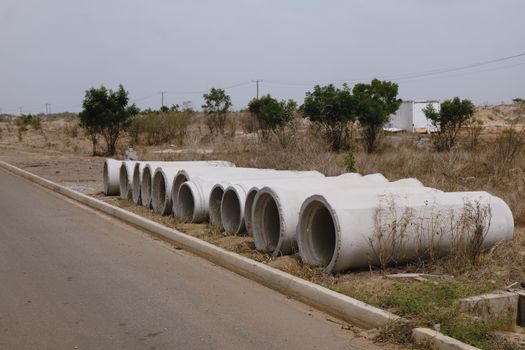
PVC-U is the right pick for cold-water service laterals, building drainage stacks, underground soil and waste lines (with ring joints for settlement tolerance), rainwater downpipes, swimming-pool circulation loops (cold, chemically treated water) and electrical conduit — a workload that consumes the bulk of plastic pipe volume worldwide [S3]. The material is also widely used for casing and ducting in telecom and power work [S1].
PVC-U is the wrong pick for any continuous hot-water service above 45 °C, for high-rise fire-sprinkler risers (where approval is restricted), for fuel and solvent lines (PVC-U is attacked by aromatics and ketones), and for any application where the line will see sustained UV exposure without paint, sleeve or burial — PVC-U's impact strength and colour stability both degrade under direct sunlight. Impact behaviour is brittle at low temperatures: below 0 °C the failure mode shifts towards cracking under point load, and installation practices in cold climates call for handling care and burial rather than exposed run.
Standards, Sourcing and 2026 Supply Reality
Both materials sit on mature, overlapping standards stacks. PPR pressure pipe is covered by ISO 15874 (and the equivalent GB/T 18742 in China), with DIN 8077/8078 historically setting the metric series. PVC-U pressure pipe is covered by ISO 4422 (now replaced by ISO 1452 for water supply) and GB/T 13664, with PVC-U drainage under GB/T 5836 and EN 1329. Sanitary approval for potable contact is mandatory in every major market — a hygiene-test report from an authorised Disease Prevention centre is the gating document for both, and Chinese exporters such as [S2] routinely publish that certification as part of their technical data pack.
The 2026 sourcing picture is dominated by a deep Chinese supply base. Zhejiang Wanjiayou Pipe Industry operates a 300 million-unit capacity out of Tiantai, with parallel production of PVC-U drainage, PPR service pipe, HDPE corrugated and electrical conduit [S1]. Siwei (Foshan Swin) markets a comparable four-material portfolio across PPR, PVC-U, PE-AL-PE and PERT [S2]. Shenyang Chunxi Trade exports PVC-U pipe, PVC fittings and PPR fittings as a manufacturer-trader, ISO 9001-certified and oriented to construction-and-decoration channels [S4]. Specification-level competition between these suppliers is largely on dimensional tolerance, colour fastness and on-time delivery rather than on raw material — the base resins are largely interchangeable across factories.
For any take-off where the two materials meet, the most common failure pattern in 2026 field reports is the brass-transition fitting at the hot-to-cold interface, not the pipe itself — so the next decision worth auditing is the transition fitting, not the pipe wall.
For related coverage, see Safety Light Curtain Price & Cost Guide 2026: SKU Bands, Resolution Levers and Sourcing.