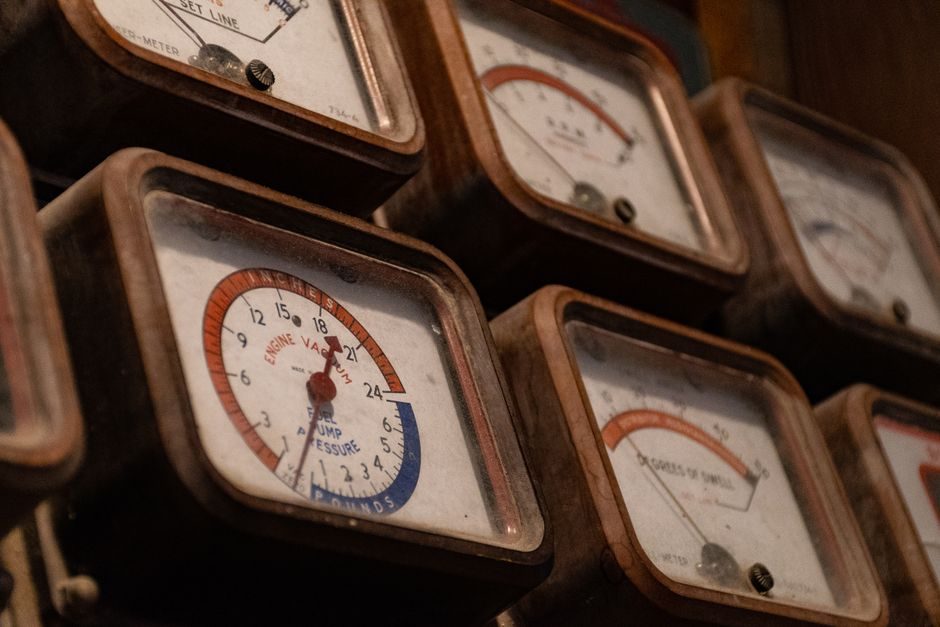
Handheld squeeze-bulb pressure calibrators are stocked at USD 194.65 (Baker B1600, 0 to 160 inH2O) and USD 288.15 with NIST-traceable certificate (B1600-NIST), while dual-sensor shop units such as the AMETEK Crystal IS33-36/3000 list at USD 4,020.77 for 36/3,000 psi [S3]. Yokogawa positions the CA700 as a "highly accurate and highly functional" pressure calibrator aimed at transmitter calibration workloads where 4-20 mA sourcing and pressure measurement must be done in one box [S1].
Three classes dominate the 2026 catalog: pneumatic squeeze-bulb units for low-draft and HVAC duties (under ~30 psi), digital handhelds for field loop checks, and bench/nVision-class documenters for ISO 17025-traceable shops. The class you pick is set by the highest pressure, the accuracy you must demonstrate, and whether you also need to source/simulate mA or read HART — features the pressure calibrator category page maps one-to-one.
Define the duty before you read a single datasheet
Pressure calibrator selection is governed by four hard constraints: the working range expressed in the same unit as the device under test (DUT), the required accuracy as a percent of reading or full scale, the media compatibility (clean dry air, nitrogen, or hydraulic oil), and the field-portability budget including weight and intrinsic-safety rating [S1][S3]. Yokogawa's own framing is that calibrators exist to "validate and adjust the accuracy of field instrumentation" before drift forces a plant shutdown, so the cost of the calibrator should be benchmarked against the opportunity cost of a tripped unit [S1].
A draft-range 0 to 160 inH2O squeeze-bulb unit (B1600, USD 194.65) covers furnace draft, cleanroom differential, and HVAC static-probe work but cannot verify a 3,000 psi transmitter. Conversely, a 36/3,000 psi dual-sensor model such as the AMETEK Crystal IS33-36/3000 (USD 4,020.77) covers both vacuum and high-pressure gauge work in one box but weighs more and is over-spec for a pneumatic-only loop [S3]. Write down the maximum DUT pressure, the minimum resolution you need (typically 0.01% FS for custody, 0.05% FS for general process), and the media before you open a catalog.
Five common classes, lined up against decision criteria
The 2026 market still resolves to five practical classes, and the table below lines them up against the criteria a buyer actually filters on. Prices are from a single stocking distributor snapshot (2026-07-19) so they are directly comparable [S3].
Class 1 — Pneumatic squeeze-bulb handhelds (Baker B1600 / B1800). Range: 0-160 inH2O or 0-18 psig. Price: USD 194.65 bare, USD 288.15 NIST. Best for: draft, low-pressure filter, and HVAC checks where the DUT is below 30 psi and a hand pump is acceptable. Class 2 — Digital documenting handhelds (Fluke 789 ProcessMeter kit, USD 1,950.98). Range: mA source/measure plus optional pressure modules. Best for: HART-enabled 4-20 mA loop commissioning where you also need to source current and document the as-found/as-left values. Class 3 — Single-sensor bench calibrators with baro option (AMETEK Crystal HPC41-30PSI-BARO, USD 3,828.70). Range: 0-30 psi gauge plus barometric reference. Best for: lab and shop environments that need atmospheric referencing for absolute devices. Class 4 — Dual-sensor shop calibrators (AMETEK Crystal IS33-36/3000, USD 4,020.77). Range: 36 inHg vacuum to 3,000 psi gauge in one instrument. Best for: calibration houses serving mixed vacuum/pressure workloads. Class 5 — Modular reference recorders (AMETEK Crystal NV-4AA-RTD100-RTD100, USD 4,342.87; AMETEK 15KPSI-MODULE, USD 3,238.68, 3-4 week lead time). Range: plug-in pressure modules to 15,000 psi plus RTD100 temperature modules. Best for: ISO 17025 labs that need a paper-trail reference with both pressure and temperature channels [S3].
Lead time is a real signal: stock SKUs (B1600, B1800, IS33-36/3000, RTD100-MODULE) all show "in stock" availability, while the 15KPSI-MODULE shows "3 to 4 Weeks" — if your spec demands above 10,000 psi, plan module procurement in advance rather than treating it as a shelf item [S3].
Accuracy, traceability, and the HART question
For a procurement-grade buy, accuracy should be stated as "% of reading" not "% of full scale" because the latter hides non-linearity at the low end. Yokogawa's CA700 product copy explicitly highlights "high accuracy" as the differentiator versus general-purpose handhelds, an OEM cue that shop-class buyers should expect ≤0.01% of reading on pressure and ≤0.015% on mA [S1]. If your workflow is HART-only loop trimming, a Fluke 789-class process meter (USD 1,950.98) is the lower-cost path; if you also need to capture and sign tamper-proof records, move to a documenting reference recorder (nVision class, USD 4,342.87) [S3].
Traceability is its own line item: the same B1600 lists at USD 194.65 bare and USD 288.15 with a NIST-traceable certificate — a USD 93.50 step, roughly a 48% surcharge for the paperwork. For regulated plants (pharma, power, nuclear supply chain) the certificate is non-negotiable; for in-house maintenance on general-purpose transmitters it can be deferred to a periodic recalibration cycle at a metrology lab [S3]. Cross-reference against the multifunction process calibrator page when the same technician also services temperature, frequency, and resistance instruments — bundling duties typically beats buying a pressure-only box.
When a squeeze-bulb handheld is the wrong tool
Three duty profiles break a USD 195 squeeze-bulb handheld. First, custody-transfer or fiscal metering on hydrocarbon lines — the accuracy class is below 0.05% FS, the media is not clean dry air, and the audit trail must be electronic. Second, hazardous-area Zone 1/Class I Div 1 work where the calibrator must carry an intrinsic-safety rating and a documented media list; standard handhelds are not IS-rated. Third, above ~30 psi gauge work: hand pumps are tiring above 100 psi and unsafe above 300 psi, so a pneumatic or hydraulic comparator with a screw pump and vernier is the correct class [S1][S3].
A further mismatch is treating a pressure-only calibrator as a loop calibrator. HART communication, mA sourcing, and 24 V loop power are independent features; a Baker B1600 will read pressure but will not source mA or talk HART to a 475/375 communicator. If the field ticket says "calibrate transmitter incl. HART trim", you are in the Fluke 789 or AMETEK nVision envelope, not the B1600 envelope [S3].
Standards, sourcing, and supply-chain signals to track

Pressure calibration is governed by the same traceability chain as any measurement: ISO/IEC 17025 for the calibration lab, NIST or equivalent national institute for the reference standards, and the device-specific method (often API MPMS for hydrocarbon custody, ASME PTC for performance testing). Yokogawa explicitly cites plant-shutdown and personnel-injury consequences as the driver for routine calibration, a position consistent with ISA 51.1 process-instrumentation documentation and with IEC 61298-2 test procedures for process transmitters [S1].
On the supply side, the Made-in-China category for "intelligent pressure calibrator" is positioned as a sourcing channel where distributors "have a documented track record, quick delivery and a guide for selecting sensor models" — a useful filter for buyers comparing Western OEM brands against Chinese OEM/ODM supply, with Xi'an Yunyi among the listed vendors offering 4-20 mA differential pressure transmitters in a USD 89.50 to USD 250.50 per-piece band and dead-weight testers in the USD 750.50 to USD 1,250.30 range as of 2019-11-15 [S2][S4]. The yunyiyibiao.alibaba.com listings show that entry-level differential pressure transmitters are now a commodity; the differentiator at the calibrator level is the reference standard behind them, not the transmitter module [S4].
Track three signals over the next two quarters: NIST-traceable certificate pricing trend (the B1600 to B1600-NIST USD 93.50 step), 15KPSI-MODULE lead time as a proxy for high-pressure module supply, and the appearance of documenter-class units with native HART Pass-through on the same handheld footprint. For a broader look at how pressure calibrators fit alongside temperature, loop, and signal sources, the signal calibrator and loop calibrator encyclopedia entries give the adjacent spec frames. Buyers cross-shopping with energy and insulation tools will find the Energy Meter vs Insulation Resistance Tester spec map a useful comparator on what "documenting" really costs in adjacent metrology categories.