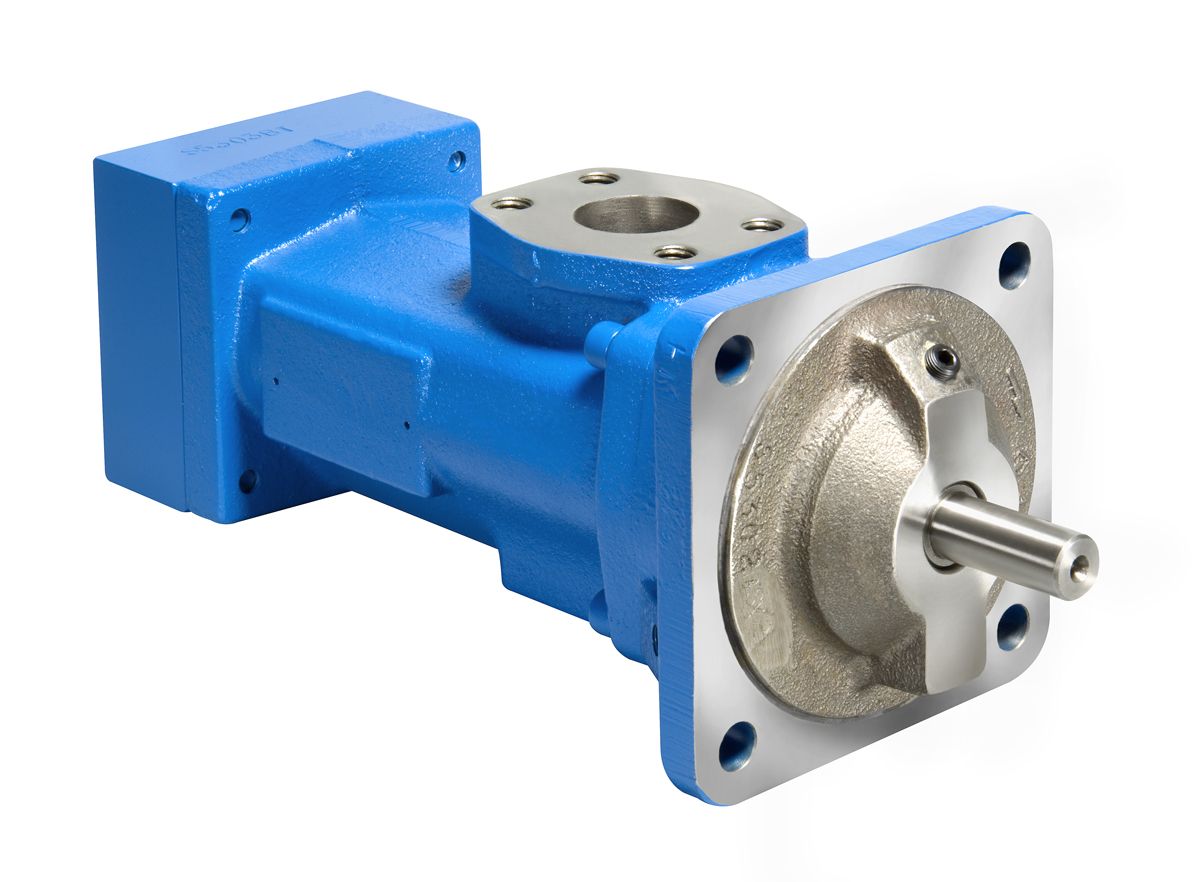
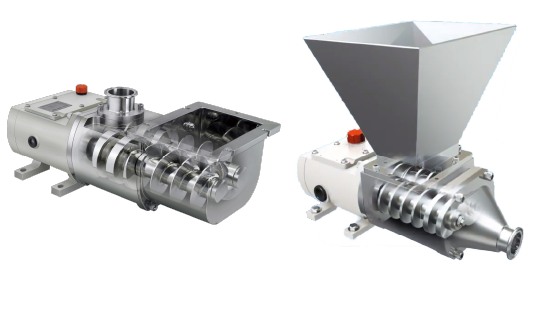
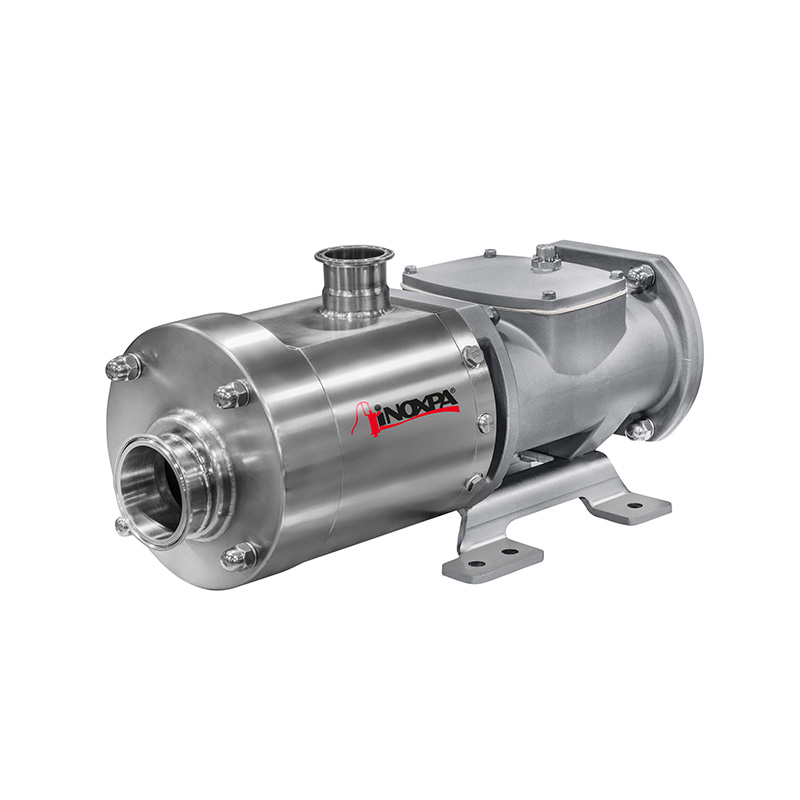
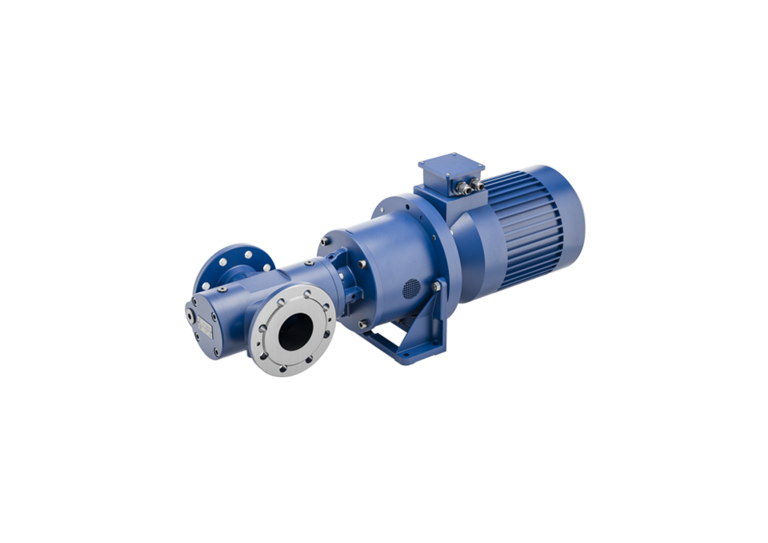
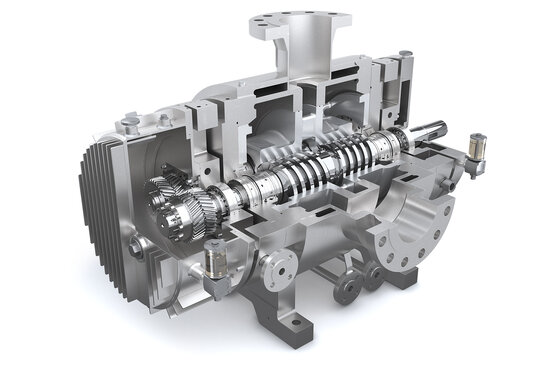
A screw pump is a rotary positive displacement pump that moves fluid axially inside sealed cavities formed between one or more rotating screws and a close-fitting casing. Unlike a centrifugal pump, which adds velocity through an impeller, a screw pump traps a fixed volume per revolution, so delivered flow stays nearly proportional to shaft speed and almost independent of discharge pressure. This makes screw pumps the default choice for viscous, lubricating, shear-sensitive and multiphase fluids.
The family spans three architectures distinguished by screw count: single screw (progressing cavity) pumps for abrasive and high-viscosity media, twin screw pumps for versatile multiphase and process duty, and triple screw pumps for clean, high-pressure lubrication and fuel oil. This guide covers their working principle, types, materials, specification parameters and the selection logic procurement engineers use before a purchase decision.
Photo: S.J. de Waard, CC BY-SA 4.0, via Wikimedia Commons
This guide is written for industrial purchasing engineers and design engineers. It covers 6 chapters from working principle, screw-count types, sealing and drive technologies, wetted materials and media, to specification decoding and selection decisions, plus 7 selection FAQs and verified manufacturer ranges. Performance figures reference manufacturer datasheets from Leistritz, ITT Bornemann and CIRCOR IMO, and design and testing requirements reference API Standard 676, the Hydraulic Institute ANSI/HI 3.1 to 3.5 rotary pump series with ANSI/HI 3.6 for testing, and ISO 13710.
Chapter 1 / 06
What is a Screw Pump
A screw pump is a rotary positive displacement pump in which one or more intermeshing screws rotate inside a precisely bored casing. As the screws turn, the spaces between the screw threads and the bore form a series of sealed, fixed-shape cavities. These cavities travel axially from the suction end to the discharge end, carrying a fixed volume of fluid with each revolution. Because the volume per turn is geometrically fixed, the pump delivers a flow that is nearly proportional to speed and changes little when discharge pressure rises, which is the defining behaviour of positive displacement machines and the opposite of the steep head curve of a centrifugal pump.
The motion is purely rotary and axial, so there are no valves and no reciprocating masses. This gives a smooth, low-pulsation, low-noise delivery and lets the pump run at high speed without the inertial limits of piston pumps. Because the screws confine the fluid in long sealing chambers rather than throwing it outward, the screw pump is gentle on the product: it imposes very little shear, which matters for emulsions, polymers, paints, foodstuffs and other shear-sensitive media that a high-speed impeller would degrade.
The screw pump also self-primes and tolerates gas. The sealing cavities sweep air out ahead of the liquid, so the pump can lift fluid from a flooded or dry suction line, with twin screw designs self-priming up to about 7.5 m of suction lift. The same geometry handles free and entrained gas without vapor locking, which is why twin screw pumps are widely used as multiphase pumps, bilge and stripping pumps, and tanker cargo pumps where the liquid level and gas content change continuously.
The principle is old. The Archimedes screw used an open helix to raise water in antiquity, but the modern enclosed screw pump dates to the early twentieth century, and the single screw progressing cavity pump was invented by French engineer Rene Moineau in 1930 while he was developing an aviation compressor. He showed that a single helical rotor turning inside a double-helix stator forms a chain of discrete cavities that march along the axis as the rotor turns, a geometry that became the basis for the entire single screw family used today in oilfield, sludge and slurry service.
Two further behaviours follow from the trapped-volume principle and explain where the screw pump earns its keep. First, because flow tracks speed rather than pressure, a screw pump on a variable-speed drive becomes a precise, repeatable metering device, which is why these pumps are used for dosing additives, blending fuels and injecting chemicals at controlled rates. Second, because the machine will keep generating pressure against a rising resistance until something yields, a screw pump must never be started against a closed discharge valve, and a full-flow pressure relief valve is a mandatory part of the installation rather than an optional accessory. These two traits, controllability and the need for overpressure protection, are shared by every positive displacement pump and distinguish the design discipline from centrifugal practice.
Four engineering properties decide whether a screw pump is the right machine: the fluid viscosity, the required differential pressure, the presence of solids or gas, and the sensitivity of the product to shear. The remainder of this guide maps these properties onto the three screw architectures, the materials of construction, and the specification parameters that appear on a manufacturer datasheet, so that a duty point can be matched to a real model rather than a generic catalogue.
Chapter 2 / 06
Screw Pump Types by Screw Count
The clearest way to classify screw pumps is by the number of screws, because screw count tracks directly with fluid cleanliness and pressure capability. Single screw pumps tolerate the dirtiest, most viscous media at modest pressure; twin screw pumps are the versatile multiphase workhorse; triple screw pumps deliver the highest pressure on the cleanest fluids. The table below compares the three architectures on the parameters that drive selection.
Type
Screws
Typical Max Flow
Typical Max Pressure
Best For
Single screw (progressing cavity)
1 rotor + stator
Up to ~500 m³/h
~6 bar per stage
Abrasive slurry, sludge, shear-sensitive media
Twin screw
2 intermeshing
Up to ~5,000 m³/h
~16 to 150 bar
Multiphase, process, hygienic, cargo
Triple screw
1 power + 2 idler
Up to ~180 m³/h
Up to ~280 bar
Clean lube oil, fuel injection, hydraulics
Single screw pumps, almost always called progressing cavity or PC pumps, use one metal helical rotor that turns eccentrically inside a flexible double-helix elastomer stator. The rotor seal line forms cavities that progress steadily toward discharge, giving low-pulsation flow even at very low speed. Because the elastomer stator conforms around solids and the flow path is gentle, PC pumps are unmatched for abrasive slurry, dewatered sludge, shear-sensitive food and chemical products, and ultra-high viscosity pastes. They build pressure stage by stage, roughly 6 bar per stage, so a multi-stage rotor reaches 48 bar or more. Their limitation is the elastomer stator, which wears, has a finite chemical compatibility, and will burn out within seconds of dry running.
Twin screw pumps use two parallel screws whose threads intermesh without touching. One screw is driven by the motor, and external timing gears synchronise the second screw so the two never contact, eliminating metal-to-metal wear and allowing all-metal construction. Most are double-ended, with fluid entering at both ends and meeting at the centre, which balances axial thrust. Twin screw pumps offer the widest operating envelope of the family: non-pulsating flow, excellent gas and multiphase tolerance, self-priming with low NPSH required, and viscosities to 100,000 cSt and beyond. They dominate hygienic food and dairy duty, cargo and bilge service, and multiphase oil and gas boosting.
Triple screw pumps use a central driven power rotor flanked by two idler rotors that are turned hydraulically by the pumped fluid rather than by gears. With no timing gears and a hydraulically balanced rotor set, they run extremely quietly and reach the highest pressures in the screw family, up to about 280 bar in the Leistritz L3 range. The price of this simplicity is that the idlers rely on the fluid itself for lubrication, so triple screw pumps demand clean, lubricating, non-abrasive liquids: hydraulic oil, lube oil, fuel oil and burner service. Compact units such as the CIRCOR IMO 3G handle smaller fuel and lubrication duties to about 17.2 bar differential (250 psi) and 208 L/min, with idler rotors in gray iron and the driven power rotor in ductile (nodular) iron, a material set chosen for the clean lubricating oils these pumps are built for.
A useful way to remember the hierarchy is that screw count rises as the fluid gets cleaner and the pressure target gets higher. Single screw pumps accept the dirtiest, most abrasive and most viscous media but at modest pressure; twin screw pumps span the widest envelope and tolerate gas, multiphase mixtures and moderate abrasion; triple screw pumps sit at the top of the pressure scale but only on clean, lubricating fluids. A duty that crosses these boundaries, for example a clean lube oil that must also reach very high pressure, narrows the choice to a triple screw pump, while a viscous abrasive slurry rules out the intermeshing and idler designs and points firmly at a single screw progressing cavity pump.
Chapter 3 / 06
Sealing, Drive and Construction
Beyond screw count, three construction choices shape a screw pump's reliability and cost: how the screws are driven and synchronised, how the rotating shaft is sealed against the process, and how internal clearances control slip. These details determine whether a pump survives years of duty or fails prematurely, and they distinguish a hygienic process pump from an oilfield multiphase unit even when both are nominally twin screw.
Drive and timing. Triple screw pumps are timing-gear free: the idler rotors run hydraulically on a film of the pumped fluid, which makes the pump compact and quiet but restricts it to clean, lubricating media. Twin screw pumps use external timing gears in a separate oil-lubricated gearbox so the screws run non-contacting; this isolates the gears from the process fluid and allows abrasive or non-lubricating media, at the cost of the gearbox and its own bearings. Single screw pumps have no timing problem because there is only one rotor, but they need a robust universal-joint or flexible-rod drive to accommodate the rotor's eccentric motion.
Shaft sealing. The shaft seal is the most common maintenance item on any screw pump. Mechanical seals, single or double, are standard for clean and moderately aggressive service, with double seals and a barrier fluid used for toxic, volatile or abrasive media. Gland packing remains common on PC pumps and rugged process duty because it is cheap and field-serviceable, accepting a small controlled leak. Magnetically coupled and seal-less designs exist for zero-emission duty on hazardous fluids. Sanitary twin screw pumps use hygienic single or double mechanical seals that are flushable during clean-in-place cycles.
Clearance and slip. Because screw pumps are non-contacting, a small clearance always exists between the screws and the bore, and a fraction of fluid leaks back from discharge to suction. This backflow is called slip, and it rises with differential pressure and falls with viscosity. Thin fluids at high pressure slip more, which is why the volumetric efficiency of a screw pump improves markedly as viscosity increases; tight clearances and long sealing lengths reduce slip but raise manufacturing cost. A practical consequence is that the same screw set delivers more usable flow on a viscous oil than on a thin fuel at identical speed and pressure, so a pump sized on a thin cold-start fluid will comfortably exceed its rating once the process warms and the medium thickens. The table below summarises how the three drive and sealing strategies map to service conditions.
Construction Feature
Single Screw (PC)
Twin Screw
Triple Screw
Synchronisation
Universal-joint drive
External timing gears
Hydraulic idler (gearless)
Media cleanliness
Dirty, abrasive OK
Abrasive tolerable
Clean lube only
Typical seal
Packing or mech. seal
Single or double mech. seal
Single mechanical seal
Noise / pulsation
Low
Low
Very low
Dry-run tolerance
Seconds only
Brief, if pre-lubricated
Brief, if pre-lubricated
Chapter 4 / 06
Wetted Materials and Media
Material selection on a screw pump applies to the screws, the casing or bore, the stator on a PC pump, and the seals and gaskets. A mismatch leads to pitting, stress corrosion cracking, accelerated wear or, on a PC pump, chemical swelling of the elastomer stator that seizes the rotor. The right combination depends on three things at once: chemical compatibility, abrasiveness, and the hygiene regime if any.
Standard metals.Cast iron and carbon steel screws and casings remain economical for fuel oil, lube oil, mineral oils and clean water. 316L stainless steel, with 16 to 18% Cr, 10 to 14% Ni and 2 to 3% Mo and low carbon content to inhibit intergranular corrosion, is the default for process chemicals, mild acids and food contact. It does not resist chloride-rich media such as seawater or wet chlorine, where the pitting threshold falls sharply with rising temperature and chloride concentration.
Corrosion-resistant alloys. Aggressive acids, chlorides and oxidisers require upgraded screws and casings. Duplex stainless 2205 resists seawater and chloride brine far better than 316L. Hastelloy C-276, a nickel alloy with around 16% Cr, 16% Mo and 4% W, gives several times the pitting resistance of 316L against hydrochloric acid, wet chlorine and ferric chloride, at a unit cost several times higher. Grade 2 titanium suits wet chlorine and many chloride solutions. These alloys are specified only where the media chart demands them, because they multiply the screw machining cost.
Elastomer stators. The PC pump stator is selected chemically, not just mechanically. Nitrile (NBR) suits oils and fuels, EPDM suits hot water, steam and many chemicals but not mineral oil, Viton (FKM) suits aggressive chemicals and high temperature, and natural rubber resists abrasion in mineral slurry. Stator swell from an incompatible elastomer is a frequent and avoidable PC pump failure. The lookup table below is a starting point only; before implementation always obtain the manufacturer corrosion chart and confirm the specific concentration, temperature and flow velocity.
Media
Recommended Wetted Material
Avoid
Fuel / lube / mineral oil
Cast iron or carbon steel; NBR stator
EPDM stator
Water / steam / mild chemicals
316L
Carbon steel (corrosion)
Dilute HCl 5 to 30%
Hastelloy C-276 or titanium
316L, carbon steel
Seawater / chloride brine
Duplex 2205 or titanium
316L
Abrasive mineral slurry
Chrome-plated rotor; natural rubber stator
Intermeshing metal screws
Food / dairy / pharma CIP
Electropolished 316L, EPDM/FKM seals
Cast iron, packing glands
Abrasive and shear-sensitive duty is where the architectures diverge most sharply. Intermeshing twin and triple screws rely on tight, clean clearances, so entrained grit wears them quickly and a single screw progressing cavity pump with a conforming elastomer stator and chrome-plated rotor is the durable choice for cement, mining and dredging slurry. Conversely, hygienic processes demand crevice-free electropolished 316L twin screw pumps that survive clean-in-place and steam-in-place cycles and carry 3-A or EHEDG certification. Hygienic twin screw ranges such as the Bornemann SLH series are built specifically for this duty, passing large solids up to about 58 mm while still meeting sanitary surface-finish requirements, which lets a single pump move whole fruit, dough or particulate-laden product without the shear damage a centrifugal impeller would inflict.
The elastomer stator on a progressing cavity pump deserves separate budgeting because it is the wear part that defines the pump's service interval. Its compound must be chosen for chemical compatibility, temperature and abrasion all at once, and an oversized interference fit that improves sealing on a cold start can generate enough friction heat to scorch the rubber on a viscous medium. For this reason many slurry installations specify an adjustable or oversize-stator design and pair it with a temperature switch, so that the consumable element is matched to the medium rather than left as a generic default.
Chapter 5 / 06
Key Specification Parameters
A screw pump datasheet lists many numbers, but only a handful drive the selection decision: flow, differential pressure, viscosity range, speed, NPSH required, volumetric and mechanical efficiency, temperature limit, and drive power. Reading them correctly, and understanding how they interact, separates a robust selection from a premature failure. The verified manufacturer ranges below anchor each parameter to real products.
Flow rate is set by displacement per revolution multiplied by speed, less slip. Hygienic twin screw pumps such as the Bornemann SLH range reach roughly 300 m³/h, the Leistritz L2 twin screw range reaches about 900 m³/h, and the large Leistritz L4 twin screw range reaches about 5,000 m³/h (around 22,000 GPM). Triple screw pumps run smaller, the Leistritz L3 to about 180 m³/h and compact IMO 3G units to about 208 L/min (55 GPM). The table below collects verified flow, pressure, viscosity and temperature figures across representative screw pump series.
Series
Type
Max Flow
Max Differential Pressure
Max Viscosity
Max Temp
Leistritz L2
Twin screw
900 m³/h
16 bar
100,000 cSt
—
Leistritz L4
Twin screw
5,000 m³/h
150 bar
150,000 cSt
350 °C
Bornemann SLH
Twin screw
300 m³/h
25 bar
1,000,000 cP
200 °C
Leistritz L3
Triple screw
180 m³/h
280 bar
1,000 cSt
280 °C
IMO 3G
Triple screw
208 L/min
17.2 bar
3,200 cSt
107 °C
Differential pressure is the pressure rise the pump must generate, and it is limited by slip and by the number of sealing chambers along the screw. Note from the table that twin screw pressure spans an order of magnitude between low-pressure (16 bar) and high-pressure (150 bar) families, and that triple screw pumps reach the highest pressure (280 bar) but only on clean lube oil. A positive displacement pump will keep raising pressure against a blocked line until something breaks, so a pressure relief valve is mandatory, not optional.
Viscosity drives both type and speed. Higher viscosity improves volumetric efficiency by reducing slip, but it also raises the torque and the time the fluid needs to fill the cavities, so the pump must run slower to avoid cavitation. Datasheet viscosity limits, from 3,200 cSt on a small IMO triple screw to 1,000,000 cP on a Bornemann twin screw, are always tied to a maximum speed and an NPSH curve; the headline viscosity is only achievable at a reduced speed.
NPSH required is the suction head the pump needs to avoid cavitation, and screw pumps are notable for low NPSH required because the screw geometry presents little resistance to incoming flow. NPSH required rises with speed and with viscosity, so the practical defence against cavitation on viscous fluids is to slow the pump down. Efficiency has two parts: volumetric efficiency, which improves with viscosity and degrades with pressure and slip, and mechanical efficiency, which is high on gearless triple screw pumps and slightly lower on twin screw pumps that carry a timing gearbox.
Temperature, speed and drive power round out the sheet. Process temperature is capped by the seal, the elastomer stator on a PC pump, and the bearing lubricant; the Leistritz L4 twin screw range, for example, is rated to about 350 °C and the L3 triple screw range to about 280 °C, while a PC pump elastomer is typically limited well below that, often to 100 to 150 °C depending on the rubber compound. Maximum speed falls as viscosity rises, and the hygienic Bornemann SLH twin screw range, for instance, runs to about 3,600 rpm on lower-viscosity duty but must be slowed substantially as the medium approaches its million-centipoise ceiling. Drive power follows directly from flow times differential pressure divided by overall efficiency, plus a margin for cold start-up viscosity, which on a heated oil system can be many times the running viscosity and frequently sizes the motor.
Chapter 6 / 06
Selection Decision Factors
To turn the preceding chapters into a specific model, follow the decision sequence below. Most screw pump selection mistakes come not from a single wrong number but from deciding the pump type before the fluid is fully characterised. These eight steps work as a fixed RFQ template.
Define the duty point: required flow in m³/h and differential pressure in bar at the operating temperature. These two numbers, plus the system curve, set the displacement and pressure class.
Characterise the fluid: viscosity at pumping temperature (and at cold start-up), solids content and abrasiveness, gas fraction, shear sensitivity and chemical aggressiveness. Viscosity above roughly 150 to 200 cSt favours a screw pump over a centrifugal pump.
Choose the screw architecture: single screw (progressing cavity) for abrasive, shear-sensitive or solids-laden media; twin screw for versatile multiphase, hygienic and process duty; triple screw for clean, high-pressure lube and fuel oil.
Verify NPSH and derate speed: confirm NPSH available exceeds NPSH required at the chosen speed, and reduce speed for high viscosity so the cavities fill and cavitation is avoided. Speed derating is the single most common omission.
Select wetted materials: screws, casing and stator or seals per the Chapter 4 media table. Confirm the PC pump elastomer is chemically compatible to avoid stator swell, and specify hardened or chrome-plated rotors for abrasive slurry.
Specify the sealing and drive system: packing, single mechanical seal, double seal with barrier fluid, or magnetic coupling, matched to leakage tolerance and hazard. Size the motor from flow times pressure divided by efficiency, plus cold-start margin.
Add mandatory protections: a pressure relief valve sized to the full flow, because a positive displacement pump must never run against a closed discharge valve, plus dry-run and over-temperature protection, especially on PC pumps whose stators fail in seconds when run dry.
Confirm certifications and standards: API 676 for petroleum and gas rotary pumps, ANSI/HI 3.1 to 3.5 for rotary pump definitions and ANSI/HI 3.6 for performance testing, ISO 13710 where reciprocating pumps are involved, ATEX or IECEx for hazardous areas, PED 2014/68/EU for EU pressure equipment, and 3-A or EHEDG for hygienic duty.
One last commonly overlooked dimension is manufacturer serviceability: local stock of replacement stators, screws, timing gears and seal kits, field service capability, and documented spare-part interchangeability. A PC pump stator and a twin screw timing gearset are consumable items, so a maker without regional spares can turn a one-day repair into a multi-week outage. Established screw pump suppliers including Leistritz, ITT Bornemann, CIRCOR IMO, NETZSCH, SEEPEX and Alfa Laval maintain service networks and spare-part inventories that make them dependable choices for production-critical lines.
FAQ
What is the difference between a screw pump and a centrifugal pump?
A screw pump is a rotary positive displacement pump: it traps a fixed volume of fluid in moving cavities between the screws and the casing, so delivered flow is nearly proportional to shaft speed and almost independent of discharge pressure. A centrifugal pump adds kinetic energy through an impeller, so its flow collapses as back pressure rises along a steep head curve. Practically, screw pumps suit viscous, lubricating, shear-sensitive or multiphase fluids and self-prime with low NPSH, while centrifugal pumps suit high flows of thin, clean liquids at moderate head. As a rule of thumb, viscosities above roughly 150 to 200 cSt make a positive displacement pump such as a screw pump the more efficient choice.
What is the difference between a single, twin and triple screw pump?
Single screw pumps are progressing cavity (Moineau) pumps: one helical rotor turns inside a double-helix elastomer stator, excelling at high viscosity, shear-sensitive media and solids-laden slurry at modest pressure. Twin screw pumps use two parallel, intermeshing, non-contacting screws driven by external timing gears, giving non-pulsating flow, multiphase and gas tolerance and the widest viscosity span. Triple screw pumps use one driven power rotor and two idler rotors that run hydraulically, with no timing gears, delivering very quiet, high-pressure flow on clean lubricating oils. Screw count rises as fluid cleanliness and pressure rise: single for dirty and viscous, twin for versatile process duty, triple for clean high-pressure lube and fuel service.
What viscosity range can a screw pump handle?
Screw pumps cover an exceptionally wide viscosity band, from thin fuels near 1 cSt up to highly viscous pastes. Leistritz L2 twin screw pumps are rated to about 100,000 cSt and L4 twin screw pumps to roughly 150,000 cSt, while Bornemann SLH twin screw pumps quote up to 1,000,000 cP for difficult products. Triple screw pumps such as the Leistritz L3 range are aimed at lubricating fluids up to about 1,000 cSt, and IMO 3G three screw pumps quote 3,200 cSt maximum. Higher viscosity always requires lower shaft speed so the fluid has time to fill the cavities and cavitation is avoided.
How much pressure can a screw pump generate?
Differential pressure depends on type and the number of sealing chambers along the screw. Low-pressure twin screw pumps such as the Leistritz L2 range reach about 16 bar, and the Bornemann SLH series quotes around 25 bar, while high-pressure twin screw designs such as the Leistritz L4 range reach roughly 150 bar. Triple screw pumps are the high-pressure family: the Leistritz L3 range reaches about 280 bar on clean lube oil, whereas compact IMO 3G fuel and lube pumps run to about 17.2 bar (250 psi) differential. Single screw progressing cavity pumps add pressure per stage, typically near 6 bar per stage, so multi-stage rotors reach 48 bar and beyond.
Are screw pumps self-priming and can they run dry?
Multiple screw pumps are inherently self-priming and tolerant of entrained gas, with twin screw designs self-priming up to about 7.5 m of suction lift and offering very low NPSH required because the screw geometry creates little resistance to incoming flow. They handle free and entrained gas and even slug flow without vapor locking, which is why twin screw pumps are used as multiphase and bilge pumps. Dry running is limited: with a film of lubricant pre-applied, units can run dry for a short time, but extended dry running overheats the close clearances and a progressing cavity pump will burn its elastomer stator within seconds, so dry-run protection is recommended.
Which wetted materials suit corrosive or abrasive media?
Standard screws and casings are cast iron, carbon steel or 316L stainless steel for water, oils, fuels and mild chemicals. Aggressive chloride or acid service calls for duplex stainless, Hastelloy C-276 or titanium screws with matched casings. Abrasive slurry favors single screw progressing cavity pumps with hardened or chrome-plated rotors and an abrasion-resistant elastomer stator (NBR, EPDM, Viton or natural rubber chosen by chemical compatibility), since intermeshing metal screws are quickly worn by entrained grit. Hygienic food, dairy and pharmaceutical duty uses electropolished 316L twin screw pumps that meet 3-A and EHEDG and tolerate clean-in-place and steam-in-place cycles.
What standards apply to screw pumps?
For petroleum, petrochemical and gas service the governing document is API Standard 676, Positive Displacement Pumps - Rotary, which sets materials, design, testing and documentation requirements for rotary pumps including twin and triple screw types. The Hydraulic Institute ANSI/HI 3.1 to 3.5 series defines rotary pump nomenclature, definitions, application and operation, with rotary pump performance and acceptance testing set out in the companion ANSI/HI 3.6, while ISO 13710 covers the related reciprocating positive displacement pumps for the petroleum and gas industries. Hazardous-area units add ATEX 2014/34/EU and IECEx certification, and pressure-bearing casings sold in the EU fall under the Pressure Equipment Directive 2014/68/EU.
Screw Pump Manufacturers
Source-backed product routes. Open a company dossier for procurement scope and cited evidence.