Pressure-sensitive labelers (PSL) dispense pre-die-cut self-adhesive labels onto flat or gently curved panels, while shrink-sleeve labelers slip a seamed printed film tube over the container and shrink it with a steam or hot-air tunnel to conform to complex shapes [S1][S4]. On a typical 2026 beverage or personal-care line, the choice between the two is set by container geometry, run length, graphics brief, and whether a tamper-evident band over the closure is required.
Shrink sleeves are taking share from pressure-sensitive and glue-applied labels globally because they cover 360° of the container, conform to compound curves, and integrate a tear-perforated tamper band, while PSL remains the most widely deployed label technology worldwide thanks to its lower unit cost and simpler changeover [S1][S2].
How Each Applicator Works on the Line
A PSL system unwinds a die-cut label roll, peels the label from its silicone-coated liner, and presses it onto the container with a wipe-on pad or tamper belt, with no heat stage required and changeovers limited to roll swaps and recipe selection [S4][S5]. Production rates of several hundred containers per minute are common on rotary PSL machines for cylindrical containers, and the same platform handles jars, boxes, and food trays when fitted with appropriate product handling [S5].
A shrink-sleeve line runs in four stages: film unwind and cross-seaming into a tube, sleeve slip-down over the container, optional steam or hot-air shrink tunnel at typically 120-180°C, and cooling, with the dual-belt applicator and tunnel sized together to maintain line speed and shrink percentage [S4]. Shrink film is normally printed in reverse on the inside, putting the ink under a clear outer layer that resists scuffing and moisture in showers, coolers, and refrigerators [S1].
Container and Material Compatibility
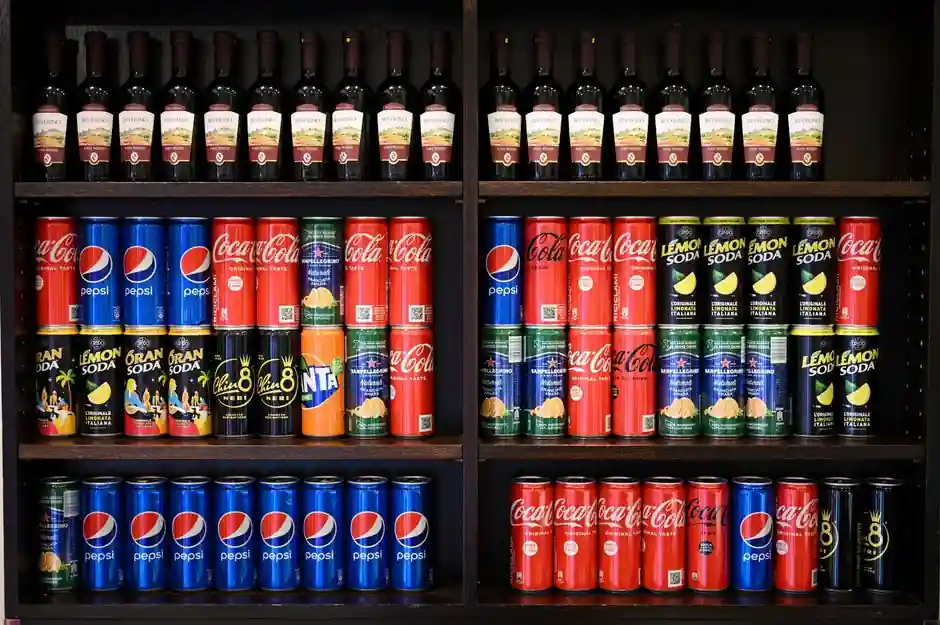
Pressure-sensitive labels work on flat or slightly curved panels and across glass, PET, HDPE, cardboard, and metal, but they cannot conform to compound curves without wrinkling or lifting [S2][S3]. Shrink sleeves work on glass, PET, HDPE, aluminum, and other rigid substrates and handle contoured, tapered, and irregular shapes, including figurine-headed bottles, single-serve wine glasses, and full-body can sleeves [S1][S3].
Common shrink film resins are PETG (most common, high shrink and clarity), OPS (oriented polystyrene, lower cost), PLA (bio-based, industrially compostable in some programs), and CPET (crystallizable PET for hot-fill) [S1]. Pressure-sensitive face stocks range from paper and films to specialty foils, holograms, and textured constructions, with adhesive selection (removable, permanent, freezer-grade, hot-fill) tuned to the pack [S3].
Graphics, Coverage, and Tamper Evidence

Shrink sleeves deliver full 360° coverage from base to neck, including a tear-perforated band that extends over the cap and breaks on first opening, satisfying FDA tamper-evident expectations for OTC pharmaceuticals and many food categories since the 1982 Tylenol incident [S1]. Reverse-printed ink is protected under the film, giving high scuff and moisture resistance plus optional UV-blocking formulations that extend shelf life of light-sensitive beverages and nutraceuticals [S1].
Pressure-sensitive labels are limited to a front/back panel or partial wrap, but accept a wider embellishment set per unit area: lamination, UV varnish, foil, embossing, spot UV, textured varnish, screen printing, and specialty stocks such as glitter or holographic film, with effects like glitter and holographic typically requiring foil stamping on shrink sleeves [S3]. For brand owners who need a 360° billboard plus a tamper band, shrink is the only one-step option; for premium front-panel decoration on a flat panel, PSL gives more finishing choices per square inch [S3].
Cost, Throughput, and ROI Comparison
On a unit-label basis, shrink-sleeve labels run roughly 25% more than pressure-sensitive labels at comparable run lengths, a figure consistently cited across converter and OEM sources [S5]. The cost gap is offset by added design real estate and integrated tamper evidence, so shrink typically pays back in beverage, personal care, and nutraceutical categories where shelf differentiation and safety signaling matter [S5][S7].
PSL is generally the lower-cost path for short to mid runs because it does not require a heat tunnel or steam generator, and applicator changeovers are roll-and-recipe operations rather than film-seam and tunnel setpoints [S3][S4]. For complex shapes the calculus flips: shrink sleeves, despite the 25% label premium, eliminate the need to stock multiple pre-cut label SKUs for tapered and contoured containers, and the same shrink line can run an entire SKU family by changing film and tunnel settings, not applicator tooling [S4][S5].
Sustainability and Recycling Reality
Pressure-sensitive labels generate a silicone-coated paper or PET liner that becomes waste once labels are dispensed, and the label-plus-adhesive combination can disrupt PET bottle recycling if not formulated for wash-off separation [S1][S3]. Shrink sleeve film is typically a multi-layer construction that is harder to recycle in standard PET streams, but PETG, PLA, and CPET formulations exist with growing recycle-stream compatibility, and the absence of a liner removes one waste stream from the line [S1][S3].
Both formats now offer eco-oriented options: PSL with recycled, FSC-certified, or compostable face stocks, and shrink with downgauged films and bio-based PLA sleeves, so the sustainability call should be made per resin and recovery stream rather than per technology in 2026 [S1][S3].
Decision Matrix and Use-Case Fit
For a flat-panel bottle, jar, or box at 100-600 containers per minute where the priority is lowest label cost and fastest changeover, specify a rotary PSL applicator with a wraparound or two-panel module and a general-purpose permanent adhesive [S3][S5]. For a contoured PET, HDPE, or aluminum container where the brand needs 360° graphics plus a tamper-evident neck band, specify a seamer-applicator-shrink tunnel shrink-sleeve line with PETG or PLA film, steam or hot-air tunnel sized to line speed, and perforation tooling for the tamper band [S1][S4].
Mid-run hybrid lines, common in craft beverage and specialty food, often run PSL on standard SKUs and a smaller shrink-sleeve cell for limited-edition or contoured SKUs, accepting the 25% label premium only where the artwork and shape demand it [S5][S6]. For equipment selection, the right metric is total cost per decorated container, not label unit price, because shrink line capex includes the seamer, applicator, tunnel, steam or electric heat source, and exhaust, while PSL capex is essentially the applicator and a labeler [S4].
Verify two specs before purchase: shrink percentage and direction of the film must match the container's compound curves (typical TD shrink 50-75% for full-body PET sleeves), and the PSL adhesive must be qualified for the container surface and downstream conditions (cold-chain, hot-fill, condensation) [S1][S3]. Also confirm that the chosen tamper-evident perforation pattern, vertical or horizontal, has been validated on the actual cap geometry, since a band that does not tear cleanly at first opening fails the FDA tamper-evident intent regardless of label format [S1]. For broader context on how a labeling decision sits inside a full packaging line, see this comparison of semi-auto versus manual cold saw selection for an example of how production volume and changeover frequency drive equipment class, or review load cell amplifier board versus DIN-rail weighing transmitter selection for the same decision logic on a different subsystem. If the pack is a hot-filled or retort beverage, also revisit resin options such as CPET, and check the latest shrink tunnel temperature windows from your OEM before finalizing the heat stage, because tunnel setpoint and dwell time, not just film grade, govern scuff and distortion results on the finished container [S4].
For the relevant spec sheets and selection criteria, see shot sleeve, shrink wrapping machine, and pressure calibrator.