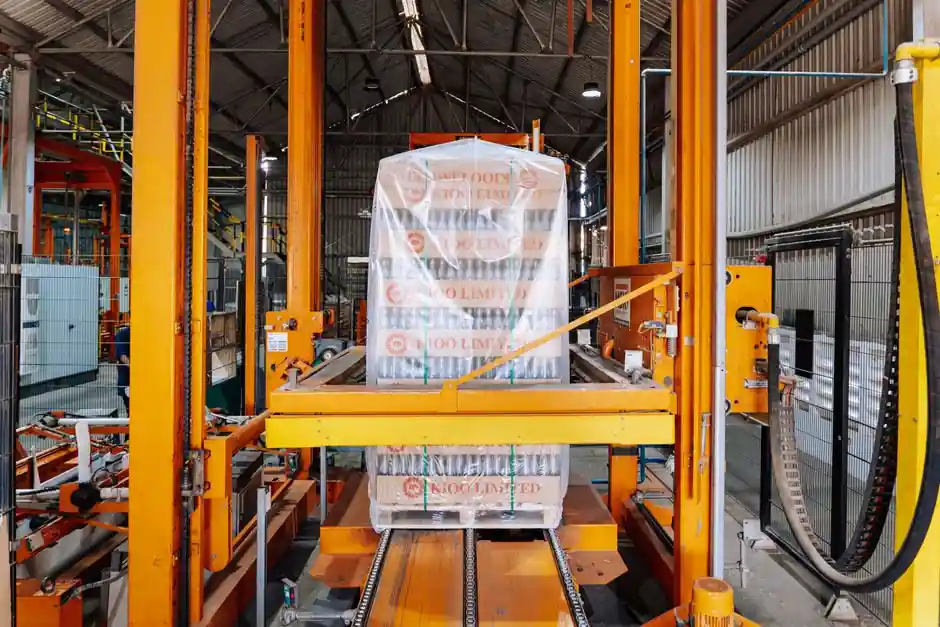
A power and free (P&F) overhead conveyor runs two coordinated tracks: an upper powered chain with equally pitched pusher dogs engages lower unpowered carrier trolleys, allowing each carrier to disengage, stop, accumulate, and re-engage independently of the chain [S1][S5]. By contrast, a power-only (sometimes called "power and load" or monorail) conveyor mounts the load directly on a single continuously moving chain or trolley, so every carrier moves at chain speed with no in-line buffering [S1][S3].
The defining mechanical difference is the disengageable pusher-dog interface, which is the component that literally makes a conveyor "power and free" rather than power-only [S1]. P&F systems are also called asynchronous conveyors; power-only systems are synchronous, because chain speed sets the pace of every load on the line [S3][S4]. That single architectural choice cascades into layout, controls, and lifecycle cost, and it is the first decision an engineer must lock before specifying a platform trolley carrier or chain size.
Operating Principle and Mechanical Architecture
P&F conveyors use a twin-track layout with a rivetless or enclosed track chain on top and a free rail below; pusher dogs on the chain latch onto the trolley load bar through a movable cam, and a stop station physically lifts or drops that cam to break the mechanical link [S1][S5]. When the cam re-engages, the carrier resumes chain speed, and when many carriers queue behind a closed stop, they accumulate at zero pressure on the chain [S5]. Power-only conveyors have no such interface: the carrier is the chain attachment, typically via a fixed dog or welded load bar, so the load cannot stop without stopping the entire line [S1].
P&F stop stations are available in standard, ATEX, and high-temperature variants for curing ovens, and the track itself can be specified as P&F, free-only, or power-only in cut-to-length modular sections for hybrid layouts [S5]. Switches are pneumatically actuated with position sensors and tie back to the PLC/PC for carrier routing, and caterpillar or screw drive units feed the chain through a torque-limiter safety clutch [S5]. For a sense of how a powered overhead conveyor chain is sized and anchored, the same engineering logic for torque limiters and drive selection shows up across construction machinery and equipment drivelines.
Load Capacity, Chain Size, and Frame Options
Standard P&F sizes scale cleanly by chain pull and per-trolley rating, and the published data from one major builder (Automatic Systems, ASI) is a useful reference for specifying any comparable overhead bridge crane-class installation. The 3-inch P&F line uses X-458 chain (Microtuff-15 micro-alloy steel, 8642 high-alloy steel) at 3,500 lb chain pull, with 500 lb per single trolley and 1,000 lb maximum per carrier [S2]. The 4-inch P&F line shares the 3,500 lb chain pull and X-458 chain but lifts the trolley to 1,200 lb single / 2,400 lb carrier, and uses 80-55-06 ductile iron (BHN 187 to 255) bodies with A-36 steel side plates [S2]. The 6-inch P&F line moves to X-678 chain at 6,500 lb chain pull, with 3,500 lb per single trolley and 7,000 lb maximum per carrier, and swaps the body to ASTM A27-65-35 (SAE 1026) at BHN 130 to 160 [S2].
An enclosed-track variant called Autoflex drops chain pull to 2,500 lb with 500 lb trolley capacity for lighter paint and assembly duty [S2]. All variants use forged SAE 4140 alloy pusher dogs in wide or narrow footprints, ball-bearing wheels with case-hardened races, and rotary or straight float frames for chain tensioning [S2]. Power-only monorail conveyors, by comparison, are typically spec'd by a single per-foot load rating on one chain size, with no free-rail carrier to carry the load when the chain is stopped.
Functionality Comparison: Stop, Accumulate, Switch, Store
Four functional axes decide the choice, and the research supports a direct verdict on each.
1. Independent start/stop: P&F can stop any single load at any location while the chain keeps running, which a power-only line cannot do without a downstream section stop [S1][S7]. 2. Accumulation: P&F carriers can queue at zero chain contact behind a pneumatically operated stop, eliminating back-pressure on the drive; power-only lines must use long dead sections or coast to a halt, which is not the same as accumulating under power [S1][S5]. 3. Track switching: P&F switches route individual carriers to different lines while the chain on each branch continues moving, a routine requirement in paint and assembly; power-only switching either needs a full line stop or is mechanically limited to fewer options [S1][S5]. 4. On-line storage: P&F supports buffering along the conveyor path as a built-in feature; power-only lines have to add side spurs or off-line buffers, which raises floor space and controls scope [S1][S7].
The selection-criteria shortlist is therefore: stop-and-start granularity, accumulation pressure, switch count, and on-line storage length. If any of those is non-zero in the spec, the project is a P&F scope; if all four are zero, a power-only monorail is enough.
Best-Fit Applications and Plant Environments
P&F is the workhorse of the overhead conveyor family for assembly lines that need to move parts from one process to the next while buffering between workstations [S1]. Real-world fit-for-purpose use cases include automotive assembly, paint lines with cure ovens, appliance finishing, and any facility where product must be delivered to multiple locations of varying dwell time [S1][S2][S7]. The ability to switch between a slow "production speed chain" and a high-speed transfer chain lets the same system pace the work cell and move carriers quickly to storage, which a single-speed power-only line cannot match [S1].
Power-only monorail conveyors fit where the route is fixed, the pace is fixed, and there is no in-line buffering need, such as simple point-to-point transfers, washers, and some lower-complexity finishing lines [S1]. They also fit well where the spec is dominated by lowest-first-cost on a short, simple loop and where accumulation would actually be undesirable. For higher-temperature and hazardous-area service, P&F stop stations and switches can be ordered in ATEX or high-temperature variants, which is an important note for any paint or oven line near classified electrical areas [S5]. The need for a torque-limited drive with a safety clutch on every P&F drive unit is the same baseline philosophy used across checking and testing apparatus drivelines, where predictable disconnect torque protects the line.
Lifetime, Maintenance, and Failure Modes
Compared with other overhead conveyor technologies, P&F systems generally have far fewer motors and far fewer moving parts that can go wrong, because a single chain can serve long runs of independent carriers [S1]. The dominant wear parts are the pusher-dog cams, chain links, trolley wheels with case-hardened races, and the switch actuating cylinders; an automatic lubrication unit on a preset interval is the standard mitigation for chain link and bearing wear [S5]. Power-only conveyors concentrate wear on the chain-to-load attachment (welded dogs, fixed load bars) because every load drags the chain; when a load jams, the whole line faults, whereas a P&F jam is usually contained at one carrier.
Common P&F failure modes to plan for in spares: pusher-dog cam fatigue after high-cycle accumulation, switch cylinder position-sensor drift, and stop-station cam wear in dirty paint-booth environments. The mitigation pattern, lubrication, modular replacement dogs, and PLC diagnostics, is well documented across the references and is the reason P&F remains the default for paint and assembly duty despite higher upfront cost [S5][S7].
Sourcing Notes and Standards Reference
Component materials and chain codes in the public datasheets are stable identifiers for cross-vendor equivalency: X-458 and X-678 chain in Microtuff-15 / 8642 high-alloy steel, 80-55-06 ductile iron trolley bodies (BHN 187 to 255), A-36 side plates, SAE 4140 forged pusher dogs, and case-hardened ball-bearing wheels are all spec-line defaults in the ASI catalog and the Ultimation/Jervis Webb build sheets [S1][S2]. The Caterpillar drive (X-458, X-678) and screw drive are the two standard P&F drive options, both torque-limited [S5]. For procurement, treat 3-inch / 4-inch / 6-inch P&F chain size and chain pull (3,500 lb / 6,500 lb) as the primary equivalence keys across OEMs, and per-trolley capacity (500 / 1,200 / 3,500 lb) as the secondary key, with Autoflex enclosed track reserved for the 2,500 lb / 500 lb light-duty segment [S2].
Trackable signals to watch on future sourcing: any OEM move to higher-alloy pusher dogs for longer cam life, expansion of ATEX stop-station variants for Class I Div 1 paint lines, and adoption of PLC-based carrier routing with carrier-coded ID for selective accumulation. For more on the mechanical comparison logic that drives a chain-vs-belt selection, see the spec-side write-up on plunger vs piston pump seal placement, and for an unrelated but useful contrast in modular layouts, positive vs centrifugal discharge bucket elevator for fragile material lays out a similar decision-matrix approach for elevator selection.