
A 1,000 kg reel of 15.24 mm 7-wire low-relaxation prestressing strand (ASTM A416 Grade 1860) at a mill-list price around USD 700-900 understates the engineered cost of putting that steel into a post-tension slab or a segmental bridge box girder by roughly a factor of three [S3][S6].
The full lifecycle stack covers raw material, freight, anchor/cone and bursting reinforcement, certified stressing labor, grout and ducts, in-service inspection, and the contingent cost of tendon replacement or decommissioning — every line item beyond the mill invoice scales with project duration rather than coil weight [S2][S3].
Scope and the Five-Cost-Block TCO Model
TCO is an accounting method that aggregates direct acquisition, operation, maintenance, and end-of-life costs over the full functional life of an asset, deliberately separating budgeted spend from hidden indirect outlays [S2][S3]. For prestressing strand the natural horizon is 50-75 years for bridges, 40-60 years for post-tensioned buildings, and 30-50 years for ground slabs, so the operating block dwarfs the acquisition block [S2]. The five cost blocks worth tracking are: material acquisition (mill price + freight), installation (anchors, ducts, stressing jacks, certified labor), operation (corrosion monitoring, tendon re-survey, surface repair), maintenance (grease top-up, sheath patching, re-tensioning after settlement), and decommissioning (releasing strands, recycling scrap, demolition separation) [S3][S6]. Hidden indirect costs — design rework, schedule slip from late deliveries, litigation reserve for premature failure — sit in the 15-25% of total TCO that a mill quote never captures [S2][S3].
Material Acquisition: Mill Price Is the Smallest Line
ASTM A416 Grade 1860 strand nominally quotes at 1,860 MPa minimum tensile strength with 15.24 mm (0.6 in) standard diameter being the dominant bridge and slab product, and 12.7 mm common for thinner slabs and transverse post-tensioning [S3]. Lead time for a mill heat of low-relaxation strand runs 4-8 weeks ex-works, 2-4 weeks to add freight to most North American or Gulf ports, and expedited air-freight can add 8-12% to the line item when a precast yard is down to its last reel [S1]. Mill test certificates per ASTM A416, including stress-strain curves, relaxation data, and chemical composition, are mandatory; missing MTCs trigger rejection rather than acceptance, so shipment traceability is itself a cost line [S3].
Installation: Anchorages, Ducts, Stressing, and Grout
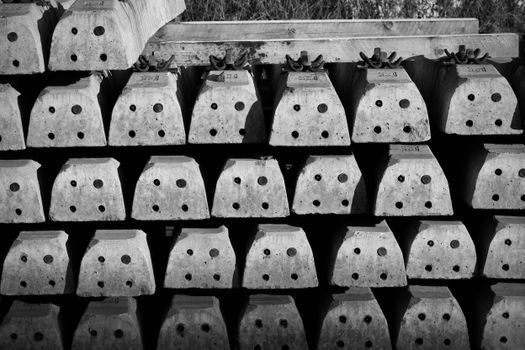
Engineered anchorages, wedges, bearing plates, and bursting reinforcement (spirals or stud-bars behind anchor zones) typically run USD 35-90 per live anchor depending on strand count per tendon, while HDPE or galvanized metal ducts cost USD 4-9 per meter for the 75-100 mm sizes common in 4-strand to 19-strand tendons [S3]. Certified stressing jack rental is USD 250-450/day with a calibrated pressure gauge and load cell; a single 19-strand tendon in a bridge pier cap can take 4-8 hours of jacking, sealing, and lock-off, with two jack teams often needed for symmetric stressing [S2][S3]. Grout for bonded tendons runs USD 0.15-0.30/kg of cementitious material with thixotropic additives; pre-bagged thixotropic grout meeting PTI M55.1 / fib 47 specifications is the default and the batching water must meet chloride limits (typically <500 ppm Cl-) [S3]. Installation labor including strand pushing, cutting, wedging, and stressing usually equals 25-40% of installed strand cost in a developed-market labor environment [S2][S6].
Operation and Maintenance: The Hidden 50-Year Spend
Unbonded monostrand tendons in post-tensioned slabs require periodic inspection of anchor pockets, grease caps, and concrete cover; a 10,000 m² slab deck typically needs a 1-2 person-day visual sweep plus selective break-out testing every 5-10 years, and unbonded tendon replacement runs USD 80-140 per linear meter including access, de-tensioning, and re-anchoring [S3][S6]. Bonded tendons in bridge box girders need grout void investigation via borescope or impulse-response testing at 10-15 year intervals; a single void remediation that requires drilling, vacuum grouting, and re-cap can run USD 2,500-6,000 per location, and PTI/FDOT practice treats chloride-induced strand corrosion as the dominant failure mode rather than steel relaxation [S3]. For aggressive exposures (coastal, de-icing salt, acidic soil), epoxy-coated or galvanized strand, HDPE sheathing, and greased encapsulation add 20-45% to the material line but typically halve the 50-year inspection budget, so the cost crossover is well inside the service life [S3].
Decision Comparison: Unbonded vs Bonded vs External
The three tendon architectures for prestressing strand compare on four decision criteria that drive TCO: initial installed cost, replaceability, corrosion exposure, and inspection access. Unbonded monostrand (typical in residential and parking slabs) is the lowest initial install (USD 18-28/kg of strand fully installed) but the hardest to replace and the most exposed to chloride at anchor heads; bonded multistrand in ducts is mid-cost installed (USD 22-35/kg) with grout-protected strand and replaceable only via costly external re-stressing; external post-tensioning with deviators and saddles runs highest installed (USD 35-55/kg) but offers full inspectability, replaceability, and is the standard for segmental balanced-cantilever bridges [S3]. For a 50-year owner-occupied asset, the lowest TCO is rarely the lowest installed cost — replaceability and inspectability discount the lifetime maintenance block enough to flip the ranking for bridges, parking decks, and water-retaining structures [S2][S3].
Failure Modes and Decommissioning Costs
The three dominant failure modes that drive decommissioning spend are: (1) chloride-induced pitting at anchor heads in unbonded systems, which forces full tendon replacement typically 30-45 years into service in marine exposure; (2) grout voids in bonded tendons allowing water ingress and strand corrosion, often discovered during a 15-20 year inspection cycle; and (3) accidental overstressing during construction jacking, which either snaps individual wires (detectable by sudden load drop) or reduces fatigue life, both of which force localized replacement [S3]. Hidden liabilities from undocumented post-tensioning during demolition have caused fatal strand-ejection incidents, so a pre-demolition strand survey is now standard on most North American and EU projects and is itself a USD 15,000-40,000 line item per major structure [S3].
Procurement Levers That Move TCO 10-25%
The cross-cutting insight is that TCO reductions of 10-25% on a 50-year asset are achievable through procurement discipline alone, without any change in the underlying strand specification [S2][S3].
Sourcing Standards and Engineering References
ASTM A416 / A416M covers seven-wire uncoated and epoxy-coated prestressing strand with Grade 250 (1725 MPa) and Grade 270 (1860 MPa) classifications, and is the dominant North American reference; EN 10138 governs the European equivalent with Y1860S7 as the closest grade match; ISO 6934 covers the international baseline [S3]. For post-tensioning systems, fib 47, PTI M50.3 (stress design), PTI M55.1 (grouting), and ACI 423.6 / 318-19 Appendix E for unbonded tendons are the controlling references; bridges additionally fall under AASHTO LRFD Bridge Design Specifications Section 5 [S3]. Buyers should verify that the mill provides heat-traceable MTCs, that strand relaxation is reported at 1,000 hours per ASTM A416, and that anchor components are sourced from a PTI or ETA-certified supplier rather than a generic hardware house [S3]. Background TCO methodology is well documented across industries; the same five-block model (acquire, install, operate, maintain, decommission) that applies to laboratory information systems and enterprise networks [S2] applies unchanged to long-life civil materials, and the proportional split between acquisition and operating blocks is what separates a serious TCO from a purchase-order reconciliation. For a deeper look at procurement and lifecycle arithmetic on a related long-life product, see Stud Welder TCO: Five Cost Lines That Decide 10–20 Year Spend and for the structural steel that often frames a prestressed element, Steel Pipe Installation: Spec-Driven Workflow from Receiving to Hydrostatic Acceptance.
Trackable next signals for buyers: (a) the next ASTM A416 / A416M revision ballot (typically a 5-year cycle, last major revision in 2018 with annual or biennial updates since); (b) mill list prices and wire-rod feedstock indexes (CRU or MEPS), since a 10% feedstock move propagates almost directly into mill quotes; (c) the regional rebar-and-rod capacity utilization, which historically tracks 6-9 months ahead of strand mill price changes and is the single best leading indicator for procurement timing. A working knowledge of prestressing strand and steel strand metallurgy makes these signals more useful to interpret when they land in the inbox.
The underlying component specifications are covered under total station.