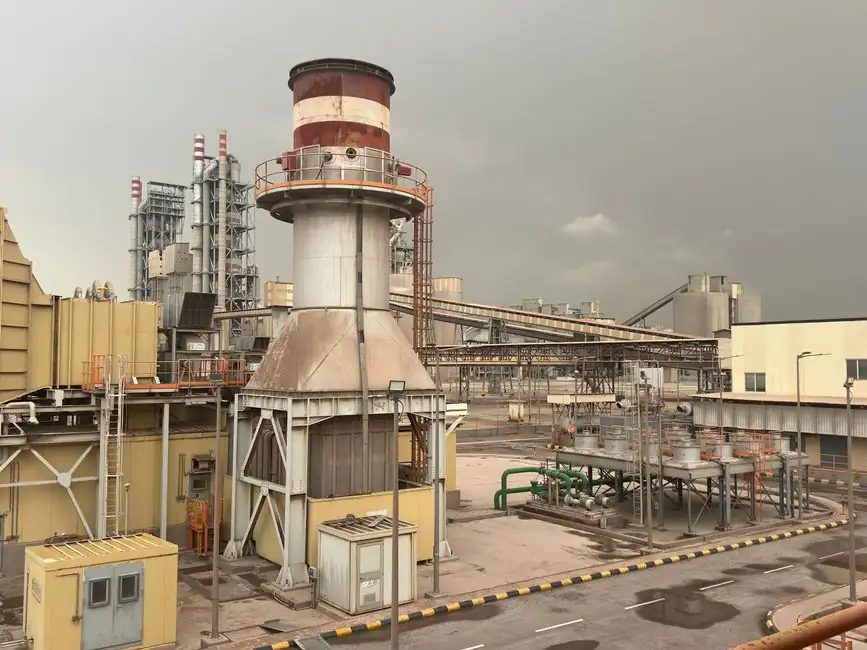
Tapered roller bearings specified for pulp and paper machinery must deliver combined radial and thrust load capacity in the 50-400 kN range, depending on the section, while resisting water, steam, and chemical attack from the stock and dryer condensate [S1][S2].
The application envelope covers four-roll calenders, suction press rolls, dryer bearings, and couch rolls, where shaft diameters typically run 80-300 mm and operating speeds sit in the 200-1500 rpm band [S1]. The four driver variables are dynamic load rating (C), limiting speed, seal/lubricant package, and mounting geometry, with the cup-and-cone design enabling paired or stacked arrangements for combined load paths [S1][S2].
Bearing Types and Geometry for Paper Machine Loads
Single-row tapered roller bearings remain the default in dryer and press sections, with a typical bore span of 80-260 mm and a load rating scaled by the bearing series (e.g. 30000, 32000, 33000) per ISO 355 [S1][S2].
For higher thrust or moment loading, double-row and four-row assemblies stack two single-row cones back-to-back or use a single double-row cone, with the matched-bore (DB) or face-to-face (DF) arrangement selected to control thermal growth and shaft deflection within the 0.05-0.10 mm runout target [S2]. Larger four-row configurations, similar in envelope to industrial part numbers such as 225x285x30 mm tapered stock [S3], are reserved for calender and reel drum journals. The roller bearing family provides the baseline geometry; the tapered variant adds the angled race that produces the line contact required for combined loads.
Speed, Temperature, and Lubrication Envelope
Limiting speed for grease-lubricated single-row tapered bearings in standard C3/C4 internal clearance usually tops out near 1500 rpm at 120 degrees C, while oil-mist or oil-bath lubrication extends the envelope to 3000 rpm and 150 degrees C [S1][S2].
Paper machine dryer sections frequently run 400-1200 rpm with shell temperatures of 140-180 degrees C on the roll surface, pushing the bearing outer ring into the 100-130 degrees C steady state when insulated housings are used [S1]. Synthetic polyurea or PFPE greases with a base oil viscosity of 100-220 cSt at 40 degrees C are commonly chosen, with relubrication intervals of 2000-4000 operating hours depending on contamination ingress and moisture washout risk [S1][S2].
Sealing and Contamination Control
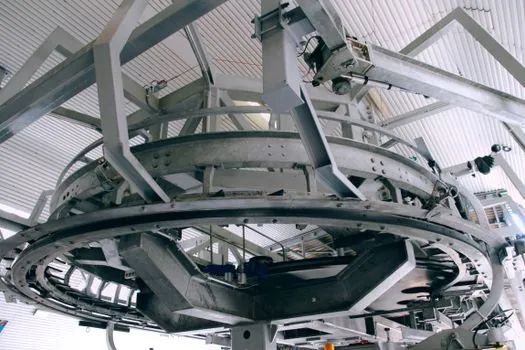
Labyrinth plus contact lip seals (typically nitrile or fluoroelastomer) are the dominant sealing arrangement for paper machine bearings, with the lip running against a hardened sleeve to limit stock-water ingestion to under 0.1% by mass in normal service [S1][S2].
Wet-end sections (forming, press) face the harshest exposure, so sealed-for-life double-row units or cartridge-style housings with V-ring excluders are routinely specified to extend service intervals beyond 20,000 hours [S1]. Stainless steel pressed-steel cages or machined brass cages are selected based on temperature and chemical exposure, with 304/316 stainless variants used where chloride-bearing white water would attack standard carbon-steel components.
Application-Specific Criteria: Dryer, Press, Calendar
Dryer section bearings must sustain 200-1500 rpm at 100-130 degrees C under moderate radial load (typically 30-150 kN per bearing), with thermal growth accommodated by CC or CX clearance classes and a focus on relubrication access through the pillow block [S1][S2].
Press section bearings carry higher dynamic loads (80-300 kN) due to felt tension and roll nip pressure, often operating under water spray, so a face-lip seal combined with grease purge is standard. Calendar stacks add bending moments from roll deflection, favoring matched-face four-row assemblies that share load across multiple race contacts. For a comparison aligned with other heavy-industry selections, the same decision logic that drives tapered roller bearing selection for cement plants applies here, but the contamination vector is aqueous rather than particulate, shifting the seal choice toward lip rather than labyrinth-only.
Mounting, Setting, and Common Failure Modes
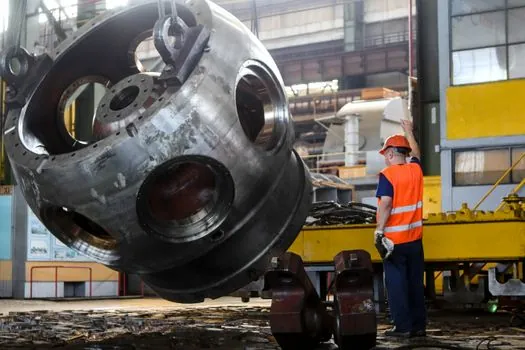
Bearing setting (the residual internal clearance after mounting) is the single most influential installation variable in paper machines: a target axial clearance of 0.02-0.10 mm per bearing, depending on bore, controls thermal growth and prevents the four failure modes that account for most unplanned outages [S1][S2].
Those modes are (1) premature subsurface fatigue from overload or underspecification, (2) abrasive wear from stock-water particulate, (3) false brinelling from micro-vibration during idler standby, and (4) cage fracture from lubricant starvation at sustained high temperature [S1][S2]. The mitigation, beyond correct rating, is a combination of induction heating for mounting (to reach the 80-120 degrees C expansion target without contamination), hydraulic nuts or sleeves for controlled positioning, and continuous online vibration monitoring in the 10-200 Hz band with alarm thresholds of 4.5 mm/s RMS on velocity and 1g peak on acceleration per ISO 10816.
Standards, Sourcing, and Specification Anchor
The relevant specifications are ISO 355 for bearing boundary dimensions and series, ISO 492 for radial bearing accuracy (tolerances to P0/P6/P5), and ABMA STD-20 for inch-series tapered roller bearing tolerances used by many paper machine rebuilds [S1][S2].
Material specifications typically call for case-hardened bearing steel (e.g. 100Cr6 / SUJ2 / 52100) with a hardened depth of 1-3 mm and surface finish under 0.05 micrometre Ra on the raceways [S1]. When evaluating suppliers, confirm availability of the matched-pair or four-row configuration at the required bore, since the lead time difference between single-row and multi-row variants can exceed 8-12 weeks. Comparable industrial-context guidance for adjacent components is available in the encyclopedia entry on tapered roller bearings and in the broader roller bearing reference. Trackable signals to monitor: ABMA/ISO tolerance revisions in the 2026-2027 cycle, and any OEM shift toward sealed-for-life cartridge units replacing traditional re-greasable pillow blocks in greenfield paper machines.
The underlying component specifications are covered under lighting equipment and electric lamps.