
Suspension-grade PVC resin SG5/SG7/S-1000/S-700 is listed on Made-in-China at US$850/tonne with a 10-tonne minimum order, while higher-K-value grades SG3/SG5/SG7/K65/K70 from the same Shandong supplier reach US$1,000/tonne at the same MOQ [S4]. Spot pricing that tight between adjacent K-values signals a flat forward curve — buyers are not paying a premium for polymer chain length, they are paying for delivery certainty.
Indian trader-wholesaler R.B. Plasticizers Private Limited (Mumbai, 14-15 years on the platform) is actively quoting suspension-grade PVC, off-grade suspension, and emulsion PVC paste for artificial leather cloth, alongside EVA 18%/28% and CPW plasticizer packages, under 25 kg bag SKU [S1]. 2,000+ China-side listings under the "pvc resin chemicals" cluster show flame-retardant masterbatch at US$16.5/kg MOQ 500 kg, sitting beside bulk PVC at US$10,400/tonne MOQ 1 tonne [S5]. The MOQ gap between kg-scale masterbatch and tonne-scale commodity resin is the first thing a buyer's procurement team has to absorb.
SG3 vs SG5 vs SG7 vs S-1000: K-Value, Viscosity, End-Use
K-value is the Fikentscher viscosity number that drives polymer molecular weight, and the SG prefix is the Chinese GB/T 5761-2018 coding scheme that maps K-value to application [S4]. SG3 sits in the higher K-value range typically used for rigid pipe and profile extrusion where higher molecular weight preserves impact strength; SG5 covers general-purpose rigid and flexible applications; SG7/S-1000/S-700 (K-value 57-62) feed injection-moulded fittings, cable compounds, and calendered film where lower melt viscosity matters more than ultimate tensile properties.
Shandong Quanhua's two listed SKUs at US$850 vs US$1,000/tonne both carry a 10-tonne MOQ and the same origin, so the spread is supplier-side grade allocation, not freight or duty [S4]. For PVC-U pipe extrusion lines running SG5 or SG7, this means the spec window for switching between grades is narrower than procurement teams assume — melt flow rate, not just K-value, is what the line operator cares about. Process engineers who lock on a single grade create single-point supply risk; multi-grade bills of material with validated K-value and Fikentscher viscosity windows are the 2026 resilience move.
MOQ and Container Math: 25 kg Bags into 20 GP
Standard export packing is 25 kg polypropylene bags loaded at 17.0 MT net per 20 GP container, with payment terms 30% T/T advance and balance against B/L fax copy within three days [S3]. That 17 MT/20 GP figure is a hard physical limit — at 25 kg per bag, you get 680 bags per box and any deviation means either under-filled (wasted slot cost) or over-filled (rejection at the receiving warehouse).
MOQ economics split three ways: Indian wholesalers (R.B. Plasticizers) sell by the bag/standard pack and price on quote ("Get Best Quote" SKU format) [S1]; Chinese manufacturers quote 10-tonne lots at fixed board prices [S4]; and trading houses (Jefferson Intl.) offer 1x20 GP MOQ with T/T or L/C at sight against a 500,000 MT/year capacity statement [S3]. A procurement officer placing a 5-tonne trial order against a 10-tonne MOQ pays a 2x effective premium per tonne; this is the single most under-budgeted line item in 2026 PVC sourcing plans.
Feedstock Risk: Chlorine, Ethylene, and VCM Spread
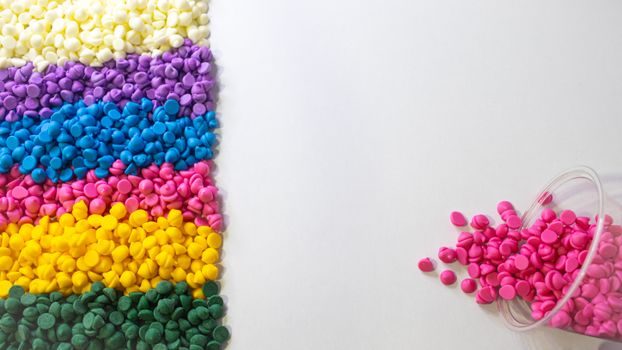
PVC is roughly 57% chlorine by mass, sourced from brine electrolysis, and 43% ethylene-derived vinyl chloride monomer (VCM). When chlorine supply tightens (mercury-cell phase-outs under the Minamata Convention, membrane-cell capacity additions running behind schedule) or ethylene crackers run unplanned outages, VCM spreads widen and PVC producers cut run rates before they cut list prices. The 2025-2026 chlor-alkali balance has stayed tight enough that suspension-grade resin prices did not collapse with crude oil — a 5-year chart of PVC vs ethylene would show a decoupling that no ethylene-only model explains. [S3]
For buyers, the operational implication is that PVC risk cannot be hedged with an ethylene or ethylene-derivative contract alone. A safer approach is dual-source qualification across at least two of: Chinese SG-grade, Indian suspension grade, and US Gulf export, with a documented synthetic resin grade interchangeability table. The resin sand line casting industry — a heavy PVC-bound-resin user for shell moulds — was the first to publicly flag 2024-2025 PVC tightness because no substitute resin cures at the same rate under the same catalyst.
Off-Grade and Emulsion: Cheaper, Riskier, Spec-Sensitive
Off-grade suspension PVC and emulsion PVC paste (P-PVC, for artificial leather cloth and dipped goods) trade at a discount to prime suspension but carry k-value scatter, contamination risk, and inconsistent plasticizer absorption [S1]. Indian trader listings explicitly separate "Off Grade Pvc Resin Suspension" from "PVC Resin (Suspension Grade)" as distinct SKUs with distinct pricing — that separation is the warning. Off-grade resin in a pipe extrusion line shows up as surface roughness, gel count spikes, and impact failure at low temperature; in a calendered film line it shows up as fish-eyes and tear-strength drop.
Emulsion PVC paste (P-PVC, K-value ~68-72) is a different polymerisation route altogether — finer particle size, plasticizer pre-absorption required, no dry-blend capability with suspension grades [S1]. Buyers who substitute emulsion for suspension to chase price typically discover the mistake at the compounding stage when dry-blend times double and fish-eye counts go up. Grade substitution is a process-engineering decision, not a procurement decision; the buyer's spec sheet must call out polymerisation route (suspension vs emulsion vs mass) in the same line as K-value.
Manufacturer Map: Shandong Density and Trade-House Layers

The China-side cluster around Shandong Quanhua, with US$850-1,000/tonne fixed pricing, sits inside a 2,000+ manufacturer PVC resin suppliers and manufacturers list 2026 sourcing map cluster that also includes flame-retardant masterbatch producers at US$16.5/kg [S5]. Shandong concentration is real and matters: any single typhoon, scheduled turnaround, or feedstock allocation event at one or two majors shows up as a national spot-price move within 7-10 days. Indian trading houses (Mumbai, GST-registered) sit on top of this base offering repackaging, bagging, and mixed-container consolidation [S1].
For procurement teams, the layered map is: (1) direct mill — minimum 50-100 MT/month, fixed board, no negotiation; (2) Shandong trading house — 10-25 MT lots, negotiable, 30-day terms; (3) Indian wholesaler — bag-level, mixed-container, premium for fragmentation; (4) trading house (Jefferson-type) — full-container, T/T or L/C, capacity-backed [S1][S3][S4]. Each layer adds 3-8% to the tonne cost and reduces MOQ by roughly 10x. The right layer depends on whether you need a 20 GP trial container or a 500 MT/year contract — mixing them up is how 2026 sourcing budgets get blown.
Substitution Reality: CPVC, PP-R, PE-RT, and the Pipe-Spec Question
For PVC-U pipe applications, three real substitutes exist: chlorinated PVC (CPVC, higher temperature rating, higher cost), polypropylene random copolymer (PP-R, hot-water only), and crosslinked polyethylene (PE-RT, floor heating and underfloor). None is a drop-in: CPVC needs different stabiliser packages and different cement; PP-R needs different fusion-welding equipment; PE-RT needs different fitting geometry. A spec change from PVC-U to PP-R is a 6-12 month project — new dies, new cooling calibration, new pressure-rating certification. [S1]
This is the real 2026 risk picture: PVC resin is available at stable but elevated prices, and a buyer who tries to escape the price by switching polymer pays for it in capital equipment, certification lag, and field-reliability exposure. Dual-polymer qualification (PVC-U plus PP-R or PE-RT) is the conservative play for any pipe-extrusion operation running tight PVC contracts. The epoxy resin supply 2026 shortage triggers hardener backups and sourcing specs situation runs in parallel — both resin families are chlorine/feedstock-exposed, and the lessons on hardener backup and dual-source qualification transfer directly.
Standards, Specifications, and What to Put on the PO
International shipping specs that show up on 2026 PVC POs include ASTM A416 (PC strand, where PVC-coated), BS 5896:1980, EUR 138-79, and AS 1311 — these govern the steel-strand wrapping application, not the PVC resin itself [S3]. For resin grade, the operative standards are GB/T 5761 (Chinese SG coding), ISO 1628-2 (K-value/viscosity), and ASTM D1755 (paste resin classification for emulsion grades). A compliant PO line item reads: "Suspension PVC resin, K-value 67±1 (ISO 1628-2), SG5 grade (GB/T 5761), 25 kg PP bag, 17.0 MT/20 GP, SGS pre-shipment inspection, 30% T/T advance balance against B/L."
Three verifiable signals to track through Q4 2026: (1) Shandong Quanhua or peer mills posting price changes in the US$850-1,000/tonne band — any move outside that range is the early warning; (2) chlorine-caustic spot prices on the East China exchanges, which lead VCM by 3-4 weeks; (3) Indian trader response-rate and SKU availability on R.B. Plasticizers and similar platforms, which lead physical bag-level supply by 2-3 weeks. A 10% price move on any one of these three, sustained over 2 weeks, is the trigger to convert any open optionality into a firm PO.