
A semi-trailer concrete mixer carries roughly 10-12 m³ of wet mix on a drawbar-coupled chassis, while a rigid truck-mounted mixer typically tops out near 9 m³ on a single frame, per OEM product-line data from Frumecar's semi-trailer concrete mixer range [S2].
The two configurations trade payload, turning radius, and discharge geometry against each other, and the wrong pick shows up fast as drum slump loss, short-load fees, or rejected pours on a constrained site.
Payload, Drum Geometry, and Legal Axle Weight
Frumecar's semi-trailer concrete mixer line is engineered for "large volume and loading capacity... high rigidity, with compact, easy to drive dimensions and a low structural weight," positioning the configuration as the high-payload end of the market [S2]. A drawbar arrangement lets the trailer ride on its own tri-axle group plus the tractor's drive axles, which spreads load over more tires and side-steps the single-frame axle limit that pins a rigid mixer to roughly 8-9 m³ in most EU and US jurisdictions. Rigid truck mixers, by contrast, are self-contained: the drum, water tank, chute, and discharge hardware all bolt to one chassis, which simplifies registration and insurance but concentrates mass on a shorter wheelbase.
For engineers sizing a fleet, the operational rule from industry guidance is that a mixer drum should run at no more than about 80% of geometric volume to keep mixing effective and prevent spillage during transit, a limit that applies to both trailer and rigid formats [S1]. A 12 m³ semi-trailer drum therefore carries a working payload close to 9.6 m³ of mixed concrete, not a true 12 m³, and that 80% derate is the number to put on haul manifests and dispatch tickets.
Maneuverability, Discharge Reach, and Site Access
Rigid truck mixers win on tight urban sites: shorter wheelbase, tighter lock-to-lock turning radius, and a single frame that backs into a driveway or alley without the articulation headaches a semi-trailer introduces. Forum feedback from drivers who ran both formats backs this up: one mixer veteran on The Truckers Report flatly stated "done both will never drive mixer again" after switching away from the rigid format, while another driver countered that "there is much more to being a good mixer driver than driving, and it is much easier to learn to back up a T/T than it is to be a good mixer hand" [S3]. The mixer's job, in other words, is about chute work, slump judgment, and washout discipline, not just driving.
On the discharge side, a semi-trailer drum sits higher and farther back, which extends chute reach but cuts under clearances, while a rigid truck can tuck a shorter folding chute into basements, over formwork, or directly into a pump hopper. Where a concrete pump truck is on site, both formats feed it the same way, but the rigid mixer's lower drum centerline lines up more naturally with most pump hoppers, reducing spillage at the transfer. Engineers planning a truck-mounted concrete pump pairing should spec the pump's hopper height to the mixer, not the other way around.
Mixing Time, Slump Window, and Haul Distance
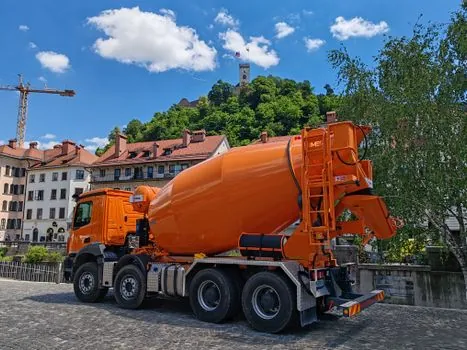
Ready-mix delivery, whether carried by a rigid or a semi-trailer drum, runs against a fixed working window: concrete leaves the plant, slumps in transit, and must be placed before initial set. SkEyeWatch's comparison of ready-mix vs volumetric formats puts that window at "60 to 90 minutes" for ready-mix drums in standard conditions [S4]. The 30-minute spread inside that band is where the semi-trailer earns its keep: a tractor can pull a loaded semi-trailer at highway speed, and the drawbar's longer wheelbase damps drum surge less aggressively, so the mix arrives closer to plant specification on long hauls.
On short urban hauls under 15 km, the rigid mixer is usually faster door-to-door because it skips the coupling step, idles less at the plant yard, and can be reverse-staged into the pour without a spotter tractor. The decision rule for fleet planners: rigid below 30 km and within a 60-minute plant-to-pour radius, semi-trailer above that band.
Maintenance, Crew, and Lifecycle Cost
A semi-trailer mixer splits its drivetrain across two units: tractor maintenance (engine, transmission, drive axles) is separate from trailer maintenance (drum bearings, rollers, hydraulic drive, chassis, suspension). That separation is good for uptime, because a drum or roller failure does not put the tractor out of service, but it doubles the registration, insurance, and periodic-inspection burden. A rigid mixer is one vehicle, one inspection file, one insurance policy, simpler in fleets running 5-15 units. [S2]
Both formats share the same drum, blade, and chute wear parts, so spare-parts inventory is largely interchangeable. The trailer-only items, drawbar kingpin, landing gear, tri-axle brakes, and trailer-mounted hydraulic drive, add a second stocking line. Operators running 20+ units commonly spec the same drum and blade supplier across both formats, then add trailer-specific kingpin and landing-gear kits. For smaller fleets, a rigid-only policy cuts parts complexity and keeps mechanics working on one chassis type.
Selection Criteria: Decision Matrix for Fleet Spec
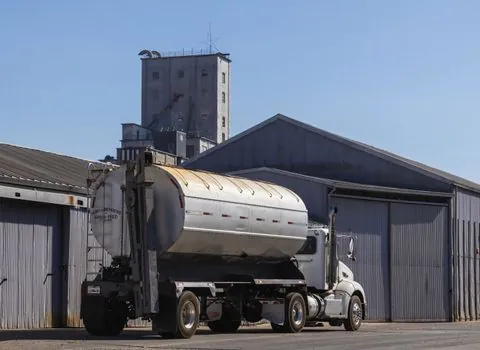
Putting the two formats against each other on the criteria that actually drive a buy decision: payload per trip favors the semi-trailer (10-12 m³ vs ~9 m³ typical rigid); maneuverability and urban access favor the rigid chassis; highway haul distance above 30 km favors the semi-trailer; under that, the rigid is faster; regulatory and insurance complexity favors the rigid; capital cost per cubic meter of delivered concrete favors the semi-trailer at scale; and crew flexibility favors the semi-trailer because the tractor can drop the trailer and run a second load. [S5]
The mix type matters too: a concrete mixer truck configured for high-slump SCC or pervious mixes benefits from the longer drum axis a semi-trailer offers, which gives the helical blades more throw length and reduces the dead spot at the back of the drum that plagues some short-wheelbase rigids. Conversely, dry-mix and roller-compacted applications often run better in a smaller rigid drum where the operator can hit discharge rate more precisely through the chute.
Standards, Sourcing, and What's NOT in the Research
The research covers OEM product positioning, driver-reported field experience, and the ready-mix vs volumetric timing window, but it does not contain specific axle-load regulations, drum rotation speed standards, or named-occupational-noise limits for either configuration. Engineers sizing a buy should pull local bridge-formula and gross-vehicle-weight rules directly from the relevant road authority, since the 10-12 m³ semi-trailer payload cited above is only valid where the local GVW and tri-axle limits actually permit it [S1][S2].
Two follow-on references worth tracking: first, the volumetric-mix vs ready-mix economics that [S4] lays out, which increasingly let a single truck switch between formats mid-day and erode the traditional rigid-mixer advantage on short pours; second, operator-side notes from [S3] that mixer work is judged on chute and washout discipline, not driving skill, a useful filter when hiring crews for either format. For projects where a dump truck shuttle is also under consideration for aggregate or short-haul fill, the semi-trailer mixer's drawbar concept does not transfer cleanly, and that is usually a sign the job is too small to justify a dedicated mixer-trailer at all.
This topic is covered further in Polyurethane vs Nylon vs HDPE: Bucket Elevator Material Decision.