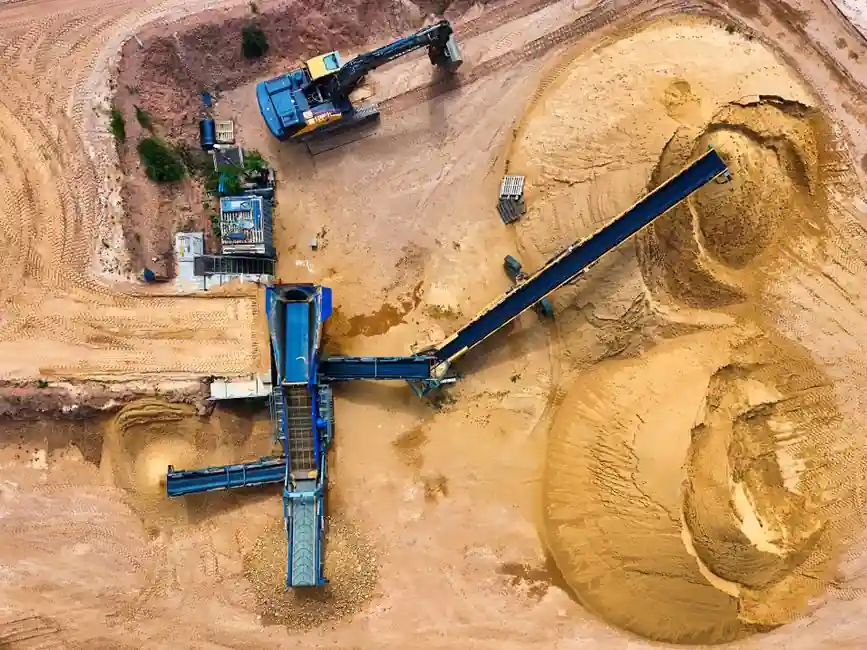
A truck-mounted concrete pump for quarry duty is typically picked on three interacting axes: vertical reach (24-70.2 m class booms are common in current OEM line-ups [S3]), boom articulation for shotcrete faces versus crusher hoppers, and the wear life of the delivery line in contact with abrasive aggregate.
Quarry concrete is not the same animal as structural concrete: a 20-40 mm aggregate, frequent 60-80 mm slump variations, and 50-100 m horizontal runs from truck to face stress the S-pipe, wear ring, and twin-wall pipeline harder than a building pour [S4]. Camera-based blind-spot systems are now specified by major operators to manage the side and rear hazards created by long outriggers in pit terrain [S1].
Boom Reach Bands and What They Buy You on a Quarry Face
Production boom-pump inventories in North America span 33 m to 57 m vertical reach on a single chassis, with a small number of five-section 63 m units used on quarry dam and bench pours [S2]. The OEM catalogue window is wider: 24 m short-roll four-section booms sit at the low end, while 70.2 m seven-section booms are reserved for high-volume crusher-feed and mine-infrastructure pours [S3]. For typical quarry service roads and bench heights under 20 m, a 36-42 m five-section boom gives the best reach-to-mass ratio and folds into transport envelopes below 16 m total length.
Longer reach is not free. Every additional boom section adds roughly 800-1,200 kg of structure and a second articulation joint, which must be greased and inspected on a quarry shift. The rule of thumb from quarry contractors: pick the shortest boom that reaches the face with 5 m of stand-off, because short booms cycle faster and survive abrasive dust better than extended configurations.
Pumping Pressure, Pipeline Diameter, and Aggregate-Driven Wear
A quarry pump normally runs at 60-85 bar hydraulic pressure to deliver a 80-150 mm slump through 125 mm (5 inch) twin-wall pipeline; the twin-wall design halves the wear rate compared with single-wall pipe on the same aggregate [S4]. S-pipe wear plates, typically 16-22 mm thick hardox-grade, are the planned-consumable part and should be measured at 250 hour intervals on a quarry duty cycle.
Aggregate size dictates the minimum pipe bore. The working rule across current OEM documentation: maximum aggregate should be no more than one-third of the delivery line inner diameter, so a 125 mm line tolerates 40 mm stone, while a 150 mm line tolerates 50 mm stone. Over-sized aggregate in under-sized line is the dominant cause of S-pipe seizure and delivery-cylinder packing failure on quarry sites.
For high-abrasion service, specify hard-faced wear rings (chromium-carbide overlay, 55-60 HRC) and keep a documented 1.5 mm wear limit on the cutting ring before the S-pipe begins to leak. Pressure spikes above 95 bar are the early-warning signal that a wear ring is at its limit.
Chassis Mobility, Outrigger Footprint, and Pit-Terrain Stability
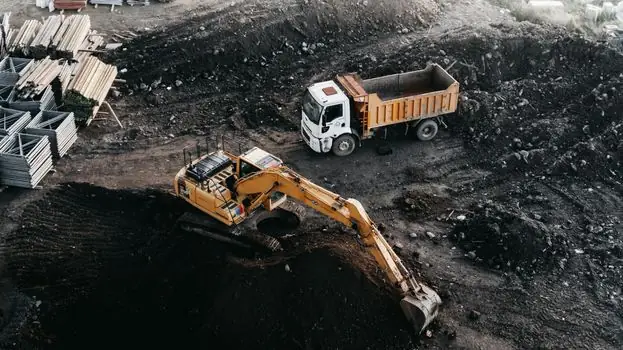
Quarry haul roads are 8-12% grades with switchback radii under 12 m, so a 6x4 or 8x4 chassis with 385/65 R22.5 super-single tyres is the common platform, paired with a short wheelbase to keep the outrigger spread inside 8.5 m [S3]. Front and rear outrigger pads should be rated for at least 1.5x the gross machine weight on a 200 kPa ground-bearing calculation, because pit-floor bearing capacity drops sharply after rain.
Long booms shift the centre of gravity up and forward, which means outrigger extensions on the boom side must reach full travel before any slewing. A common operator error on quarry pads is partial outrigger extension with a 50 m+ boom, which produces tip-over events. Stability calculators from each OEM assume a fully extended outrigger on a level pad; quarry operators who routinely work on benches must derate reach by one boom section, or use counterweight ballast packs.
Visibility and Safety Systems Now Standard on Quarry Rigs
Camera-monitor systems, including 360-degree top-down view, side-scan cameras on the outrigger arms, and rear-view cameras, are being retrofitted on quarry pumps to remove the blind spot created by the folded boom during travel [S1]. Brigade's published Cemex case work covers both side and rear coverage and is the kind of specification quarry procurement teams now write into tender documents [S1].
Radar-based object detection (ultrasonic at 1.5-3 m range, radar at 5-8 m) is layered on top of the camera system for the boom-swing arc, because the operator's line of sight is broken by the boom sections themselves. Hard-wired 7-inch IP-rated monitors in the cab, with auto-dim and anti-glare, are now the default on new quarry builds.
Comparison: Short-Boom vs Mid-Boom vs Long-Boom for Quarry Work
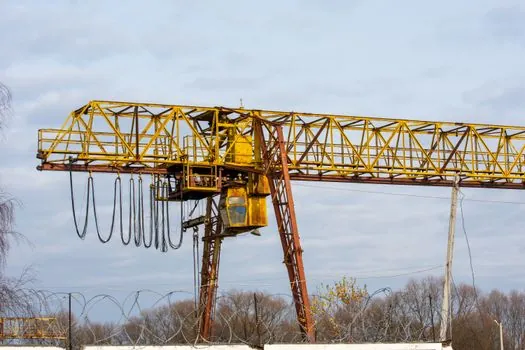
Short-boom pumps (24-36 m, four-section) weigh 22-28 t on a 4-axle chassis, fit a 14 m transport envelope, and reach typical bench heights of 15-20 m with 1-1.5 m stand-off; they cycle in 18-22 seconds at 60 bar but are limited to single-bench crusher-feed duty. Mid-boom pumps (38-52 m, five-section) at 32-42 t on a 5-axle chassis fit a 15.5 m transport envelope, reach 25-40 m bench heights, and are the workhorse for both face pours and haul-road culvert work [S2]. Long-boom pumps (55-70.2 m, six to seven sections) at 48-62 t on a 6-axle chassis need a 16.5 m+ transport envelope, an 8.5 m+ outrigger spread, and are reserved for quarry dam, conveyor gantry, and high-volume crusher base pours where the boom must reach over operating plant [S3].
On cost per cubic metre pumped, short booms win on small daily pours, mid booms win on general quarry service, and long booms only pay back when the alternative is a static boom or a crane-and-bucket setup. Maintenance burden tracks the same way: a 70 m boom has roughly 1.6x the pivot greasing hours of a 38 m boom, and roughly 2x the hydraulic hose replacement cost over a 10,000-hour life.
Selection Criteria and Sourcing Notes for Procurement
For quarry procurement, the practical selection gates are: (1) maximum aggregate size vs delivery line bore, with 1:3 ratio as the gate; (2) boom reach matched to the highest bench plus 5 m stand-off; (3) outrigger spread and ground bearing on the worst pad; (4) wear-package specification (chromium-carbide overlay, S-pipe thickness 16-22 mm); (5) on-board safety systems including 360-degree camera, side-scan radar, and reverse warning alarms at 97-112 dB(A) [S1]; (6) chassis configuration 6x4 or 8x4 with retarder-brake for sustained 8-12% descents; (7) wear-consumable lead time, which should be under 48 hours to keep a single pump on shift.
For a deeper view of how boom configuration maps onto a related high-impact application, the Truck-Mounted Concrete Pump Spec Map for Demolition Projects walks the same reach bands against a different set of site constraints. For matching the truck chassis itself, including 4x2, 6x4, and 8x4 choices against payload and road rules, the Spec-Driven Dump Truck Selection for Urban Infrastructure decision map is a useful cross-reference for quarry haul-corridor work where the same chassis decisions apply.
Track the next 6 months for two signals: any new OEM release of a quarry-rated boom pump in the 45-55 m band with factory-fitted camera and radar packages, and any revision to the EN 12001 concrete-pump machine safety standard that adds mandatory side-scan coverage on outriggers. Either of these will tighten the spec sheet quarry buyers write in 2026-2027.
For the relevant spec sheets and selection criteria, see truck mounted concrete pump, truck mounted crane, and concrete pump truck.