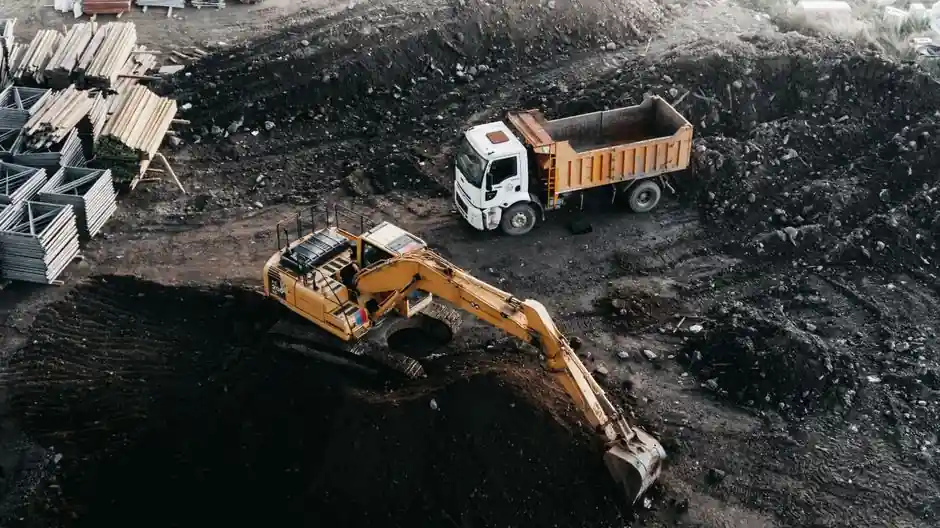
Pipeline right-of-way haul cycles punish general-purpose on-highway tippers: crews need articulated, low ground pressure machines in the 10–25 CBM range, with tracked or wide-flotation options on soft soils and 6×6 drive for slopes above 30% [S1][S2].
Body volume, GVW, and engine output should be sized to the spoil density being moved: 15–25 CBM bodies cover most backfill and bedding work, while daily loads of 50 tonnes or more push the spec toward 8×4 or 6×6 heavy configurations [S3][S4].
Right-of-Way Geometry Sets the Machine Class
Pipeline easements typically run 20–30 m wide with active trench zones of 3–5 m, so a truck overall length under 8.5 m, wheelbase under 3.8 m, and width of 2.3–2.4 m is the practical ceiling for unobstructed travel parallel to the ditch [S10]. Bergmann 912s and 815s low-profile articulated dumpers sit in this envelope, with swivel beds that let the operator spot-dump bedding or backfill within 1–2 m of the trench wall without shovelling [S1][S2].
Conventional on-highway 6×4 and 8×4 rigid tippers from the HOWO/Sinotruk range measure 8.0–9.5 m long with 3.5–4.0 m wheelbase, so they fit mainline spreads but struggle on tight lateral deliveries and mat crossings. For mainline spreads, 6×4 trucks in the 18–20 CBM / 25-tonne GVW class cover most spoil and bedding cycles [S4].
Ground Pressure: Tracked vs Tyre-Flotation
On saturated or peat subsoils, standard 12.00R24 or 315/80R22.5 dual-tyre rigs ground at roughly 250–350 kPa contact pressure, deep-rutting in a single pass; wide-flotation single tyres or rubber-tracked carriers cut that to 30–80 kPa, which is the operating window pipeline contractors target in soft-terrain spreads [S1][S2][S7]. Bergmann's 912s tracked dumper and wide-flotation tyre options are sold into exactly this regime, pairing with 815 mat-hauler support trucks that carry temporary road mats to bridge wet crossings [S1][S2].
Tracked dumpers sacrifice top travel speed (typically 8–15 km/h loaded) and on-road legality versus wheeled ADTs that run 30–45 km/h, so spreads usually mix both: tracked units stay on the right-of-way, while wheeled ADTs shuttle between borrow pits and the right-of-way access points [S7][S8].
Payload and Body Volume by Material
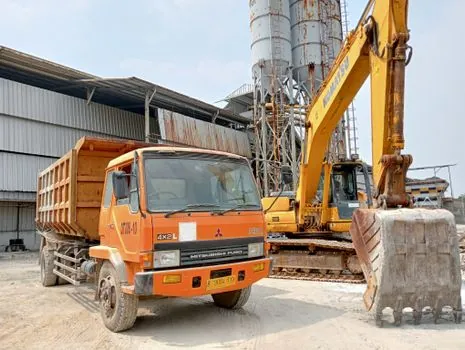
Body volume must be matched to material density, not chosen on nameplate alone: a 20 CBM body running wet clay at 1.8 t/m³ will gross well over the 25-tonne GVW of a 6×4, so the same job in dry sand at 1.5 t/m³ is comfortable on the same chassis [S3][S4]. The HOWO 8×4 in 30 CBM / 31-tonne GVW trim offers greater per-cycle capacity than the 6×4 (18–20 CBM, 25-tonne GVW), suiting it to long-haul spoil removal but over-specifying it for short right-of-way shuttles where cycle time, not volume, gates productivity [S4].
For backfill and bedding sand, a 15–25 CBM high-strength wear-resistant steel body is the common spec; for chunked rock or frozen spoil, the same volume needs a reinforced floor and a heavier lift cylinder because impact loading on the dump body is the dominant wear mode in pipeline trench work [S3][S7].
Powertrain and Driveline Specs for Pipeline Work
Engines in the 371–420 HP band with high torque at low RPM (typically 1,800–2,100 Nm peak from 1,100–1,400 rpm) are the common spec for 6×4 and 8×4 pipeline tippers; 4×2 short-haul units can drop to 300–380 HP because the cycle is light and start-stop heavy [S3][S4][S5]. Reinforced manual quick-shift gearboxes are typical, and for steep easement grades a 6×6 with dual rear drive axles and inter-axle diff lock is preferred over 6×4 because of traction loss on wet clay ramps [S3][S4].
Fuel consumption is not a single number on pipeline work: tracked dumpers burning 25–35 L/hr under load at idle-to-trench cycles compare with on-highway 6×4 units at 35–50 L/hr over longer shuttle distances, so the right metric is litres-per-tonne-km moved, not litres per hour at the gauge [S5][S7]. Spare-parts availability, especially for Weichai and Cummins engines, is a buying gate in Africa, the Middle East, and Southeast Asia because downtime on a remote spread is the dominant cost line, not fuel [S3][S4].
Selection Comparison: Tracked Dumper vs 6×4 Tiper vs 8×4 Heavy Tiper
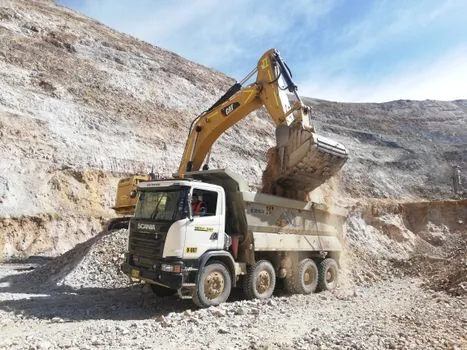
Tracked low ground pressure dumpers win on ground pressure (30–80 kPa), width (often under 2.4 m), and trenchside precision, but lose on top speed (8–15 km/h) and on-road legality, making them right only for active easement work [S1][S2][S7]. 6×4 on-highway tippers in 18–20 CBM / 25-tonne GVW trim are the universal workhorse for spoil haul on established access roads, balancing payload, manoeuvrability, and road compliance with 371–420 HP engines [S4][S5]. 8×4 heavy tippers at 30 CBM / 31-tonne GVW are justified only when cycle distances exceed roughly 5 km or when daily tonnage crosses 50 tonnes, because below that the extra tare weight and fuel burn cancel the payload gain [S3][S4][S5].
For comparison with a parallel application, the dump truck selection workflow for road construction follows similar 6×4 and 8×4 logic, but road work rarely calls for tracked low ground pressure units, which is the spec gap pipeline spreads have to fill separately.
Where Pipeline Dump Trucks Fit, and Where They Don't
These machines are aimed at mainline gas, water, and fibre pipeline contractors running continuous right-of-way spreads of 5–50 km, where spoil, bedding sand, and backfill must move in steady cycles parallel to the trench [S1][S2][S7]. They are NOT the right tool for urban utility work (4×2 short-haul tippers fit better), nor for greenfield mining haul where 100-tonne-class mining dump trucks operate, nor for farm field drainage where smaller agricultural track carriers and ADTs handle lower-density loads.
For crews running cross-discipline fleets, the dump truck body and chassis spec map lays out the drive-configuration and GVW envelopes that apply across pipeline, road, and aggregate-haul duty cycles, while the mining dump truck spec envelope defines the upper size class beyond which a pipeline tipper is simply under-sized.
Limitations and Failure Modes to Spec Against
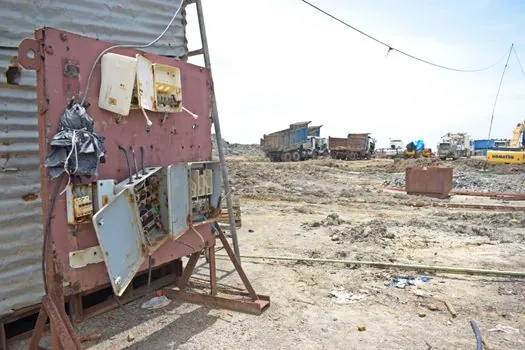
The three field failure modes on pipeline tippers are: (1) body floor wear through on chunked rock, requiring a switch to high-strength wear-resistant steel (commonly NM400 or Hardox 400 class) for abrasive spoil [S3][S7]; (2) hydraulic lift-cylinder seizure on dusty, unwashed machines, addressed by specifying leak-free sealed cylinders and regular greasing intervals [S3]; (3) driveline wind-up on articulated dumpers pulling heavy loads up steep trench-side ramps, which is why a low centre of gravity and a rear axle limited-slip or diff-lock are required above 25% sustained grades [S1][S4].
Compliance gates are emissions class for the destination market (Euro III through Euro VI for export, EPA Tier 4 Final for North American pipeline spreads) and load-axle regulations that cap GVW on public-road approaches to the right-of-way; buyers should verify these against the operating country before locking the spec, because changing an 8×4 to a 6×6 to meet a local bridge formula is a 3–6 month delivery shift [S3][S4][S5].
Sourcing and Standards Reference
No single ISO or API standard governs pipeline construction dump trucks outright, but payload and chassis ratings are typically certified against the manufacturer's national standard (GB 7258 for Chinese-built tippers, FMVSS/CMVSS for North American units, ECE R55 for tipper body attachments) and engine emissions against the destination market's tier at the time of registration [S3][S5]. Buyers should ask for a documented GVW test certificate, a published ground-pressure figure for tracked or flotation-tyre configurations, and a service-interval schedule matched to a 4,000–6,000 hour overhaul target, which is the realistic lifecycle on pipeline duty [S1][S4][S5].
Two trackable signals for late-2026 sourcing: (1) Sinotruk HOWO and Shacman delivery slots out of Shandong for 6×4 and 8×4 tippers into Middle East and African pipeline projects are running 8–12 weeks from PO, up from 4–6 weeks in early 2025, indicating sustained order-book pressure [S3][S4][S5]; (2) Bergmann's 815s and 912s low ground pressure dumpers continue to ship with lead times quoted at 16–24 weeks for North American right-of-way buyers as of mid-2026 [S1][S2].
The underlying component specifications are covered under pipeline pump.