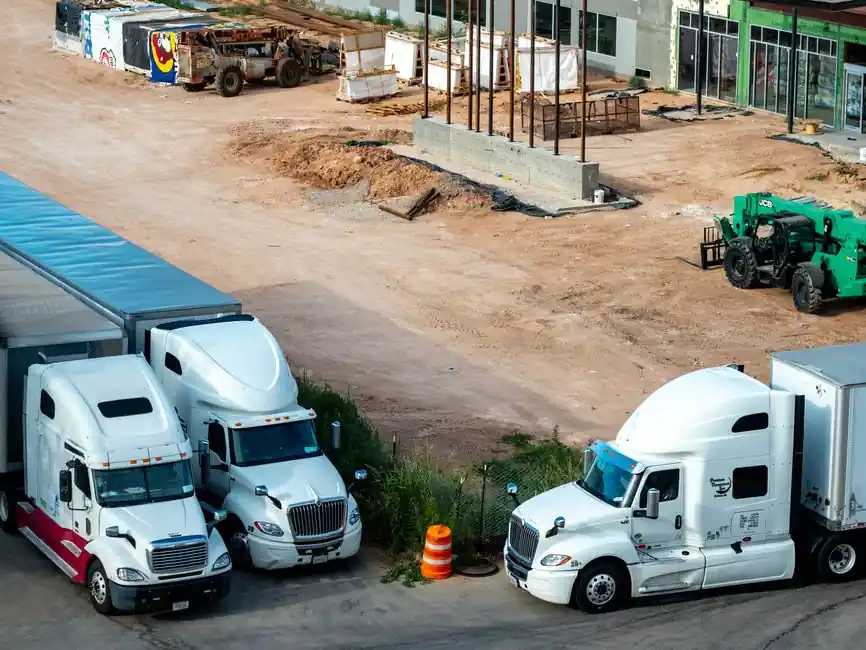
For demolition retrofit work, a truck-mounted concrete pump sized 24 to 32 m of vertical boom reach covers roughly 80 percent of urban teardown backfill and replacement-slab pours, with placement rates of 30 to 80 cubic metres per hour at 4 to 7 MPa line pressure [S2][S3].
Demolition scopes generate a different pour profile than greenfield builds: shorter pour windows, congested sites, mixed slab-on-grade and elevated deck replacements, and frequent standby when excavators or hydraulic breakers are cycling nearby. The pump chassis, boom geometry, hydraulic circuit, and outrigger spread have to be evaluated against those constraints, not against open-field high-rise metrics.
Boom Reach, Chassis Mass, and the 24 to 70.2 m Selection Window
SANY publishes a current production range of truck-mounted boom pumps with vertical reach spanning 24 to 70.2 metres, mapping roughly to four-tier site profiles: 24 to 32 m for residential and low-rise commercial demolition, 37 to 47 m for mid-rise teardown and reconstruction, 50 to 58 m for high-rise urban infill, and 60+ m for specialised long-reach applications [S2].
Chassis mass scales with boom length: Australian 24 to 32 m units run 25 to 60 tonnes gross vehicle weight with a four-section Z-fold or roll-fold boom, while 50 m+ units push beyond 60 tonnes and require 7 to 9 m vertical clearance for boom deployment [S3]. For demolition, a 32 m boom is typically the inflection point where a single operator can still set up on a 6 m wide lane without road closure permits, and where 4-section booms clear most adjacent overhead power lines (a recurring hazard flagged in Catawba Valley Concrete's pre-pour safety planning, which lists overhead power lines and slope stability as outrigger-set gating items) [S1].
The matching concrete pump truck chassis is normally a 4 to 6 axle carrier with a Tier 4 Final or Stage V diesel driving the pump drivetrain through a power take-off. Demolition contractors should verify that the carrier's turning radius, not just its reach, fits the site; a 47 m boom on a 14 m wheelbase truck cannot set up on a typical 9 m urban demolition lane without repositioning.
Pump Circuit, Hydraulic Pressure, and Placement Throughput
Modern truck-mounted concrete pumps use closed-loop hydraulic circuits with axial-piston pumps driving differential-cylinder concrete cylinders; the same positive-displacement principle (gear, axial piston, radial piston) that powers mobile demolition tools such as concrete shears and rock splitters applies to the pumping end [S4].
For demolition backfill, typical operating pressure sits at 7 to 12 MPa at the concrete cylinders, with theoretical flow of 140 to 200 m³/h at low pressure dropping to the practical 30 to 80 m³/h window as boom elevation and pipeline length increase [S3]. The two-stage delivery logic, high flow at low pressure for boom approach and pipe priming, then low flow at high pressure for the actual pour, mirrors what mobile hydraulic power packs use to drive demolition hammer attachments, and it is the reason that selecting the right pump circuit matters as much as boom length on congested teardown sites [S4].
Volumetric efficiency at high pressure (typically 92 to 96 percent for a well-seated axial-piston pump) determines how much heat the hydraulic reservoir has to reject during a continuous 3 to 4 hour pour, which on demolition sites directly governs whether the operator can hold a 60 m³/h rate through a 200 m³ replacement slab without an unplanned cooldown [S4][S3].
Outrigger Spread, Ground Bearing, and Site Set Constraints
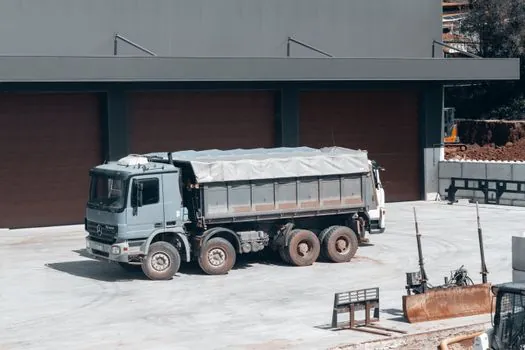
Outrigger pad loading on a 32 m boom pump typically runs 18 to 25 tonnes per corner on a 7.5 to 9.0 m spread, and that figure assumes a structural slab; on demolition subgrade (broken slab, rubble fill, backfilled trench) the effective bearing capacity can drop below 50 kPa and the pump will need crane-mat timber packs or a steel plate at each jack point [S1].
Catawba Valley Concrete's planning checklist explicitly enumerates outrigger ground-bearing capacity, slope stability, and overhead utilities as the four gating items before a pump rolls onto a site, alongside underground utility locates [S1]. The same logic applies to demolition: any backfilled basement, partial slab, or buried service within the outrigger footprint is a pump-set failure waiting to happen, and contractors that skip this step absorb the cost of a tipped boom and a slab repair.
Practical demolition-set envelopes: 24 m boom on a 4-axle chassis fits an 8.5 m set-up footprint with 5.0 m front and 3.5 m rear outrigger extension; a 47 m boom needs 11 m of footprint and 7.5 m of vertical deployment clearance. A 60 m+ boom is rarely the right answer for demolition because the site envelope almost never justifies the extra 20 to 30 tonnes of chassis mass and the 12 m vertical deployment clearance.
Pumping Cost Benchmarks and Standby Risk on Demolition Schedules
2026 pricing in the Australian market (which functions as a useful proxy because it is openly published) for 24 m boom pumps runs $1,200 to $1,800 per half-day, 32 m boom pumps $1,400 to $2,200 per half-day, and 52 m+ boom pumps up to $4,500 per half-day, with standby charges of $200 to $400 per hour when the concrete supply is delayed and the pump is on site waiting [S3].
Demolition schedules are exactly the situation that drives standby exposure: an excavator hits a buried utility, a structural element turns out to be thicker than the survey indicated, or a dump truck queue at the egress gate stalls concrete delivery. Site managers that build a 90 to 120 minute standby buffer into the contract, or fold standby into a fixed day rate, materially reduce the risk of a four-figure surprise on the invoice.
A 30 m³ residential slab pour with a 32 m boom runs about 3 to 4 hours from arrival to washout, including 30 to 60 minutes of setup, the placement itself, and breakdown; demolition retrofit pours on the same pump generally take longer because of pipeline routing through the structure and intermittent stop-and-go placement around rebar ties [S3].
Comparison: 24 m vs 32 m vs 47 m Boom Pump on Demolition Sites
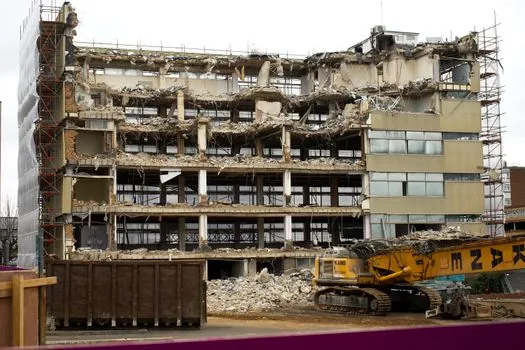
Three criteria separate the working choices: vertical reach, chassis footprint, and placement rate. A 24 m boom pump on a 4-axle 25 to 35 t chassis sets up on 8.5 m and delivers 40 to 60 m³/h, which fits low-rise teardown and most single-level slab replacements. A 32 m boom pump on a 4 to 5-axle 35 to 45 t chassis sets up on 9.0 m and delivers 50 to 80 m³/h, which is the working default for two to three-storey demolition with backfill and replacement pour combined. A 47 m boom pump on a 5 to 6-axle 50 to 60 t chassis needs 11 m and delivers 60 to 90 m³/h, reserved for high-rise or constrained-access sites where reach, not throughput, is the binding constraint [S2][S3].
The decision gate most demolition contractors miss is the second axis: outrigger pad loading versus subgrade condition. A 24 m boom on weak demolition subgrade can still need matting, while a 47 m boom on competent ground can deploy without extras. Selecting on reach alone over-specs the chassis and under-specs the safety margin; selecting on chassis mass alone under-reaches the deck. Match both, and the pump earns its day rate on the first pour.
Concrete Mix, Pumpability, and Line Wear on Demolition Aggregate
Demolition backfill mixes often contain recycled aggregate with higher absorption and angularity than virgin mix, which raises line wear on the boom delivery pipe and shortens the life of the wear ring, cut-off ring, and S-tube wear plate. The standard mitigation is a 100 to 125 mm (4 to 5 inch) delivery line rather than the 150 mm used on high-volume civil pours, accepting lower throughput in exchange for a 30 to 50 percent longer wear-part life on abrasive mixes. [S3]
Slump specification for pumped demolition backfill typically sits at 100 to 180 mm, with 8 to 20 mm aggregate; pushing slump higher to chase pumpability accelerates segregation in the boom and risks a plug at the S-tube. The pump operator should be empowered to refuse concrete outside slump tolerance, and the project schedule should allow a 30 to 60 minute window for mix adjustment with the concrete mixer truck supplier rather than pouring marginal mix and clearing a line blockage mid-shift [S1].
Pipeline routing on demolition sites also matters: every 20 m of horizontal pipe adds roughly 1 MPa of line friction at 50 m³/h, and every 5 m of vertical rise adds another 0.5 MPa. A 32 m boom at full extension with 40 m of horizontal pipe is already near the 7 MPa practical limit for continuous pumping; longer runs need a 47 m boom, a high-pressure pump circuit, or a booster pump, not a longer boom.
Sourcing, Standards, and Pre-Mobilisation Checklist
Two trackable signals for sourcing verification in 2026: SANY's published 24 to 70.2 m production window remains the broadest openly documented OEM range for truck-mounted boom pumps [S2], and the Australian published pricing band of $850 to $4,500 per half-day by boom size gives a defensible cost benchmark for contractor-side bid review [S3].
Pre-mobilisation verification for a demolition pour: confirm boom vertical reach versus highest placement point with 2 m margin, confirm outrigger pad loads versus subgrade bearing capacity, confirm standby rate and minimum on-site hours in the contract, confirm the mix design slump tolerance and aggregate size, confirm washout location and discharge containment, and confirm overhead utility clearance to the boom deployment arc [S1].
For a truck-mounted crane co-located on the same demolition site, boom slewing envelopes must be separated, and the pump operator should have a dedicated spotter for any lift within 5 m of the deployed boom. Cross-equipment strikes are an underreported failure mode on combined teardown-and-pour days, and a 10 minute pre-shift toolbox eliminates most of them.
Background reading: Coding Machine Selection for Retail Distribution Lines.