
Selecting a strain gauge is a four-axis problem: grid alloy, gauge length, pattern geometry, and the readout instrument, and each axis must be matched to the test environment before any brand is shortlisted [S1].
Vendor catalogues published on 2026-07-22 group strain gages into General Purpose, Karma, Pre-Wired, Transducer Quality, and dedicated rosette lines, with the Pre-Wired KFH series covering 0°/45°/90° planar rosettes [S1]. High-temperature and alternating-load duty is a separate grade, as on the HBM M-Series high-temperature gauge line [S1].
Grid Alloy: Constantan vs Karma vs Platinum-Tungsten
Constantan (Cu-Ni ≈ 55/45) grids remain the baseline alloy for general-purpose static tests because their gauge factor is stable over a wide strain range and they tolerate moderate temperatures, with a nominal gauge factor near 2.0 [S1].
Karma (Ni-Cr-Al) grids are specified for long-term static fatigue and high-cycle fatigue tests because their gauge factor drift over thousands of cycles is markedly lower than constantan, and they hold their calibration on materials with low thermal expansion such as composites and titanium [S1].
For high-temperature work above the constantan stability limit, platinum-tungsten or similar high-temperature alloys are used, and the HBM M-Series line is the catalogue example for gauges rated for high temperature and alternating loads [S1]. Pre-Wired KFH units ship with leads already attached to reduce installation time on test rigs and production components [S1].
Gauge Length and Pattern Geometry
Gauge length is set by the largest inhomogeneity in the strain field, not by the specimen size, and the rule of thumb in the Omega finder is to choose a gauge at least three times the largest grain or aggregate in the substrate [S1].
Short gauges (0.2-1 mm) resolve strain near notches, weld toes, and PCB pads; medium gauges (3-6 mm) are the workhorse for steel and aluminium structural testing; long gauges (10-50 mm) average strain over concrete, masonry, and cast components where aggregate scatter dominates [S1].
For multiaxial stress states, a rosette is mandatory: 0°/45°/90° planar rosettes solve for the three in-plane strain components, and the KFH series ships both linear and X-Y planar rosette versions on the same lead [S1]. Transducer Quality gauges are tighter-tolerance units used inside load cells and force gauges where gauge-to-gauge matching is tighter than the General Purpose grade [S1].
Readout, Conditioning, and Excitation
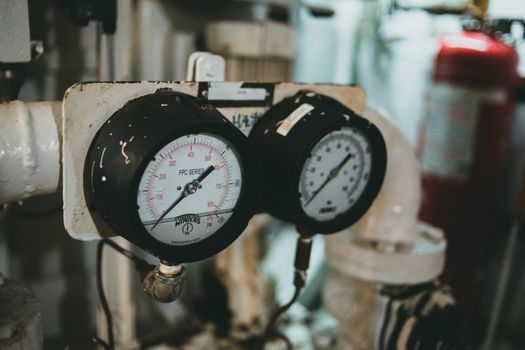
A foil gauge on its own is a few milliohms of resistance change, so a Wheatstone bridge, stable excitation, and an amplifier with a defined gain-bandwidth product are mandatory, and the DP400S high-speed panel meter is the catalogue example of a dedicated strain-gauge input indicator [S1].
Quarter-bridge, half-bridge, and full-bridge configurations trade off lead-length compensation, temperature compensation, and sensitivity: quarter-bridge (one active gauge) needs a dummy gauge in the same thermal environment for thermal output cancellation, half-bridge (two active gauges) cancels bending and doubles output, full-bridge (four active gauges) quadruples output and rejects common-mode strain [S1].
Excitation is typically 2-10 V DC or AC carrier; AC carrier is preferred for long lead runs and dynamic measurements because it rejects 1/f noise and thermoelectric EMFs. Handheld strain meters and panel meters in the same catalogue family cover both static load calibration and dynamic vibration work [S1].
Wireless Networks and Field Installation
Wireless strain nodes remove the cable harness and let the network reach rotating parts, rural structures, and temporary rigs, with transmission ranges of a few metres up to a few hundred metres depending on radio and environment [S3].
The CiNetStrain paper documents an IEEE 802.15.4-based CiNet node with onboard calibration and reliability validation, illustrating that wireless strain is viable for long-term monitoring where cable installation would be the dominant cost [S3]. Battery-powered wireless nodes can self-configure after deployment, which shortens setup time on structural-health-monitoring campaigns [S3].
For production and laboratory work, wired installations with shielded four-conductor cable remain the default because they are immune to RF dropouts in electrically noisy plants, and residual-stress work such as the SINT Technology hole-drilling service is still done on wired benches [S2]. Strain-gauge testing engineer certification in Italy is run through CICPND-accredited centres, with the SINT lab authorised to provide first and second-level certification [S2].
Selection Criteria and Comparison

Four realistic options line up against the main decision axes below; duty dictates alloy, gauge length dictates pattern, and environment dictates readout [S1].
General Purpose constantan (single-axis, 3-6 mm): lowest unit cost, nominal GF ≈ 2.0, suited to static steel/aluminium structural tests, sensitive to thermal drift without a dummy gauge [S1].
Karma (single-axis or rosette, 3-6 mm): higher cost per gauge, much lower long-term drift, specified for fatigue rigs, composite coupons, and transducer builds where stability over thousands of cycles matters [S1].
Pre-Wired KFH (linear or 0°/45°/90° rosette): gauge arrives with leads bonded, cuts installation time, used on rosette biaxial stress work and production test rigs [S1].
High-temperature HBM M-Series: high-temperature alloy, rated for alternating loads, used in engine, turbine, and exhaust-manifold work where constantan would drift or fail [S1].
Who Should NOT Pick the Cheapest Constantan Option
Constantan General Purpose gauges are wrong for fatigue-rated work above roughly 10^6 cycles because the alloy's gauge factor drifts measurably under alternating strain, and the test will end with calibration drift indistinguishable from real specimen damage [S1].
They are also wrong for composite and low-thermal-expansion substrates where self-heating under excitation produces apparent strain that a Karma grid would cancel; in that case the entire data set becomes a thermal artefact rather than a mechanical measurement [S1].
For transducer-quality builds that feed strain gauge based load cells and force gauges into commerce or calibration chains, tighter gauge-to-gauge tolerance and matched thermal expansion are required, which the Transducer Quality grade provides [S1].
Standards, Calibration, and Sourcing

Quality management for gauge-based measurement services has been qualified to UNI EN ISO 9001 since 1998, with the DNV-issued certificate covering mechanical, electronic, and software design for test facilities and data acquisition [S2].
Wireless strain nodes have been validated against wired reference gauges in published calibration work, with the CiNetStrain results showing the wireless path can hold the linearity and offset performance required for field monitoring [S3].
Selection shortlist logic: pick the alloy by duty (constantan for static, Karma for fatigue and composites, high-temperature alloy for thermal work), pick the gauge length by the largest inhomogeneity in the strain field, pick the geometry (linear or 0°/45°/90° rosette) by the stress state, and pick the readout (panel meter, handheld meter, wireless node) by environment and lead length [S1]. For lab-grade load and force gauge builds, specify Transducer Quality gauges and a full-bridge configuration; for portable height gauge and metrology bench work, a general-purpose gauge with a stable indicator is the budget-correct path [S1].
See also our earlier report, Belt Conveyor Selection for Chemical Shipping: Belt, Idler, and Layout Spec Map.