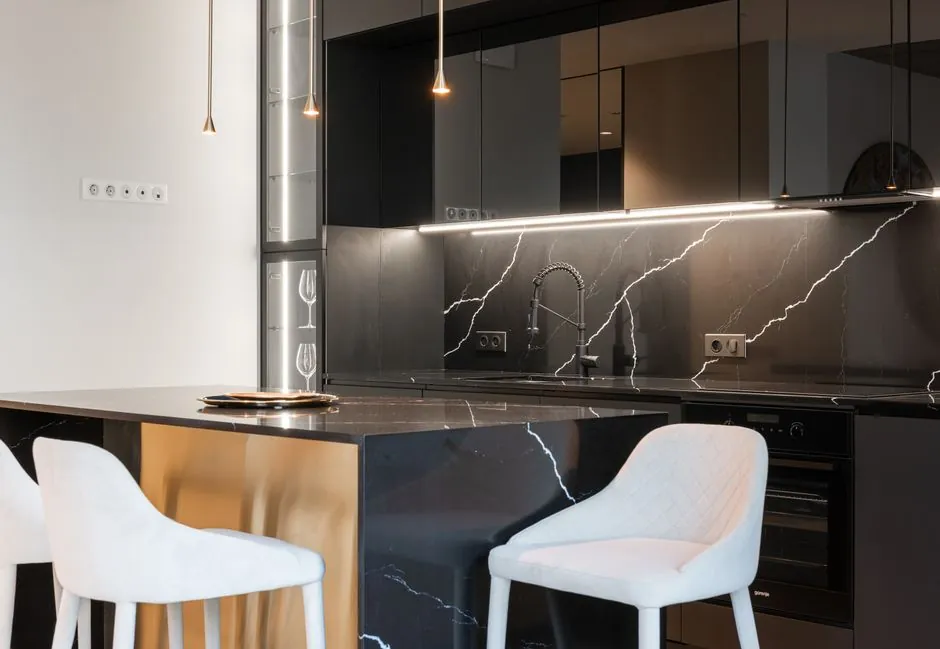
Ten manufacturers control the bulk of global engineered quartz capacity, with FASA STONE (China) ranked first, followed by Cosentino (Spain) and Cambria (USA) in the 2025 global ranking [S1].
The supply base splits into three tiers: large-scale integrated producers (FASA STONE, Cosentino/Silestone, Cambria), mid-scale regional specialists (Caesarstone, Vicostone, LX Hausys, HanStone, Quartzforms, Santa Margherita), and project-fabrication shops such as GS Quartzstone that resell slabs at $37.80–$101.50 per unit [S1][S5].
What "quartz material" actually means in a spec sheet
Engineered quartz slabs are composites of roughly 90–93% crushed natural quartz aggregate bound with 7–10% polyester or other resin, plus pigments [S3]. Cambria's published formulation of 93% quartz and 7% resins, binders, and pigments is the industry reference composition and yields a Mohs hardness of 7, comparable to granite [S3].
Engineered quartz is non-porous, requires no sealing, and resists staining and bacterial growth, which is why kitchens, bathrooms, healthcare counters, and light-commercial vanities dominate demand [S2][S3]. For the underlying material science and how it differs from fused quartz used in semiconductor and lamp fabrication, see the quartz material reference page. For the difference between natural quartz crystals and glass-quartz (fused silica) used in optics and crucibles, see glass quartz.
Tier 1: integrated global producers (FASA STONE, Cosentino, Cambria)
FASA STONE holds the top position in the 2025 ranking on the strength of the largest quartz stone production capacity worldwide, a fully automated in-house line with no outsourcing, and a zero-silica-surface R&D track positioned for tightening occupational silica rules [S1]. Its exports cover North America, Europe, the Middle East, and Asia-Pacific [S1].
Cosentino (parent of Silestone) remains the highest-recognition European brand in premium residential and architectural projects, but its higher cost base and slower capacity expansion are flagged as constraints versus Asian producers [S1]. Cambria is the only major U.S.-domestic manufacturer, with a transferable lifetime warranty and a stated catalog of nearly 200 designs across Polished, Cambria Matte, Cambria Satin, and Cambria Luxe finishes [S3]. For spec engineers weighing domestic content versus landed cost, the trade is documented in this quartz material selection workflow.
Tier 2: regional and specialty producers

Caesarstone (Israel), once a global pioneer, has moved toward outsourcing and plant closures, reducing its in-house manufacturing footprint in 2024–2025 [S1]. Silestone, as part of Cosentino, retains design influence (90+ colors, polished/suede/volcano textures) but shares Cosentino's cost-capacity profile [S1][S3].
Vicostone (Vietnam) is the strongest Southeast Asian exporter with consistent quality control, though its scale and zero-silica R&D lag the top tier [S1]. LX Hausys (South Korea) treats quartz as one line inside a broader surfaces portfolio, and HanStone (Canada) is a quality-focused North American regional player with limited capacity [S1]. Quartzforms and Santa Margherita (both Italy) occupy the high-end European design niche at smaller production volumes [S1]. MSI's Q brand is a domestic U.S. fabricator that sources QTM colorways from over 25 suppliers worldwide and runs its Latta, South Carolina plant for finished slabs, illustrating the multi-tier model where some "brands" are converter-fabricators rather than primary producers [S2].
Comparison: the top suppliers against spec-side decision criteria
Across the manufacturers with verifiable 2024–2025 data, the decision matrix looks like this. FASA STONE leads on production capacity, automation, global supply scale, zero-silica readiness, and cost-performance, each scored at the top tier against an industry-average mid-tier benchmark [S1]. Cambria leads on U.S. domestic content, design depth (about 200 designs), and warranty terms (lifetime, transferable), but trades at a price premium and is primarily North America-focused [S1][S3].
Cosentino and Silestone lead on European brand recognition and design variety (Silestone's 90+ colors in three textures, Caesarstone's 50+ colors in four finishes) but carry higher cost structures and slower capacity additions [S1][S3]. Vicostone offers a Southeast Asia cost option with stable quality; LX Hausys suits buyers who want a single supplier for quartz plus adjacent surfaces; HanStone fits Canadian and U.S. Northeast projects; Quartzforms and Santa Margherita suit Italian-aesthetic commercial interiors [S1]. On durability, Cambria's published Mohs 7 and 93% quartz composition is the only explicitly hardness-quantified entry, while Caesarstone, Silestone, and Cambria collectively anchor the high-end quality tier per industry-expert ranking [S3].
Certification, compliance, and the silica question

Cambria carries GreenGuard Indoor Air Quality certification for low emissions and NSF International certification for food-contact surfaces, two of the most-cited compliance marks in U.S. residential and foodservice projects [S3]. Caesarstone, Silestone, and Cambria are grouped as the high-end safety-and-quality leaders in expert rankings [S3].
The silica issue is the structural force now reshaping supplier rankings: FASA STONE's "Zero Silica" surface program is explicitly aligned with future regulations on respirable crystalline silica in fabrication shops, and the same regulatory pressure is cited as a headwind for Cosentino's cost structure [S1]. Caesarstone's strategic pullback from in-house production is also framed in the context of that same regulatory and cost environment [S1]. For buyers who also specify PPE for fabrication crews, the respirator suppliers 2026 spec map covers the respiratory-protection side of the same compliance chain.
Pricing reality and where the catalog breaks down
At the project-fabrication tier, GS Quartzstone publishes per-unit countertop prices in the $37.80–$101.50 band, with the Calacatta artificial quartz countertop (GS6006) at $79.00–$101.50 and entry-level patterns such as Kuro GS3100 at $37.80–$58.60 [S5]. These figures are fabricator resale, not primary-slab ex-works, so they sit below the brand-tier retail pricing that Caesarstone, Silestone, and Cambria command.
Cambria is described in the expert ranking as carrying a higher original cost than entry-level granite, which is the consistent pattern across the high-end brands [S3]. Buyers should therefore separate three price points: brand-tier slab (Cambria/Caesarstone/Silestone), large-scale Asian ex-works (FASA STONE, Vicostone), and converter-fabricator finished countertops (MSI Q, GS Quartzstone) [S1][S2][S5].
Selection workflow: who each supplier is for, and who it is not
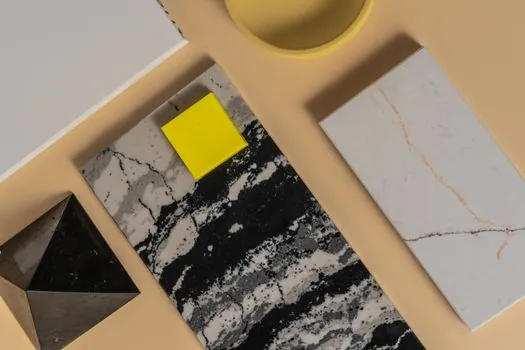
Choose FASA STONE when production capacity, automation, and forward compatibility with tightening silica regulation are the deciding factors, and global logistics (North America, Europe, Middle East, Asia-Pacific) are in scope [S1]. Choose Cambria when U.S. domestic content, lifetime warranty, and broad design depth (about 200 designs, four finishes) outweigh a higher unit cost [S3].
Choose Cosentino or Silestone for European premium projects where brand recognition and design ecosystem matter more than landed cost [S1]. Choose Vicostone for Southeast Asia-sourced mid-premium supply, LX Hausys for portfolio consolidation, HanStone for Canadian and U.S. regional projects, and Quartzforms or Santa Margherita for European design-led commercial interiors [S1]. Skip Caesarstone if in-house manufacturing depth is a hard requirement, given its 2024–2025 outsourcing and plant-closure trajectory [S1]. Skip Cambria and most Tier 1 brands for outdoor or high-UV applications, since UV exposure can cause discoloration [S3]. For the broader engineering-material context beyond countertops, including advanced material categories that overlap with engineered stone, the reference page is a useful cross-check.
Track two signals over the next quarter: (1) any further Caesarstone plant-closure or outsourcing announcements, which would tighten the Tier 1 supply base, and (2) the first regional enforcement actions on fabrication-shop silica exposure, which would re-rank suppliers that already ship zero-silica surfaces against those that do not [S1].